Paul Verhoeven turns Arnold Schwarzenegger’s confusion into a funny, unnerving science-fiction thriller. The violence occasionally crowds out the questions, but the uncertainty about what is real survives a considerable amount of gunfire.
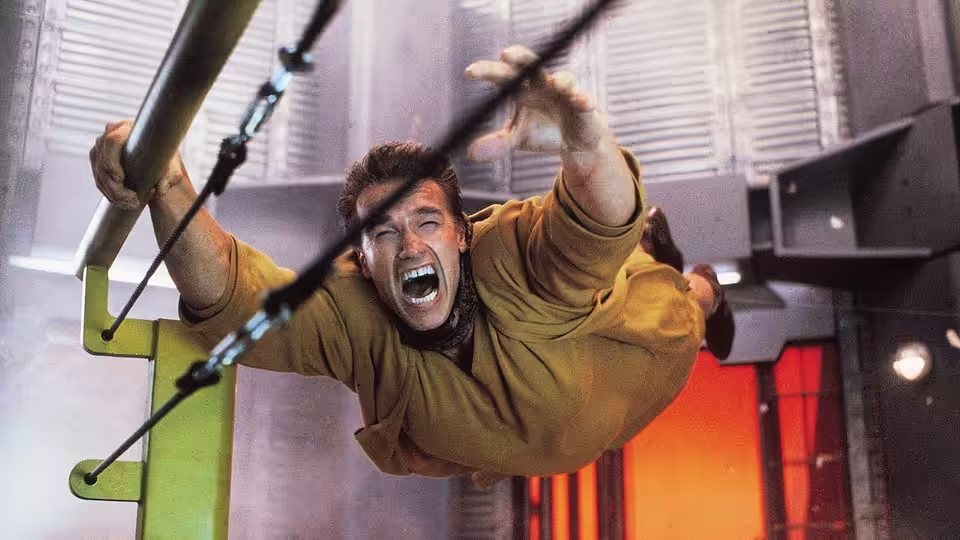
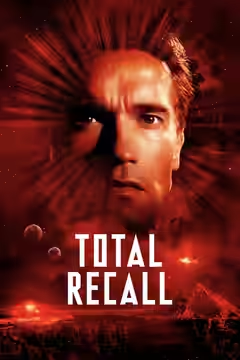
Total Recall is a sharp, funny science-fiction action film whose appetite for violence occasionally gets ahead of its ideas. Paul Verhoeven puts an identity crisis inside an Arnold Schwarzenegger vehicle and refuses to treat either ingredient politely. Quaid has the physique to deal with most threats, but an implanted memory presents a problem that strength cannot settle. Much of the pleasure comes from watching a star so physically assured play a man who cannot be certain of himself.
The screenplay by Gary Goldman, Dan O’Bannon and Ronald Shusett gives that uncertainty enough room to survive the action. Quaid’s difficulty is easy to grasp: remembering something does not establish that it happened. The film keeps us looking for reassurance and then questioning how readily we accepted it, which makes us share something of its hero’s trouble. There is enough forward movement that considering the possibilities never feels like homework, and enough doubt to make the pursuit worth thinking about.
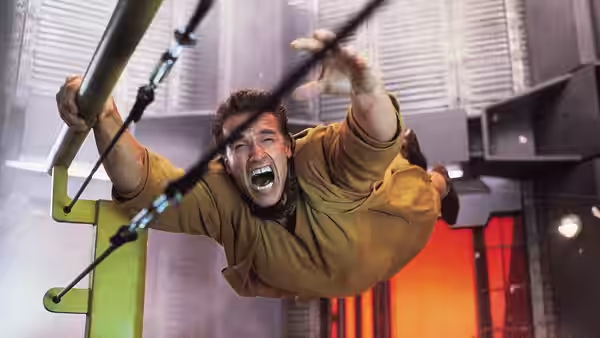
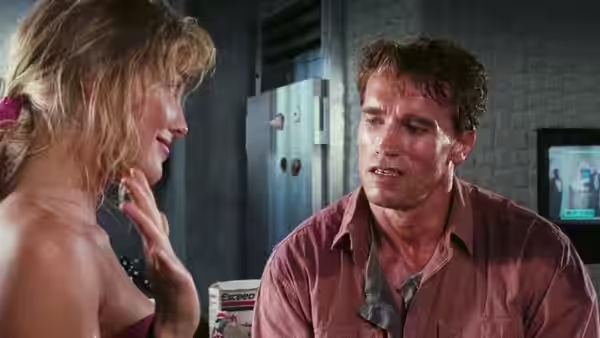
Schwarzenegger is essential to that effect, and his stiffness is useful here. His effort to make sense of things is visible, giving Quaid a vulnerability that a smoother performance might have lost. We were more unsettled by his uncertainty than we expected, because his physical confidence offers so little protection against his own memories. Sharon Stone, as Lori, is alert and precise, giving her exchanges with him enough bite to keep our attention between the bursts of violence.
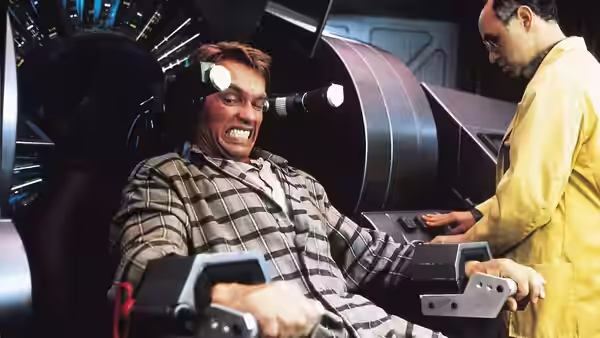
Jost Vacano’s cinematography makes good comic use of Schwarzenegger’s bulk without losing the confusion in his face. William Sandell’s production design can look conspicuously artificial, but that quality suits a story that asks us to distrust Quaid’s surroundings. Some effects reveal their workings a little too readily; their awkward physicality also makes the bodily damage unpleasant to contemplate. Verhoeven is willing to make his star look ridiculous, and the images gain something from denying Schwarzenegger the dignity that an action lead usually expects.
Frank J. Urioste’s editing gives the pursuit a welcome directness. We may be unsure what Quaid should believe, but the action seldom leaves us wondering what has just happened. Jerry Goldsmith’s score presses forward with a seriousness that makes the grotesque comedy more amusing, rather than signalling every joke. Between the cutting and the music, the film makes its 113 minutes feel brisk, while leaving us enough space to question what we have been shown.
The qualification is the sheer amount of violence. Verhoeven sometimes appears so pleased with another opportunity for bodily punishment that the question of who Quaid is has to wait its turn. A few stretches would be tenser with fewer impacts, and the humour cannot make every excess feel necessary. The cruelty will be a reasonable stopping point for some viewers, particularly when the action keeps insisting on itself after the immediate shock has worn off.
Within science-fiction action, this is an unusually successful use of a star whose presence could easily have overwhelmed the stranger material. Schwarzenegger gives us someone worth following even when we cannot confidently explain what he is following, and the film trusts us to tolerate that uncertainty. Choose it for an evening when laughing and recoiling at the same image sounds appealing; anyone hoping for a quiet examination of memory should look elsewhere.