Blake Crouch adapts his own novel into nine handsome, glum hours in which Joel Edgerton plays two versions of one man. The idea is good and the first two episodes grip; after that the series keeps opening doors onto rooms we have already seen.
Blake Crouch has adapted his own 2016 novel into a nine-episode series, and the question it asks is the old one: what if you had chosen differently. Jason Dessen (Joel Edgerton) teaches physics at a small Chicago college, is married to Daniela (Jennifer Connelly), who gave up painting, and has a teenage son, Charlie (Oakes Fegley). One night he is bundled into a van, and wakes in a hangar where strangers applaud him for coming back. In this world he never married and built a box instead. It is a good premise, and for two episodes the series treats it like one.
Edgerton plays both men and has the sense not to play them very differently. The Jason who went home is warm, distracted, a little soft in the shoulders; the one who built the box stands straighter and smiles a fraction late. Nothing else changes, which is the point. Connelly has the harder job, a woman who notices something wrong in her own kitchen without being able to say what, and she does it without a speech, in the way she watches her husband eat. The scenes between them, in either world, are the ones we believed.
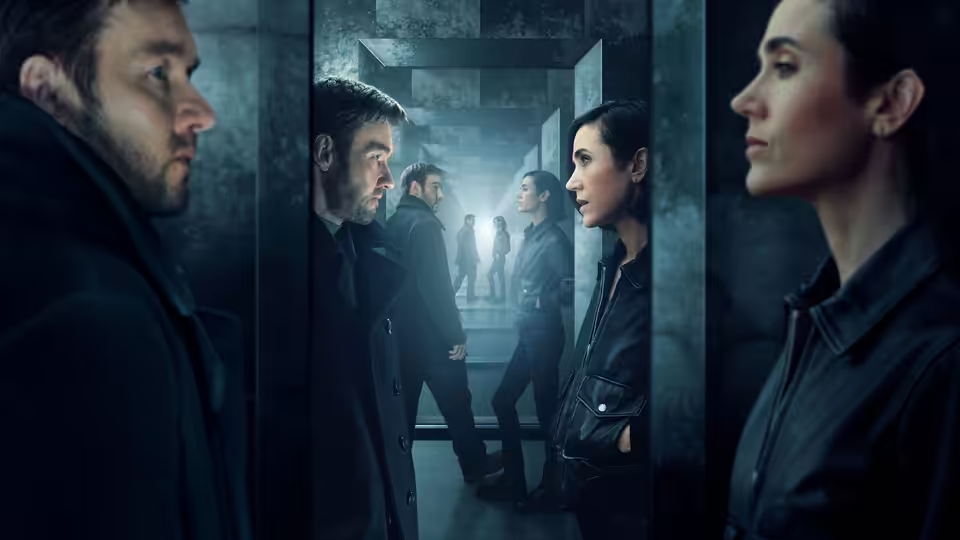
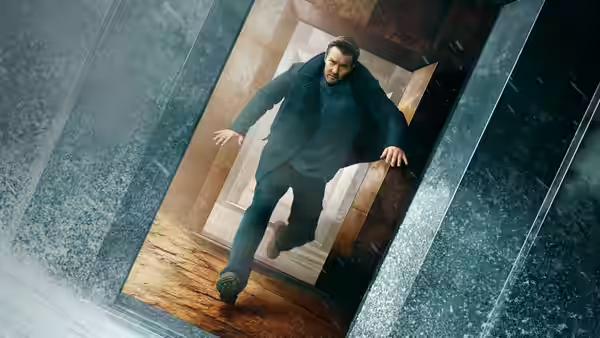
Patricio M. Farrell’s box is the best thing in the series: a plain dark cube with a single door, and beyond the door a corridor that goes on further than the eye can follow, lined with identical doors. Jeffrey Greeley and John Lindley light the corridor flat and even, so nothing in it tells you where you are, and shoot the Chicago outside in cold, clean blues, all glass and wet pavement. Mac Quayle and Jason Hill’s score is a low electronic hum that sits under everything and never lifts. After four hours we wanted it to.
Nine hours is the trouble. The corridor is a fine image and the script knows one thing to do with it: open a door, find a Chicago that is ruined or a Chicago with one small difference, close the door, argue in the corridor. Alice Braga’s Amanda Lucas, the psychiatrist who comes along for the journey, is given the job of asking Jason what he is feeling roughly every twenty minutes, and Braga is far better than the job. Nobody in any world is glad to be alive. We were gripped by the first episode, the van and the hangar and the applause; by the sixth we were counting the doors and had stopped wondering what was behind them.
Jimmi Simpson’s Ryan Holder, the friend whose career went where Jason’s did not, is the one loose, likeable presence, and the series uses him less than it should. Dayo Okeniyi’s Leighton Vance runs the place that built the box and glowers on schedule. Ten directors and seven editors are credited across the season, Jakob Verbruggen and Alik Sakharov among the former, and the episodes have the smooth, matched look that comes of that. None of them has a signature, and none is allowed one.
The multiverse on television has mostly been an excuse for costumes. Crouch’s version is smaller and more honest: not a thousand selves but two, and one marriage. It sits nearer the old ghost story about the man shown the life he did not live than to anything with capes, and that is to its credit. Those stories are over in two hours, though, because the lesson is learned in two hours, and this one keeps reteaching it with a slightly different skyline.
Watch the first two episodes and see whether the corridor gets you. If it does, the middle is there, and the last hour rewards some patience. It carries a 15 certificate, first aired on 7 May 2024, and a second season of ten episodes followed.