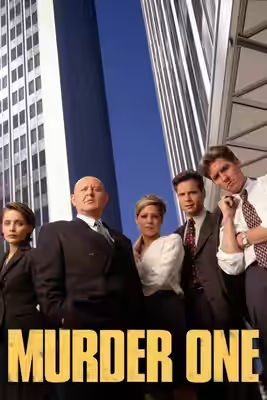
Steven Bochco’s series spends an entire season on a single murder trial, and the gamble mostly pays off: Daniel Benzali’s defence lawyer is a slow, quiet pleasure. It asks for patience, repeats itself, and the second year loses its nerve.
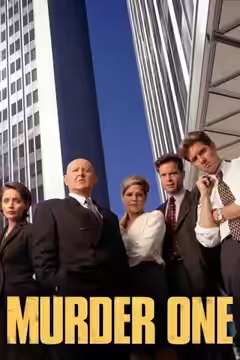
Most courtroom series of the 1990s closed a case a week. Murder One, created by Steven Bochco with Charles H. Eglee and Channing Gibson, spends its entire first season, 23 episodes of it, on one. A girl is found dead in a Los Angeles flat, a rich man is seen leaving the building, a young actor is charged, and the defence lawyer who takes the case does not get to put it down until the last episode. That is the whole idea, and in 1995 it was a brave one. It still asks more of you than most television does.
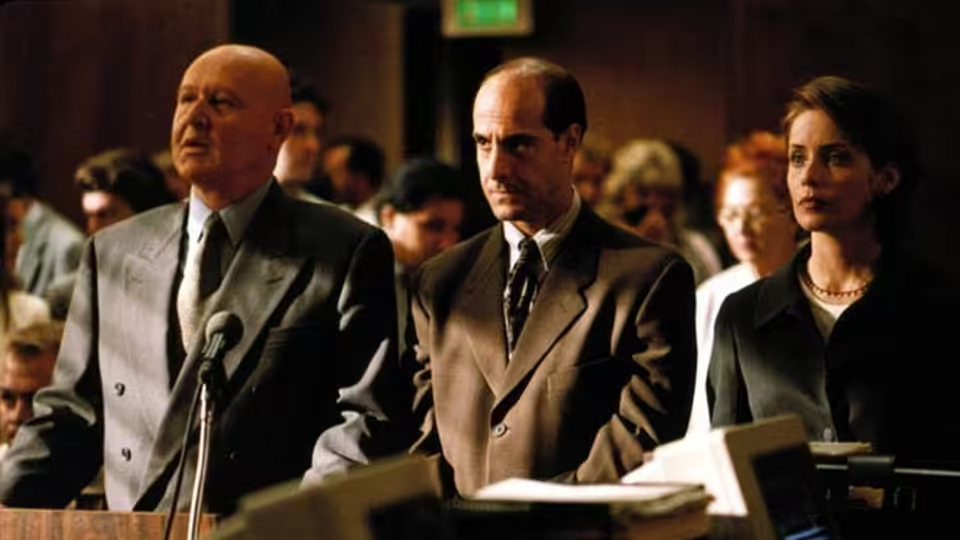
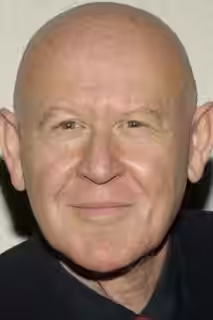
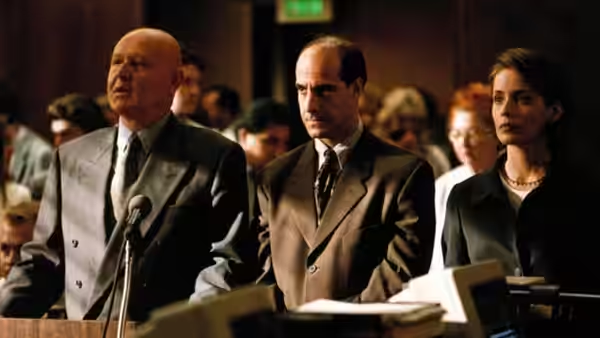
The lawyer is Ted Hoffman, and Daniel Benzali plays him as a man who has worked out that the loudest person in any room is losing. He is bald, heavy-lidded and soft-spoken, and he lets silences run long enough that witnesses fill them. We did not expect to be gripped by a man asking the same question three times in a slightly lower voice, and then we were, sitting forward on the sofa through a cross-examination in which nothing happens except a witness slowly realising he has been caught. We cannot recall Benzali raising his voice once. By the tenth episode you can hear a threat in him saying good morning.
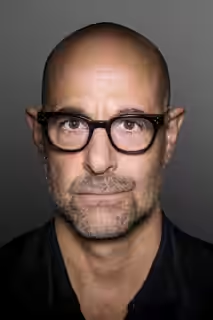
Stanley Tucci’s Richard Cross is the other reason to watch. Cross is a rich man who was in the dead girl’s building that night, and Tucci plays him with a small permanent smile and a voice that never gets above conversational, as if being questioned about a murder were a mild inconvenience in his afternoon. Every scene he shares with Benzali is two quiet men waiting for the other to move. Around them the series fills its offices properly: Michael Hayden, Mary McCormack, J.C. MacKenzie and Grace Phillips as Hoffman’s associates Chris Docknovich, Justine Appleton, Arnold Spivak and Lisa Gillsepie, Barbara Bosson as the prosecutor Miriam Grasso, and Dylan Baker as Arthur Polson, the detective who built the case and keeps turning up to defend it.
The look matches the lead. The Hoffman offices are dark wood and glass, the courtroom is wide and pale, and the directors, a long bench that includes Michael Fresco, Charles Haid and Elodie Keene, mostly keep the camera still and let people talk. Mike Post’s theme is a low, slow piece for strings and a drum that sounds like a door closing, and it tells you the tone in about eight seconds. The writing, from a room that includes David Milch, William M. Finkelstein and Eglee himself, is where the series earns its length. Evidence arrives in the order a real trial would produce it, which means long stretches of forensic argument and the occasional episode in which the big news is a phone record.
It is not all that disciplined. Each episode opens with a recap that grows longer as the season goes on, and by the middle stretch the recaps are doing the plot’s work for it. Hoffman’s home life, with Patricia Clarkson as his wife Annie, is the weakest strand; Clarkson is given a kitchen and a run of scenes in which she asks when he will be home, and she does what she can with them. And the series does love a twist. Several arrive at the end of episodes with a sting from Post and a cut to black, and after the fifth or sixth we started to feel managed rather than surprised. The case still holds, and we will not say how it ends.
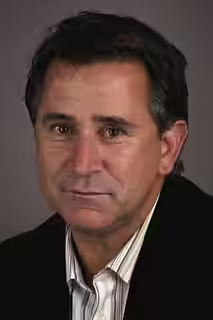
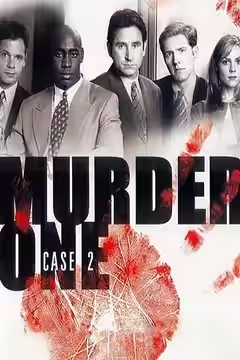
The second season is a different programme. It drops the single case for three shorter ones, and it drops Benzali, moving Anthony LaPaglia’s Jimmy Wyler to the lead. LaPaglia is good and the cases are competent, and it is a sadder, more ordinary thing, the series it would have been if nobody had taken a risk. Eighteen episodes, and we remember about three.
Watch the first season one episode at a time rather than in a weekend, so that the gaps do some of the work. It is a 15 certificate and the crime at the centre of it is ugly. The pleasure is not the crime. It is Benzali, with his hands folded, waiting.