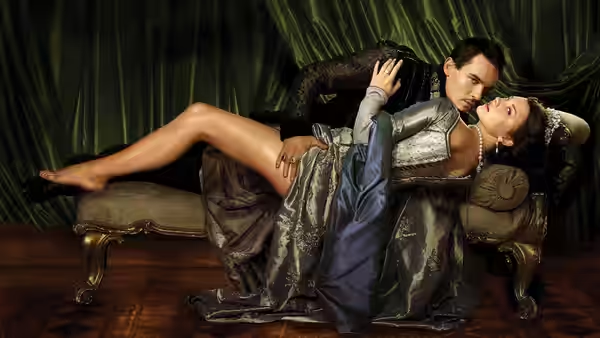
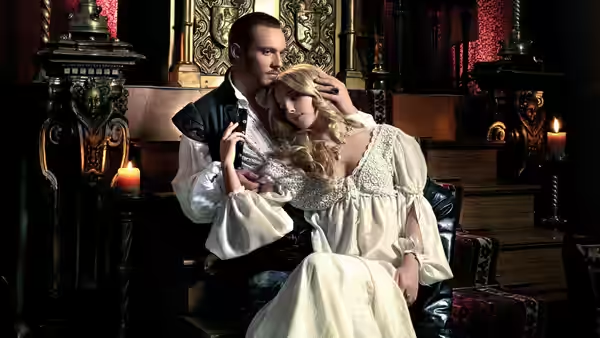
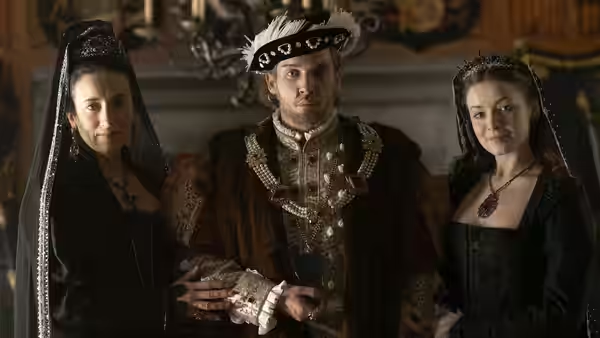
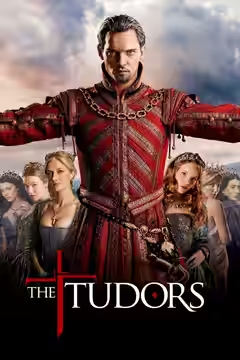
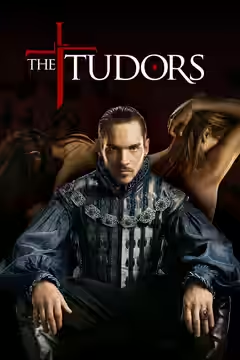
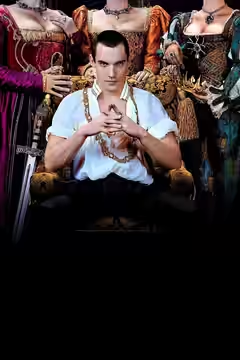
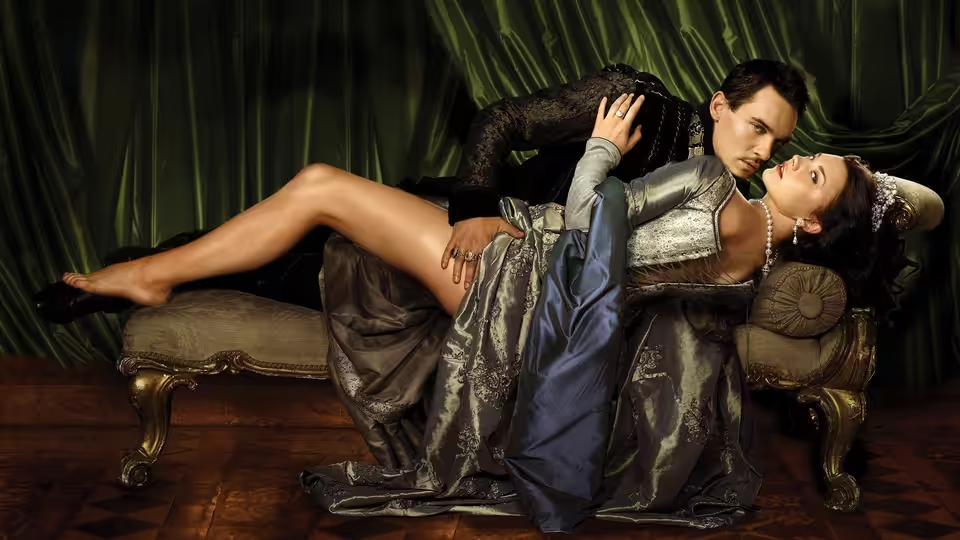
Henry VIII (Jonathan Rhys Meyers) embraces a woman on an ornate chaise
Series review

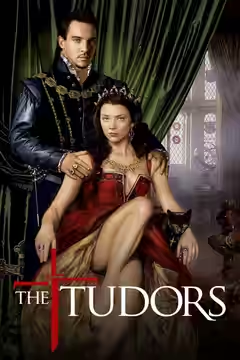
The Tudors

2007 · Created by Michael Hirst · Series · 55m · FSK 16

In a sentenceWe would happily postpone the royal bed-hopping for another scene with Maria Doyle Kennedy

At the English court during the early reign of Henry VIII of England (Jonathan Rhys Meyers), the king’s desires keep intruding on the business of government. He wants freedom to pursue his appetites, while his marriage to Catherine of Aragon (Maria Doyle Kennedy) presents a problem he cannot settle by himself. Cardinal Thomas Wolsey (Sam Neill) is among those caught up in the court’s political manoeuvring, with Anne Boleyn (Natalie Dormer) also part of the royal circle. Bedroom encounters and court discussions run alongside one another as the prospect of divorce gives the king’s private dissatisfaction public consequences.

Fi1m review

The Tudors makes diverting royal soap, helped by Maria Doyle Kennedy and a persuasive sense of courtly wealth. Its impatient king and wandering pace make it harder to recommend as serious historical drama.

Michael Hirst’s The Tudors is watchable royal melodrama with a disappointingly narrow idea of its king. It approaches the early reign of Henry VIII of England through appetite, marriage and the people obliged to deal with the consequences. That is a workable way into court politics, particularly when desire can make trouble for everyone nearby. The difficulty is that the series keeps returning to the same explanation for its ruler’s behaviour: he wants something and resents being denied it. The supporting cast gives us good reason to keep watching.

Jonathan Rhys Meyers supplies the impatience readily enough, and his energy suits a drama determined to avoid solemn historical pageantry. We can understand the attraction of a king who behaves badly without pausing to justify himself. But the performance offers too little variation in that wilfulness, and the writing does not give him enough competing impulses to make him difficult to predict. After a while, another royal demand does little to sharpen our understanding. The political discussion has to work around a ruler whose reactions have become familiar.

We felt for Maria Doyle Kennedy’s Catherine of Aragon because she makes the hurt within the marriage matter amid all the manoeuvring. Her performance gives the prospect of divorce a human cost that the series otherwise risks treating as a complication to be managed. She also gives us someone worth listening to when the royal appetites have become tiresome. Sam Neill’s Cardinal Thomas Wolsey brings welcome composure to the surrounding politics. Both performances allow thought to register without requiring another explanation of what everyone wants.

The court is persuasive as a place where people enjoy having money and position. Tom Conroy’s production design supplies the wealth, while Joan Bergin’s costumes make the effort of presenting oneself for inspection seem part of daily life. Ousama Rawi’s cinematography helps sustain that sense of display, though the murk around the sex scenes is less useful. Those passages can feel oddly dutiful for a programme so keen to seem uninhibited. We are given plenty of intimacy without consistently learning much about the people involved.

The writing is frequently too helpful about its intrigues, spelling out tensions before the actors have much chance to establish them. Michael Hirst gives the court enough competing interests to sustain curiosity, but the early signposting makes some exchanges feel like preparation for the next exchange. The attention to historical detail is welcome, even when the drama takes liberties. We need not demand a lesson from every costume drama. We can still expect a clearer sense of why these particular people matter to one another.

Editors Wendy Hallam Martin and Lisa Grootenboer face a difficult balance between private encounters and public business, and the pace sometimes drifts despite all the activity. The programme can be busy without feeling as though it has moved far. Trevor Morris’s music supplies some of the gravity missing from the king’s characterisation. There is still dependable pleasure in watching capable performers negotiate this court. The problem is the time spent waiting for the next exchange with someone as interesting as Catherine of Aragon.

Historical television can take pleasure in bad behaviour without turning every conversation into a lesson. This series belongs with the court melodramas, and its appeal depends on how much time we want to spend with privileged people pursuing their appetites. A stronger account of the politics would have made their decisions more interesting to follow. Try it if court gossip is enough to carry an evening; expect to exercise some patience whenever the king takes charge.

Critical consensus AI synthesised

64
Positive
3
Mixed
3
Negative
0

Most critics find The Tudors watchable and diverting, though enthusiasm is qualified rather than wholehearted. Praise centres on the scale and opulence of the production, with Henry’s appetites and court manoeuvring generally proving more rewarding than the attempts at action or suspense. The more favourable reviews enjoy its mixture of sex and politics, while finding enough period detail and humour to sustain the entertainment.

Reservations cluster around loose pacing, uneven casting and a lack of depth beneath the court spectacle. The reviews disagree over whether the sexual emphasis supplies energy or merely chases attention, and historical detail earns praise even as liberties attract criticism. The AV Club finds Jonathan Rhys Meyers’s Henry petulant rather than complex. The Times is markedly cooler than the rest, finding the opening episode dull and its intrigue ineffective, though it credits Maria Doyle Kennedy’s Catherine of Aragon with bringing humanity.

The Hollywood Reporter
28 March 2007
75*

A lavish 10-part drama that is a feast for the eyes with stellar performances, a historically authentic aura and a solid, dependably entertaining quality. The focus on Henry’s passions and court intrigue succeeds more than any action or suspense elements.

Read the full review →
Variety
23 March 2007 · Brian Lowry
70*

A big, bold, opulent gamble that is watchable and diverting though not the great series it might have been, lustily combining bodice-ripping with medieval geopolitics. Uneven casting and occasional meandering temper enthusiasm, but the international appeal justifies the risk.

Read the full review →
The AV Club
2 January 2008 · C+ · Scott Tobias
63

The series is a capable but unremarkable soap opera retelling of Henry VIII's early reign and divorce from Catherine of Aragon, lacking a compelling point of view compared to HBO's Rome. Jonathan Rhys Meyers portrays the king as a petulant, willful man-child focused on his appetites rather than a complex figure.

Read the full review →
Empire
10 December 2007
60*

The results are mixed, with early episodes feeling heavily signposted but later ones improving and showing strength for historical detail. The attempts to sex things up feel like ratings-grabbing rather than appropriate.

Read the full review →
The Times
8 October 2007 · Andrew Billen
49*

The series is a shameless bonk fest that turns Henry VIII into a yobbo, but the first episode proves much duller than expected. The sex scenes are poorly lit and the political intrigue fails to intrigue, though Maria Doyle Kennedy as Catherine of Aragon brings some humanity.

Read the full review →
Paste
11 February 2009 · Jeffrey Bloomer
70*

The second season remains a gaudy window into Henry VIII's reign, overrun with crude intrigue and exuberant sex. It has real scale and a wry sense of the past and future despite loose pacing and historical liberties.

Read the full review →

Straight answers AI written, from our review

Is The Tudors worth watching?
The Tudors is worth trying if court gossip and royal romance are enough to carry an evening; we score it 65 out of 100. Maria Doyle Kennedy’s Catherine of Aragon and the persuasive courtly wealth keep it watchable, but the repetitive characterisation of Henry and drifting pace make it harder to recommend as serious historical drama.
How long is The Tudors, and what is it rated?
The Tudors has episodes of about 55m and is rated 16 by the FSK in Austria. It is a drama and romance series.
Where can I watch The Tudors in Austria?
The Tudors is streaming on Netflix and Amazon Prime Video in Austria, and it is also available to buy from Amazon Prime Video. Availability is checked daily; the links above go straight to each service.
How violent or frightening is The Tudors, and is it suitable for children?
The Tudors has a UK 15 certificate and contains sex scenes, making it unsuitable for children under 15. The bedroom encounters make this adult court melodrama rather than family historical viewing; we cannot give a more specific warning about violence or frightening material from the content described in our review.
How does The Tudors compare to The Favourite?
The Tudors offers sprawling royal soap, while The Favourite is the stronger choice for vicious court comedy and close attention to the women manoeuvring for position. We find the king’s repetitive wilfulness limits the series; the film makes royal rivalry funny and uncomfortable through three rewarding central performances, though its camera sometimes works too hard.
What should I watch after The Tudors?
After The Tudors, try The Favourite (2018, Fi1m 87): Courtly ambition becomes vicious comedy, with close attention to the women doing the manoeuvring. Then The Lion in Winter (1968, Fi1m 81): A royal family turns succession planning into an extended exercise in mutual cruelty.

Cast

If you liked this, try…

  1. Wolf Hall (2015) · not on Fi1m yetFor court politics whose smallest courtesies can carry a serious threat.

  2. Queen Margot (1994) · not on Fi1m yetAnother royal marriage caught between religious conflict, sexual attraction and family calculation.

  3. The Favourite (2018, Fi1m 87)Courtly ambition becomes vicious comedy, with close attention to the women doing the manoeuvring.

  4. The Lion in Winter (1968, Fi1m 81)A royal family turns succession planning into an extended exercise in mutual cruelty.

  5. The Banquet (2006) · not on Fi1m yetPalace rivalry and forbidden desire unfold through formal spectacle and carefully staged violence.