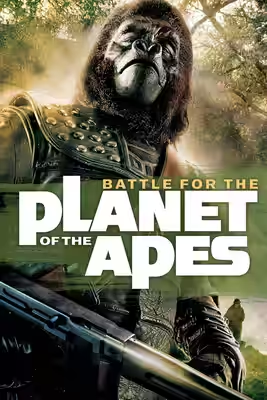
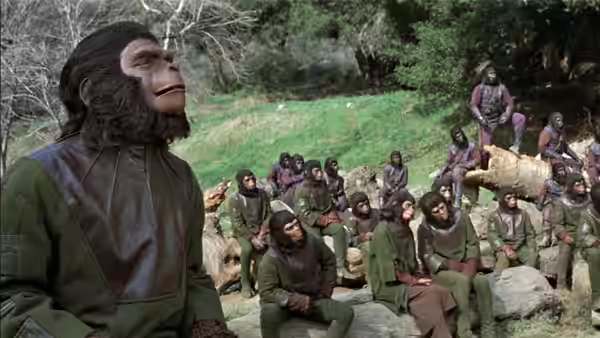
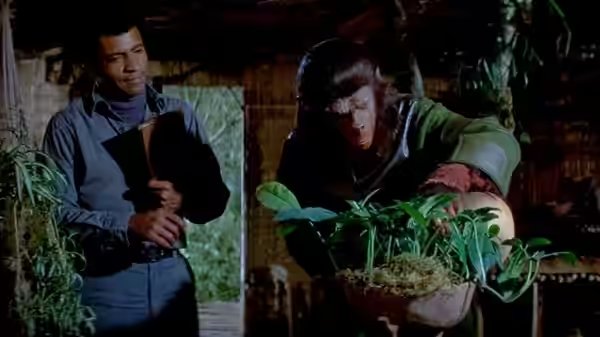
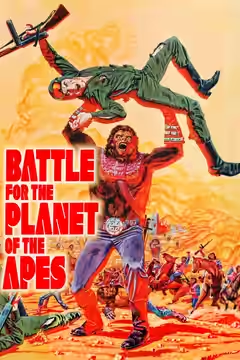
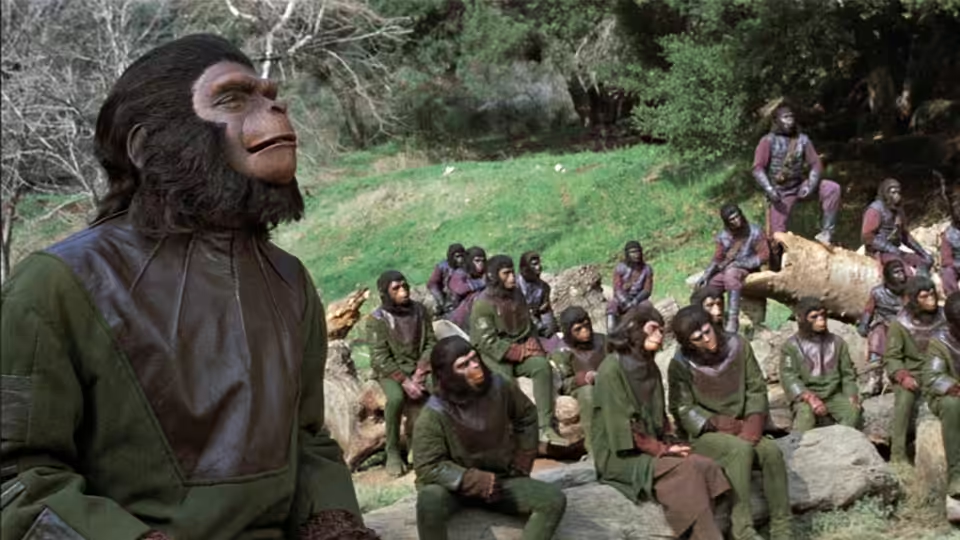
An ape in a green vest stands before a group of seated apes on rocks
Film review

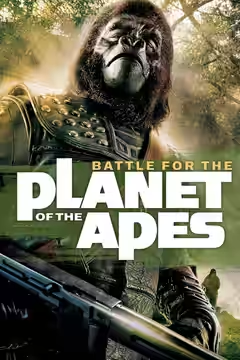
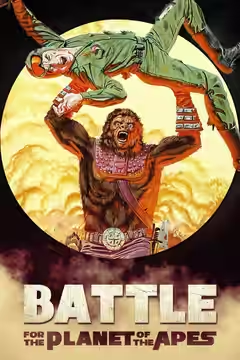
Battle for the Planet of the Apes

1973 · Directed by J. Lee Thompson · 1h 33m · RO AP

In a sentenceThe end of the world, staged in a wood by a dozen extras in pull-over masks

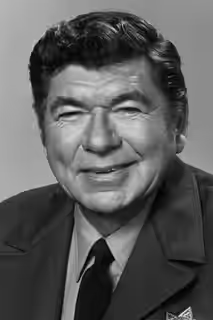
Years after the ape uprising and the war that followed it, Caesar (Roddy McDowall) rules a settlement of huts and orchards where apes and the surviving humans live side by side, apes a step above. His wife Lisa (Natalie Trundy) and son Cornelius (Bobby Porter) want the peace kept; the gorilla general Aldo (Claude Akins) wants the humans gone and says so at every council. Caesar’s human aide MacDonald (Austin Stoker) tells him that recordings of his parents survive in the archives of the Forbidden City, the bombed capital beyond the hills. Against Aldo’s objections, Caesar decides to go and find them, taking MacDonald and the orangutan scholar Virgil (Paul Williams) with him.

Fi1m review

The fifth and last of the original Apes films arrives with the budget gone and the ideas mostly gone with it. Roddy McDowall holds it together from behind the mask, but the battle of the title is a scuffle in a wood.

Paul Dehn’s story wants to end the series on a kinder note than the four films before it managed. J. Lee Thompson, who directed Conquest of the Planet of the Apes (1972), picks up some years after that film’s riot. The bombs have fallen, the cities are ash, and Caesar (Roddy McDowall) has built a village where apes and humans farm and argue together, with the humans a step below. The question the film asks is whether the future the first picture showed us is fixed or can be argued out of. That is a good question. The film has 93 minutes to answer it and spends most of them on horseback.

McDowall is the reason to stay. He has played this ape across two films now and knows how to act through the appliance: the tilt of the head, the way Caesar’s hands go still when he is angry. There is a scene in the ruined city where he sits at a console and listens to his dead parents’ voices on tape, and we were moved more than we expected to be by a man in rubber staring at a reel-to-reel. It is the one moment where the film’s idea, that a leader might want to know his own history before making anyone else’s, is felt rather than stated. Severn Darden’s Kolp, running his underground garrison in a greatcoat and a permanent sneer, is good value too, and Paul Williams gives the orangutan Virgil a fussy warmth the script does not otherwise provide. Lew Ayres appears for one scene as Mandemus, who keeps the armoury, and lectures everyone about guns with such gravity that we rather wished he had been given the film.

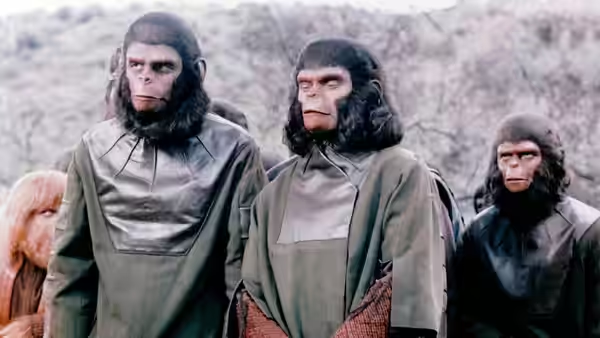
Then there is the money, and there is not much of it. Ape City is a dozen thatched huts on a hillside. The Forbidden City is a few blocks of rubble and a corridor. Morton Haack’s costumes are the tunics of the earlier films, and they still look right on the principals, but in the wide shots the extras wear pull-over masks that do not move when they speak and have no eyes behind them, and the film keeps cutting to them. Richard H. Kline shoots the whole thing in flat midday sun, so nothing is hidden. In the ruins he manages a few frames of grey dust and long shadow that suggest what a properly funded film might have looked like, and then we are back in the wood.

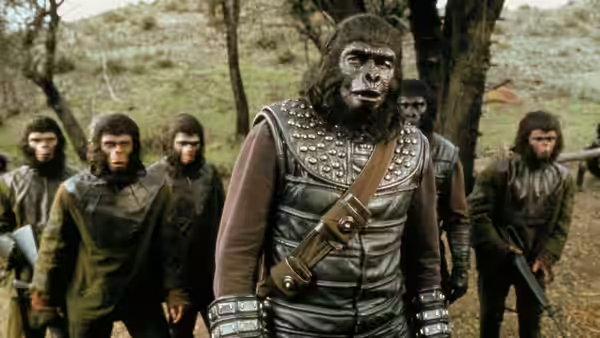
The battle of the title arrives late and is over quickly. Jeeps drive into a clearing, apes drop out of trees, men in fatigues fall over. Alan Jaggs and John C. Horger cut it so that we are seldom sure where anyone is standing, and the second half of the fight is the first half with different extras. We were bored, and then we were embarrassed for the stunt performers in their loose masks, and then we were bored again. Leonard Rosenman scores it with bugles and snare drums, a march that promises a scale the picture never reaches.

John William Corrington and Joyce Hooper Corrington’s screenplay is mostly council meetings. Apes sit in a circle and say what they believe; humans stand at the edge and say what they are not allowed to believe; Claude Akins’s gorilla general Aldo bellows that apes should rule and is told to sit down. The one sharp idea is small: in Caesar’s village a human may not say the word “no” to an ape, and the schoolroom scene in which Noah Keen’s teacher says it anyway has more tension than the battle. The film knows this is its best scene and does nothing with it.

Planet of the Apes (1968) ended on a beach with an image nobody who saw it has forgotten. Conquest had anger in it, a riot that felt like a riot. This one has a hopeful speech and a fight in a field, and the hope is not earned because we have not seen the two sides do anything together but quarrel.

Fans of the series will want to see how it ends, and they should, once, in an afternoon, with low expectations. The tagline calls it the most suspenseful showdown ever filmed. Somebody in the publicity department had not seen the film, or had, and decided to be kind.

Critical consensus AI synthesised

29
Positive
0
Mixed
1
Negative
7

The reviews are close to unanimous: this is the weakest of the original five films. The complaints cluster on money. A cut budget shows in the make-up, the battle footage and the locations, and several critics call the result cheap and perfunctory. The script draws almost as much fire: too much talk, a knotted plot, continuity that does not hold, and a lighter tone that several feel drains the series of the satire that carried the earlier entries. What praise there is goes to Roddy McDowall, whose performance is singled out as solid amid the constraints.

The spread is narrow, with seven of eight negative. The one mixed notice, from Collider, credits Thompson’s atmospheric direction and the attempt at a hopeful ending, while finding the film fails to earn it. Roger Ebert goes furthest the other way, calling it incompetently made, with ragged transitions and inaudible dialogue. Radio Times concedes fans may still enjoy it.

Variety
1 January 1973 · ** · Variety Staff
30*

The final effort is limp, though the previous films maintained quality longer; notes the plot elements and cast including Roddy McDowall and Claude Akins.

Read the full review →
Empire
29 March 2006 · Ian Nathan
20*

The critic finds it a limp and humourless B-movie that has abandoned the series' satirical verve, with too much talk, a knotted plot, clunky action, and unconvincing make-up due to budget cuts. They conclude it should be buried in the Forbidden Zone as it lacks the charm and intelligence of the others.

Read the full review →
Radio Times
★ · Alan Jones
20

The critic calls it the least effective entry in the original Planet of the Apes series, with Roddy McDowall leading an attempt to restore racial harmony amid cheap production values and a lack of novelty or strong story. Endless action fails to disguise the threadbare monkey business, though fans of the franchise may still enjoy it.

Read the full review →
RogerEbert.com
10 July 1973 · Roger Ebert
10*

The critic finds the film incompetently made with ragged transitions, inaudible dialogue, cheap battle footage, and a thin story, calling it the last gasp of a dying series made only to extract money from remaining fans.

Read the full review →
Collider
7 July 2014 · C+ · Matt Goldberg
63

The critic finds that the film attempts a hopeful tone after the series' prior pessimism but fails to earn it, falling short of its aspirations in themes, execution, and decisive conclusions despite some atmospheric direction by Thompson and thoughtful moments.

Read the full review →
Film Stories
15 May 2024 · A J Black
40*

The film is a cheap-looking forest romp that fails to deliver on its epic ambitions due to limited resources and direction. It marks the end of the original series amid poor reception and low box office.

Read the full review →

Straight answers AI written, from our review

Is Battle for the Planet of the Apes worth watching?
Battle for the Planet of the Apes is worth watching only if you have followed the original series and want to see how it ends; we scored it 36. Roddy McDowall's Caesar and a good scene with his parents' voices on tape are the reasons to stay, but the budget is gone, the battle is a scuffle in a wood and most of the film is council meetings.
How long is Battle for the Planet of the Apes, and what is it rated?
Battle for the Planet of the Apes runs 1h 33m and is rated AP by the RO in Romania. It is an action and science fiction film.
Where can I watch Battle for the Planet of the Apes in Romania?
Battle for the Planet of the Apes is streaming on Disney+ in Romania. Availability is checked daily; the links above go straight to each service.
How violent or frightening is Battle for the Planet of the Apes, and is it suitable for children?
Battle for the Planet of the Apes carries a UK 12 certificate and is mild for the rating: a short, confused fight in a clearing with jeeps, gunfire and men falling over, and no real horror. The apes in loose pull-over masks are more likely to prompt laughter than fear, so it should suit older children who can sit through a great deal of talking.
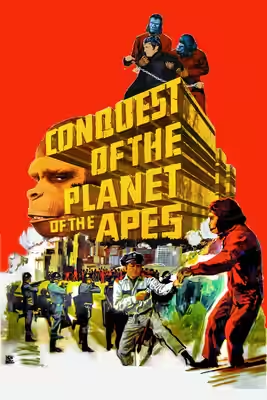
How does Battle for the Planet of the Apes compare to Conquest of the Planet of the Apes?
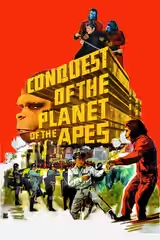
Battle for the Planet of the Apes is the softer and weaker of the two, a hopeful sequel to Conquest of the Planet of the Apes that never earns its hope. Both films are cheap and directed by J. Lee Thompson, but Conquest has anger and a riot that feels like a riot, while Battle has speeches and a scuffle. Watch Conquest first and stop there if you must.
Do you need to have seen the other Planet of the Apes films before Battle for the Planet of the Apes?
Battle for the Planet of the Apes is the fifth and last of the original films and is not a place to start; its story assumes you know Caesar and the uprising from Conquest of the Planet of the Apes. Newcomers should begin with the 1968 Planet of the Apes, and only completists need arrive here, once, in an afternoon.
What should I watch after Battle for the Planet of the Apes?
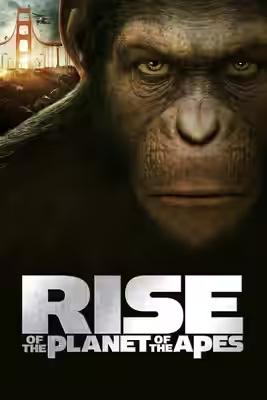
After Battle for the Planet of the Apes, try Planet of the Apes (1968, Fi1m 84): Where it began, with a script that argues and a beach nobody forgets. Then Conquest of the Planet of the Apes (1972, Fi1m 73): Thompson and McDowall the year before, with money, anger and a riot that lands; and Rise of the Planet of the Apes (2011, Fi1m 80): The same story of a clever ape and a cage, told with the resources this one lacked.
What order should I watch the Planet of the Apes films in?
Release order is the safe choice for Planet of the Apes, and it is the order our collection page lists them in. Battle for the Planet of the Apes is number 5 of the 9 Planet of the Apes titles on Fi1m; before it comes Conquest of the Planet of the Apes and after it Rise of the Planet of the Apes. The full order.

Part of · 5 of 9

Planet of the Apes

9 films on Fi1m · 1968–2024 · average 68 · best Planet of the Apes 84

All 9 in order

Cast

If you liked this, try…

  1. Planet of the Apes (1968, Fi1m 84)Where it began, with a script that argues and a beach nobody forgets.

  2. Conquest of the Planet of the Apes (1972, Fi1m 73)Thompson and McDowall the year before, with money, anger and a riot that lands.

  3. Rise of the Planet of the Apes (2011, Fi1m 80)The same story of a clever ape and a cage, told with the resources this one lacked.

  4. A Boy and His Dog (1975) · not reviewed yetAnother cheap Seventies apocalypse, this one nasty, funny and genuinely strange.

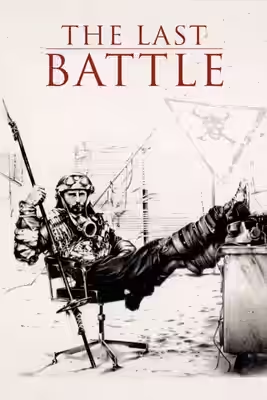
  5. Le Dernier Combat (1983, Fi1m 74)Besson’s wordless, black-and-white ruin, proof that no budget need not mean no ideas.

Free account

Know what to watch tonight

Two lists that know where things are streaming, collections you can share, your own score beside ours, and Discover that remembers what you have seen.

  • Want to see, sorted by what is streaming now
  • Seen, with your score out of ten
  • No adverts, ever