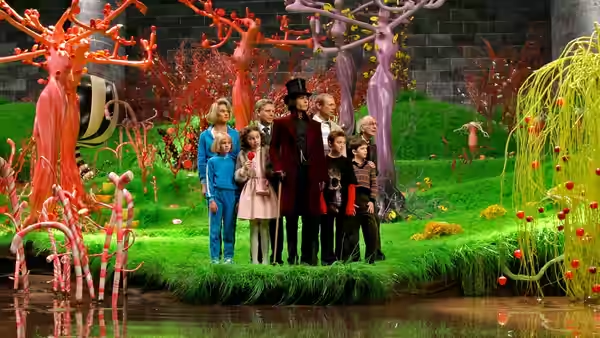
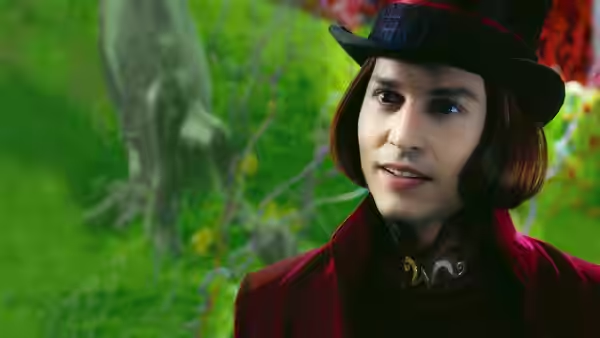
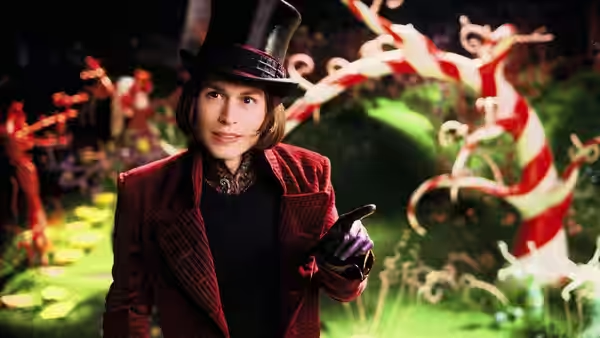
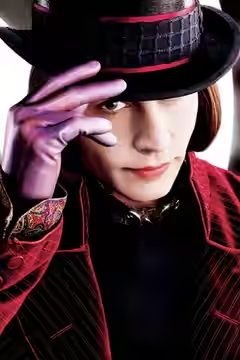
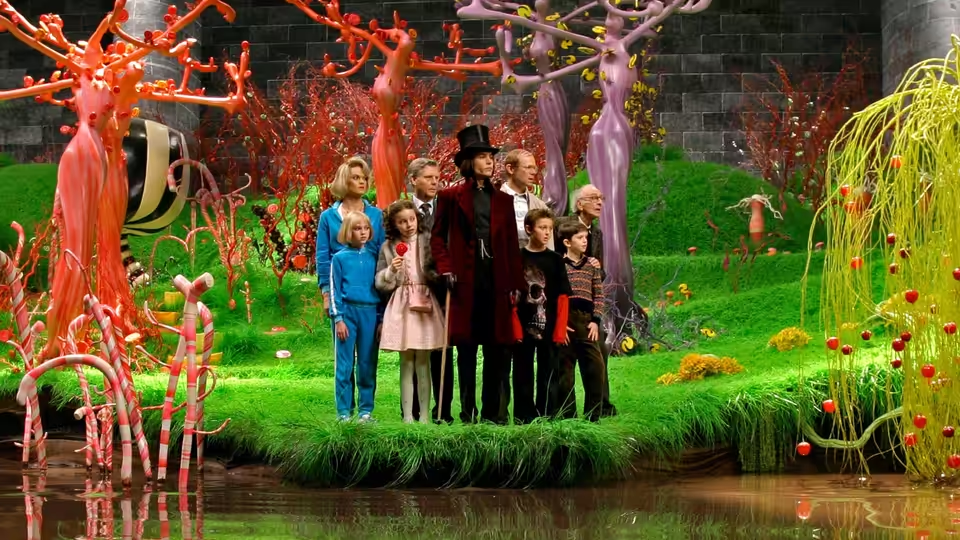
Willy Wonka (Johnny Depp) stands with children among colorful trees by a river
Film review

Charlie and the Chocolate Factory

2005 · Directed by Tim Burton · 1h 55m

In a sentenceJohnny Depp plays Wonka as a man who has never met a child and would rather not start now

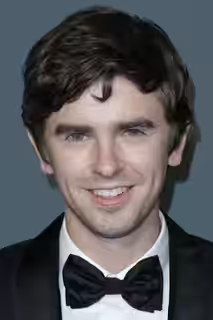
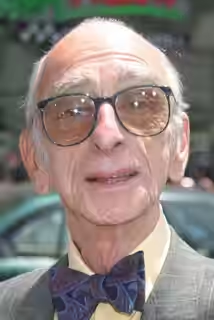
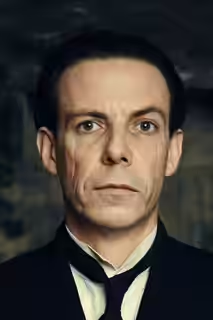
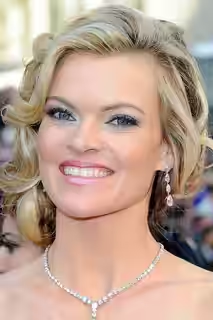
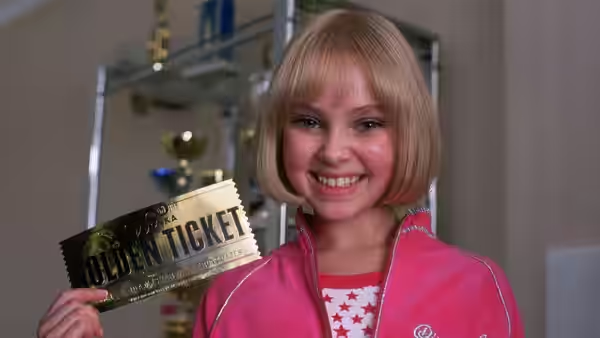
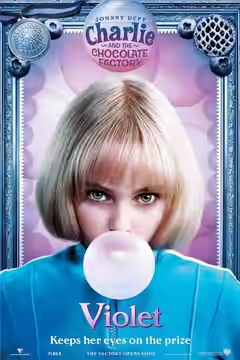
Charlie Bucket (Freddie Highmore) lives with his parents and four bedridden grandparents in a crooked wooden house in the shadow of the Wonka chocolate factory. Mr. Bucket (Noah Taylor) screws caps onto toothpaste tubes; Mrs. Bucket (Helena Bonham Carter) serves cabbage soup; Grandpa Joe (David Kelly) once worked inside the factory and has not seen its gates open in years. Then Willy Wonka (Johnny Depp) announces five golden tickets hidden in Wonka bars, each good for a factory tour and a lifetime supply of chocolate. Four go quickly: to a German boy who never stops eating, a rich girl whose father (James Fox) buys bars by the crate, gum-chewer Violet Beauregarde (AnnaSophia Robb), and a boy who prefers television. Charlie gets one bar a year, on his birthday.

Plays from YouTube when you press play; nothing loads from them until then.

Fi1m review

Tim Burton’s second run at Roald Dahl’s book is faithful, handsome and often funny, and it never warms up. The Bucket household is lovely; the factory is a marvel to look at; the man who owns it keeps the whole film at arm’s length.

Tim Burton goes back to Roald Dahl’s book rather than to the 1971 film, and John August’s screenplay keeps the book’s shape: Charlie at the centre, four dreadful children taken into the factory with him, an Oompa Loompa song after each misfortune. Burton adds one thing of his own, a father for Willy Wonka. The result is a faithful, sumptuous, frequently funny 115 minutes that we admired throughout and liked in patches. Adults may find themselves waiting for a warmth that arrives only when Wonka is off screen.

The warmth is all in the Bucket house. Alex McDowell builds it as a shack leaning at forty-five degrees, with the four grandparents sharing a single bed in the middle of it. Philippe Rousselot shoots the town in the colours of slush and lights the house with one weak bulb. Noah Taylor plays Mr. Bucket as a man quietly ashamed of the toothpaste caps, Helena Bonham Carter ladles out cabbage soup as if it were a treat, and David Kelly’s Grandpa Joe leaps out of bed with a joy that has been waiting decades. We were moved by these scenes more than we expected, and by Freddie Highmore most of all, who plays Charlie’s goodness without a trace of smugness. When he offers to sell his ticket to feed the family, we believed him.

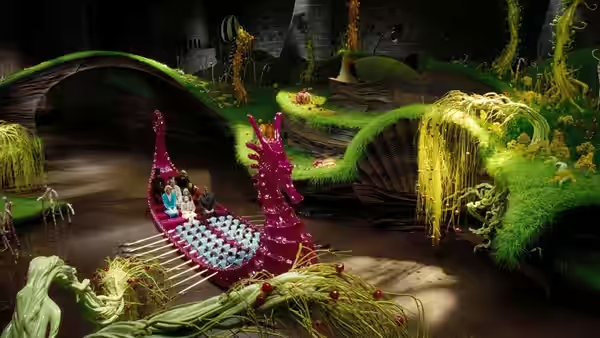
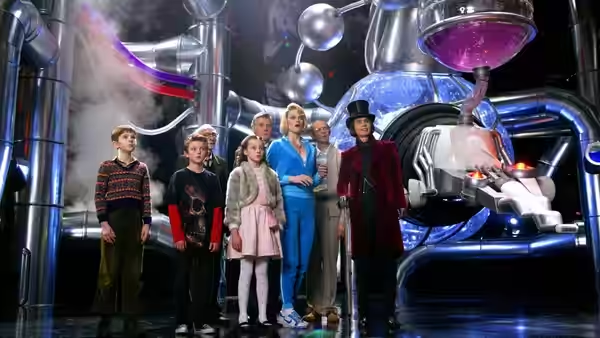
Then the gates open and the film changes palette. McDowell’s chocolate room is a green valley with a brown river running through it and a waterfall churning at one end; there is a boat made of boiled sweet, a glass lift that goes sideways, a white room where a television waits. Rousselot saturates every one so hard that, after the grey outside, the eye needs a moment to adjust. Gabriella Pescucci dresses Wonka in a plum frock coat, a top hat and goggles, and the four other children in the exact clothes their parents would choose for them. Chris Lebenzon moves briskly between rooms and never lets a set piece outstay itself. It is a factory we wanted to walk round.

The trouble is the man giving the tour. Depp plays Wonka with a pale face, a bob, a set of large false teeth and the bright, careful voice of a children’s television presenter who does not care for children. Some of this is funny, and Depp’s timing is good; we laughed at the burning welcome-puppets and at Wonka’s small delight in them. But we also spent long stretches watching him through our fingers, not because he was frightening but because he was so plainly uncomfortable in his own film. Gene Wilder’s Wonka kept you guessing whether he liked you. Depp’s does not, and once that is settled there is nothing left to wonder about him.

Danny Elfman sets Dahl’s own verses to music, and Deep Roy, multiplied by computer into every Oompa Loompa in the building, performs them as a chorus line. Each number is in a different borrowed style, and the choreography is inventive, but the arrangements are loud and the words often go under them, which is a pity when the words are the joke.

The father is a worse idea. Christopher Lee plays Dr. Wonka, a dentist who forbade his son sweets and clamped his head in braces, and the film cuts back to him in flashback whenever Wonka is asked a question he would rather not answer. The problem is that Wonka was a man who did not need explaining, and every minute spent explaining him is a minute taken from Charlie.

Burton has done this pale outsider before, with Depp, in Edward Scissorhands (1990), and that film ached where this one only twitches. He did the difficult father in Big Fish (2003) and did it better. Here he has a marvellous factory and a Charlie worth the ticket, and he has left them with a host who wishes they would all go home. See it with a child of eight or so, who will not mind, and watch the Bucket scenes for yourself. It carries a PG and opened in British cinemas on 29 July 2005.

Critical consensus AI synthesised

68
Positive
9
Mixed
10
Negative
1

Most critics are warm but not won over. The reviews lean positive, with almost as many mixed verdicts as favourable ones, and the praise clusters firmly on the look of the thing: the factory design, the colour, the invention in the set pieces. Several find it closer to Dahl’s book than the 1971 version, and Freddie Highmore’s Charlie is admired where he is mentioned. Johnny Depp’s Wonka draws the sharpest reactions in both directions, described as creepy and terrific by some and one-note by others.

The reservations gather around the added backstory for Wonka, which many of the mixed reviews call unnecessary and soppy, and around a tone some find darker than the material can bear. The spread is fairly wide. Den of Geek sits lowest, arguing Depp gives the wrong performance entirely, while later reappraisals from Polygon and Collider are among the kindest, suggesting the film has aged better than its first notices.

Empire
29 July 2005 · William Thomas
87*

The critic praises Tim Burton's version for its rich sweetness and acidic wit, visually jubilant factory design, and strong performances, especially Freddie Highmore's emotive Charlie and Johnny Depp's eccentric Wonka, delivering a witty, imaginative family film.

Read the full review →
The Guardian
29 July 2005
80*

The critic finds Tim Burton's film a highly enjoyable and authentic Dahl adaptation that mixes sentimentality with satirical gross-out, marking his best work in years. Depp's Wonka is terrific casting as a dysfunctional dandy, though the film is quite scary and darker than the 1971 version.

Read the full review →
Evening Standard
10 April 2012 · Derek Malcolm
78*

The critic calls it splendid filmmaking that kids will love, highlighting Burton's visual feast, imaginative factory, and Depp's mysterious Wonka, while noting a certain shallowness of focus and overly feelgood ending.

Read the full review →
The New York Times
15 July 2005 · A.O. Scott
77*

The critic calls Burton's adaptation wondrous and flawed, praising its success at feeding the youthful appetite for aesthetic surprise through its sumptuous, eerie look and inventive set pieces despite some lapses. The one thing singled out is the way pleasure mixes with a shadow of menace in the film's visual and tonal mood.

Read the full review →
Time Out
26 July 2005 · DC
77*

Burton delivers a charming children’s film with imaginative production design and a wonderfully creepy Depp performance as Wonka, though an unnecessary father-son subplot feels soppy and recalls the weaker elements of Big Fish.

Read the full review →
Los Angeles Times
15 July 2005 · Kenneth Turan
72*

Burton's version is visionary and phantasmagorical but more Burton than Dahl, relentlessly strange and dark with breathtaking visual imagination that makes even chocolate seem evil; it works overtime to warm up the chilly material but the darker tone dominates. The critic singles out the breathtaking visual imagination and precise images as the standout element.

Read the full review →

Straight answers AI written, from our review

Is Charlie and the Chocolate Factory worth watching?
Charlie and the Chocolate Factory is worth watching for families with a child of eight or so, and we scored it 64. The Bucket household scenes are lovely and Freddie Highmore's Charlie is worth the ticket, but Johnny Depp's Wonka keeps the film at arm's length and the added father subplot takes minutes from the boy it should be about.
How long is Charlie and the Chocolate Factory, and what is it rated?
Charlie and the Chocolate Factory runs 1h 55m. It is an adventure and comedy film.
Where can I watch Charlie and the Chocolate Factory in Belgium?
Charlie and the Chocolate Factory is streaming on HBO Max and Amazon Prime Video in Belgium, and it is also available to rent from Amazon Prime Video and Apple TV from €2.99. Availability is checked daily; the links above go straight to each service.
How does Charlie and the Chocolate Factory compare to The City of Lost Children?
Charlie and the Chocolate Factory is the brighter and more child-friendly of the two, while The City of Lost Children is darker, stranger and more crowded in its storytelling. Jeunet and Caro's film is the more inventive and the more touching, and its central partnership warms up in a way Burton's factory never does. Burton's is the safer choice for younger viewers; the French film rewards adults who can tolerate some confusion.
Is Charlie and the Chocolate Factory based on a true story or a book?
Charlie and the Chocolate Factory is based on Roald Dahl's novel, not on a true story. John August's screenplay keeps the book's shape closely, with Charlie at the centre, four dreadful children and an Oompa Loompa song after each misfortune, and sets Dahl's own verses to music. Burton adds one thing the book does not have, a father for Willy Wonka; knowing the novel is not needed to follow it.
What should I watch after Charlie and the Chocolate Factory?
After Charlie and the Chocolate Factory, try The City of Lost Children (1995, Fi1m 78): A French fairground of stolen children and mad science, darker and stranger than this. Then Edward Scissorhands (1990, Fi1m 83): Burton and Depp’s first pale outsider, and the one with a heart; and Fantastic Mr Fox (2009, Fi1m 84): Wes Anderson’s Dahl, dry as a biscuit and twice as funny as it needs to be.

Cast

Awards

Academy Awards, 2006

Nominated
Best Costume Design

Kids' Choice Award for Favorite Movie, 2006

Nominated
Kids' Choice Award for Favorite Movie

BAFTA Film Awards, 2005

Nominated
BAFTA's Children & Young People Award - Feature Film

Broadcast Film Critics Association Award for Best Family Film, 2005

Nominated
Broadcast Film Critics Association Award for Best Family Film

If you liked this, try…

  1. Willy Wonka & the Chocolate Factory (1971) · not on Fi1m yetGene Wilder’s Wonka might actually like you, which is far more unsettling.

  2. Matilda (1996) · not on Fi1m yetDanny DeVito’s Dahl, with the cruelty intact and the child properly in charge.

  3. The City of Lost Children (1995, Fi1m 78)A French fairground of stolen children and mad science, darker and stranger than this.

  4. Edward Scissorhands (1990, Fi1m 83)Burton and Depp’s first pale outsider, and the one with a heart.

  5. Fantastic Mr Fox (2009, Fi1m 84)Wes Anderson’s Dahl, dry as a biscuit and twice as funny as it needs to be.