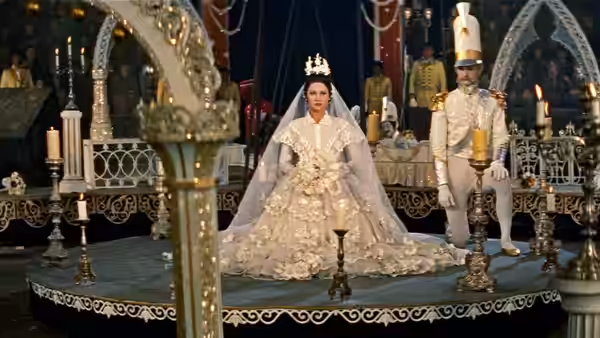
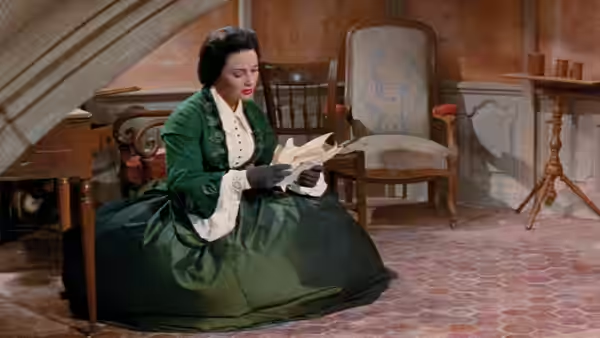
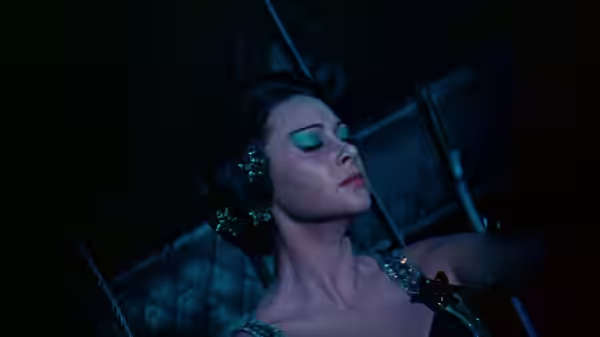
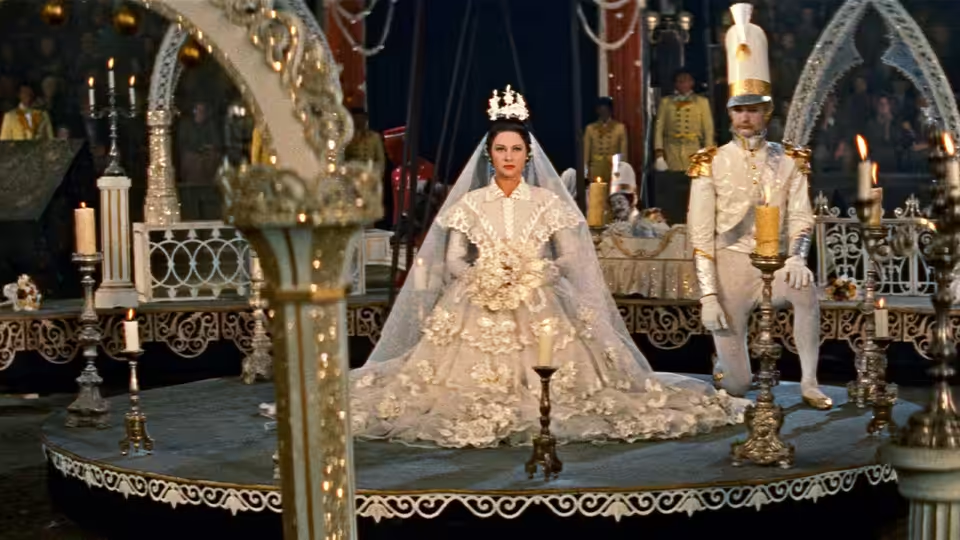
Lola Montes (Martine Carol) stands in a bridal gown beside a groom at an ornate altar
Film review

Lola Montès

1955 · Directed by Max Ophüls · 1h 56m

In a sentenceThe circus has excellent costumes and appalling manners

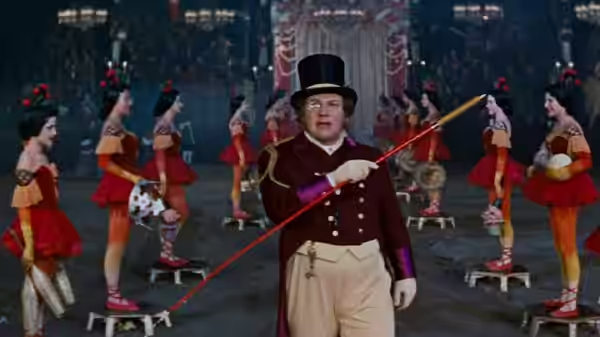
Lola Montes (Martine Carol) appears as the attraction in a circus, where the Circus Master (Peter Ustinov) presents her life as entertainment. Her romances and reputation supply the material for a public spectacle, with Franz Liszt (Will Quadflieg) among the figures in her story. Lola has to participate in a performance in which she is also the subject under scrutiny. Around her, the circus turns celebrity into pageantry, while its master oversees what the audience is invited to see.

Plays from YouTube when you press play; nothing loads from them until then.

Fi1m review

Max Ophüls makes a circus entertainment out of a woman’s exposure, and makes us uneasy about enjoying it. Lola Montès is worth seeing for its moving camera and theatrical splendour, though its heroine remains frustratingly distant.

Max Ophüls is interested in what happens when a famous woman’s life becomes public entertainment. Lola Montès makes that entertainment lavish enough for us to enjoy, then gives us reasons to feel uncomfortable about enjoying it. It is a fine, disquieting film, recommended with a reservation about how little access it gives us to Lola herself. The circus puts that problem before us from the start. There is an audience, a woman to be watched and a professional in charge of presenting her.

Christian Matras’s fluid widescreen photography keeps the circus from becoming a row of attractions waiting to be inspected. The camera’s movement continually changes which part of the display commands our attention, so watching becomes an active, slightly unsettled pleasure. Jean d’Eaubonne’s production design gives those movements plenty to take in, with the scale of the circus pressing upon its central figure. Georges Annenkov’s costumes contribute to the same crowded richness. We can enjoy the workmanship while noticing how easily Martine Carol gets absorbed into the display.

We felt uneasy watching Lola become just one more attraction amid the circus pageantry. There is so much to look at around Martine Carol that the eye can wander away from the person whose life supposedly matters most. That is a persuasive way of showing what celebrity does to someone, and it also exposes a weakness in the film. Martine Carol’s reserve does not always suggest feelings being kept back; sometimes it leaves too little to hold our attention. The spectacle occasionally has to supply interest that the performance cannot.

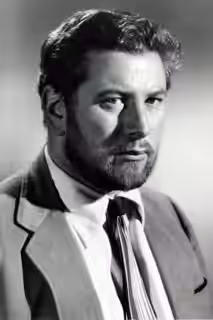
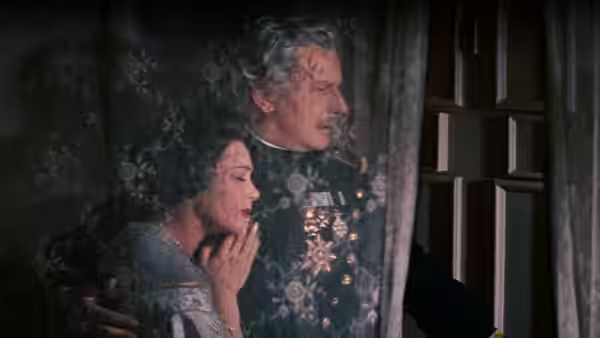
Peter Ustinov is well suited to the Circus Master, giving the business of presenting Lola a brisk professional confidence. His authority helps the circus feel like a working entertainment, with someone responsible for keeping its audience interested. That ordinary competence is an uncomfortable quality in a man presiding over another person’s exposure. Anton Walbrook brings a welcome warmth to Ludwig I, King of Bavaria. He gives us a person to attend to without needing the surrounding spectacle to make him interesting.

Georges Auric’s score reinforces the ceremony, helping the spectacle feel insistently public. Its grandeur suits a circus that is always asking for our attention, and the music contributes to the slightly overbearing pleasure of the display. The editing is credited to Jacqueline Sadoul, Madeleine Gug and Adolf Schlyssleder, whose work keeps the presentation of Lola central to the telling of her story. It is not always dramatically brisk. Some passages continue to offer visual pleasure after their point about public curiosity has become clear, and the pace can feel more stately than Lola’s situation warrants.

For a romantic drama, Lola Montès puts unusual pressure on the pleasure of looking. Max Ophüls allows the circus to remain enjoyable even while showing how degrading its treatment of Lola can be. That makes the audience’s appetite harder to dismiss as somebody else’s failing: we have been enjoying the same display. The film is most persuasive when it makes us notice where our own attention has gone. Give it an evening without a second screen competing for your eyes.
Critical consensus AI synthesised

73
Positive
5
Mixed
3
Negative
1

Most critics respond favourably to Lola Montès, with praise concentrated on Ophüls’s fluid camerawork, elaborate staging and circus spectacle. The photography, sets, costumes and score draw admiration, while several reviews see the theatrical presentation as central to the film’s account of celebrity and public humiliation. Its admirers argue that the visual extravagance makes spectators aware of how performance shapes what they see, rather than simply providing decoration.

The spread of opinion is wide, and the reservations centre on emotional distance, thin characterisation and style overwhelming the story. Even some favourable reviews question the film’s psychological depth. Variety offers the sharpest dissent, finding the treatment elegant but lifeless and Lola difficult to sympathise with, though it praises Anton Walbrook. Slant Magazine takes a contrasting view of the central performance, arguing that Martine Carol’s limited charisma serves the film’s examination of cinema’s power to both revere and mock dreams.

Slant Magazine
20 September 2008 · ★★★★/4 · Fernando F. Croce
100

Croce praises the film as Ophüls’s boldest vision of cinema’s power to revere and mock dreams. He singles out the fluid camerawork and argues that Martine Carol’s limited charisma serves the film’s self-reflexive vision.

Read the full review →
The New Yorker
19 September 2012 · Richard Brody
90*

Brody regards the film as a recovered masterwork whose grandiosity becomes its tragic, sumptuous subject. He praises Ophüls’s spectacle for capturing both the passion of performance and the self-abasement of celebrity.

Read the full review →
Empire
13 April 2006 · David Parkinson
85*

Parkinson considers the film a visually sumptuous, politically incisive must-see, despite reservations about its psychological depth. He especially praises the photography, sets, costumes, score and Ophüls’s fluid widescreen camerawork.

Read the full review →
The Guardian
12 July 2009 · Philip French
85*

French presents the film as an eye-opening restoration of Ophüls’s final work. He singles out the restoration and its acute commentary for praise.

Read the full review →
Time Out
· TR
64*

The available page identifies this as a review, but gives no readable critical verdict. It provides no accessible detail about what the critic praises or criticizes.

Read the full review →
Los Angeles Times
1 March 1991 · MARK CHALON SMITH
55*

The critic finds the film unwieldy and emotionally muted in parts, but ultimately invigorating. The swirling camera and vivid circus pageantry are singled out for praise.

Read the full review →

Straight answers AI written, from our review

Is Lola Montès worth watching?
Lola Montès is worth watching for its fluid camerawork and lavish circus spectacle, and we score it 81. We find its treatment of a woman’s life as public entertainment persuasively uncomfortable, though Lola herself remains frustratingly distant and the stately pace suits viewers with more patience for theatrical splendour than romantic intimacy.
How long is Lola Montès, and what is it rated?
Lola Montès runs 1h 56m. It is a drama and romance film.
Where can I watch Lola Montès in Poland?
Lola Montès is not on any streaming or rental service in Poland at the moment. It is available in 2 other countries; change your country at the top of the page to see where. Availability is checked daily.
How does Lola Montès compare to The Earrings of Madame de...?
Lola Montès is more emotionally distant than The Earrings of Madame de..., which we favour for its warmer performances and closer attention to people. Both find Ophüls examining romantic disappointment, but Lola Montès offers elaborate circus pageantry and discomfort about public curiosity; the lighter touch of The Earrings of Madame de... makes it the better choice for a moving romance.
Is Lola Montès based on a true story or a book?
Lola Montès is adapted from a novel by Jacques Laurent. We recommend approaching it as a drama about celebrity and public scrutiny rather than as a factual account of Lola’s life: its chief concern is how a circus turns her romances and reputation into entertainment.
What should I watch after Lola Montès?
After Lola Montès, try The Earrings of Madame de… (1953, Fi1m 87): Max Ophüls gives romantic disappointment a lighter touch and closer human attention. Then The Blue Angel (1930, Fi1m 81): Stage entertainment becomes painfully public humiliation, with little comfort from the audience; and The Red Shoes (1948, Fi1m 92): For the pleasure and unease of watching performance demand more than talent.

Cast

If you liked this, try…

  1. The Earrings of Madame de… (1953, Fi1m 87)Max Ophüls gives romantic disappointment a lighter touch and closer human attention.

  2. The Blue Angel (1930, Fi1m 81)Stage entertainment becomes painfully public humiliation, with little comfort from the audience.

  3. The Red Shoes (1948, Fi1m 92)For the pleasure and unease of watching performance demand more than talent.

  4. The King of Comedy (1982, Fi1m 88)Fame becomes an awkward transaction between the performer and the watching public.

  5. Millennium Actress (2001, Fi1m 86)A performer’s remembered romances become inseparable from the spectacle surrounding her.

Lola Montès (1955) review: A fine circus with a distant star (Poland) | Fi1m