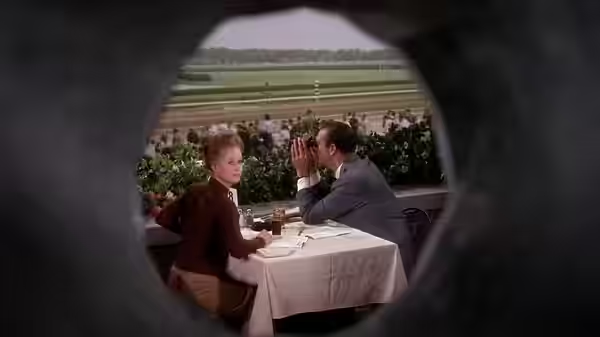
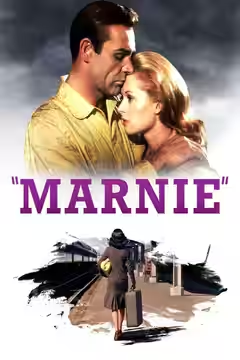
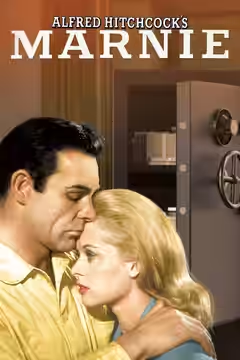
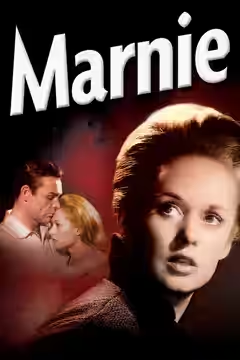
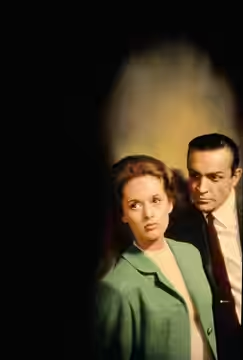
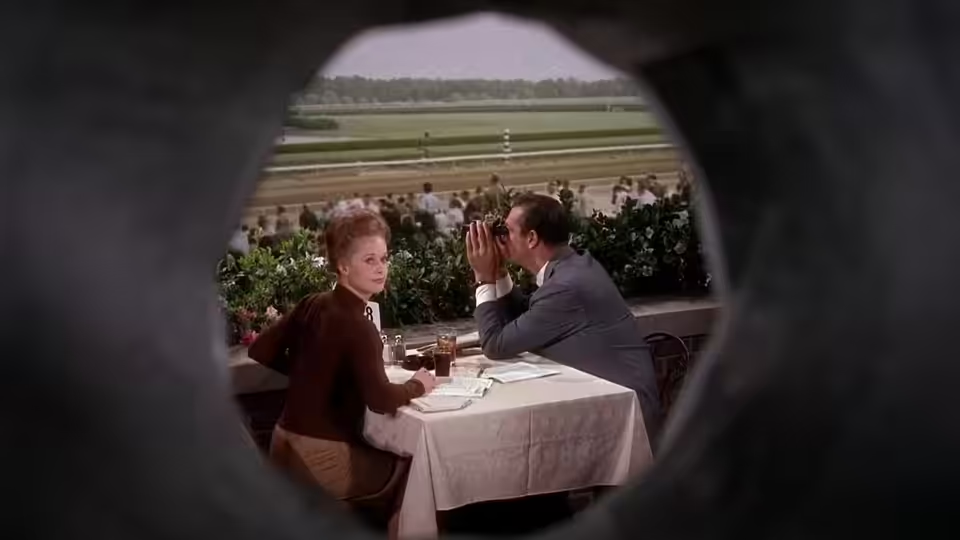
Marnie Edgar (Tippi Hedren) sits across from Mark Rutland (Sean Connery) at a racetrack table
Film review

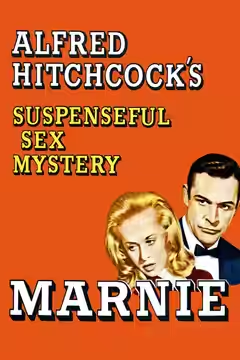
Marnie

1964 · Directed by Alfred Hitchcock · 2h 10m

In a sentenceSean Connery catches a thief and decides to keep her, which is the film’s idea of romance

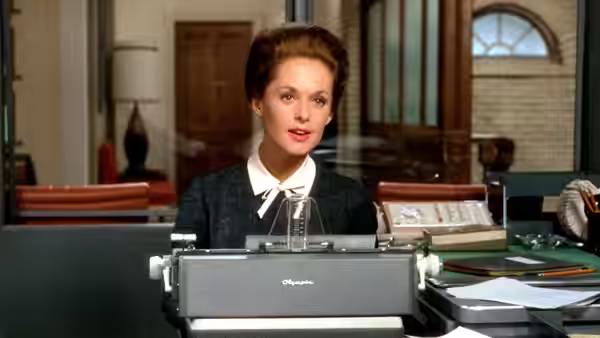
Marnie Edgar (Tippi Hedren) is a thief. She walks out of the office of Sidney Strutt (Martin Gabel) with the contents of his safe, changes her name and her hair colour, and moves on. Between jobs she visits her mother, Bernice (Louise Latham), who keeps her daughter at a distance and will not say why. Marnie’s next post is a clerical job at Rutland’s, the firm run by Mark Rutland (Sean Connery), a widower who has done business with Strutt and recognises the new girl at once. He says nothing and watches. Lil Mainwaring (Diane Baker), his late wife’s sister, watches too, and does not like what she sees. When Marnie empties the Rutland safe, Mark is waiting for her, and he is not interested in calling the police.

Fi1m review

Hitchcock’s study of a thief who cannot bear to be touched is uneven, oddly staged in places and unusually honest about its own cruelty. Tippi Hedren and Louise Latham make it worth an evening; the painted backdrops and Sean Connery’s amateur psychiatry do not.

Alfred Hitchcock’s Marnie opens with a woman walking away down a railway platform, a yellow handbag under her arm full of another man’s money. What follows, for 130 minutes, is Hitchcock trying to find out what is wrong with her, using a rich man with time on his hands as his instrument. Working from Winston Graham’s novel and a screenplay by Jay Presson Allen, he has made a thriller with almost no suspense and a love story in which the lover behaves like a warden. It is uneven, and more honest about its own cruelty than most films of its decade. We admired it more than we enjoyed it.

Tippi Hedren, a year on from The Birds, plays Marnie Edgar in two registers. In offices she is smooth and pale and gives nothing away; in her mother’s house in Baltimore she is a child again, asking to be loved. Louise Latham plays the mother, Bernice, with a hard mouth and a way of drawing her hand back when her daughter reaches for it, and their scenes are the best in the film. One of them got at us more than we expected: nothing happens except that a woman declines to stroke her grown daughter’s hair, and Hedren’s face falls in a way no line could have managed.

Some of the craft is Hitchcock at his most exact. Marnie’s second robbery, at Rutland’s, is held by George Tomasini as one wide shot split down the middle: Marnie at the safe on the right, a cleaner mopping towards her on the left, and no music at all. Robert Burks lights the office in the flat glare of a Friday afternoon, so there is nowhere to hide. Edith Head dresses Marnie in greys and greens that make her look like part of the filing system, and puts the one warm colour in that handbag. When Marnie takes off her shoes to cross the floor in silence, and one starts to slide out of her pocket, we stopped breathing, and we knew exactly what Hitchcock was doing to us and did not mind.

Other choices have aged badly, and we do not think all of them were meant. When Marnie rides, the horse is real and the countryside behind it is plainly a film of countryside, moving at a different speed. Robert F. Boyle’s set for Bernice’s street ends in a painted harbour with a ship in it the size of a cathedral, so obviously a backdrop that for a moment we took it for a joke. Bernard Herrmann’s score is large and romantic and arrives on cue every time Marnie feels anything, telling us what the actress has already shown.

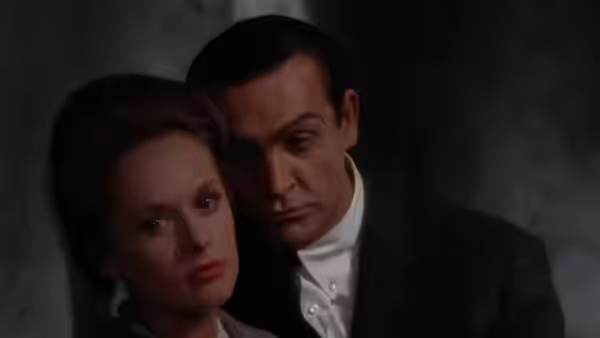
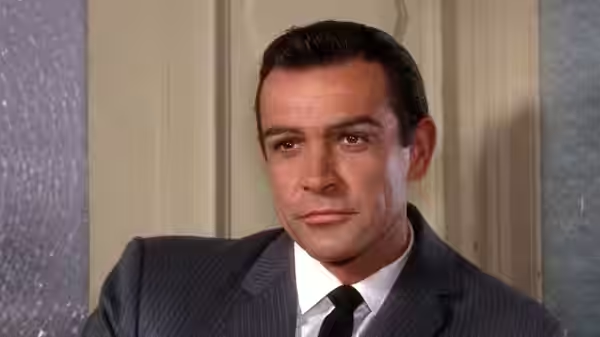
Then there is Mark Rutland, whom Sean Connery plays with relaxed good humour and a stare he holds a beat too long; the film never asks us to like him quite as much as it expects. Mark catches a thief and decides to keep her; he reads books on the criminal female and quizzes her over dinner. Diane Baker, as Lil, the sister-in-law who wanted Mark for herself, watches the whole business with a face that says so, and she gets the film’s few dry lines. There is a scene in the second half, on a boat, that we will not describe. It turned our stomach, and it is meant to; the trouble is that the film then wants us to go on hoping these two will be happy, and we could not.

Against Hitchcock’s own work it is the odd one. Vertigo (1958) made a man’s obsession with remaking a woman into a tragedy; Psycho (1960) made a damaged childhood into a knife. Marnie wants both and settles for talking about them, and the last stretch explains in words a good deal the pictures had already made plain.

See it for Hedren and Latham, and for the safe. Watch it at home, where the back projection is easier to forgive and the mother’s house feels smaller and closer. Expect two hours of a man deciding what a woman is for, and a film that half knows it should not have let him.

Critical consensus AI synthesised

60
Positive
3
Mixed
2
Negative
3

The reviews split almost evenly, with as many critics dismissing Marnie as admiring it. Where praise lands, it lands on Hitchcock’s direction: even The New Yorker, which finds the film trashy and badly acted, enjoys his abrupt, showy visual storytelling. Tippi Hedren draws steadier support, with Empire singling out her scenes with Marnie’s mother and the injured horse, and Variety calling her credible while blaming Hitchcock for giving her too little to vary.

The reservations cluster around the film’s finish and its surfaces. Time Out notes the common complaint that it lacks suspense; Radio Times warns that the artificial sets and back projection will not suit everyone; Variety finds the climax misses its point, and Sight and Sound thinks the whole thing falters after a promising opening. The spread is wide, from Slant’s view of it as Hitchcock’s defining late work to reviews that find the performances and later stretches rough. The admirers tend to read it as psychology rather than as a thriller.

Slant Magazine
17 February 2006 · ★★★★/4 · Fernando F. Croce
100

Croce regards Marnie as Hitchcock’s definitive late-period masterpiece, praising its daring psychological and formal experimentation. He singles out the hunting sequence for fusing the film’s themes and visual language into a powerful turning point.

Read the full review →
Empire
1 March 2007 · Kim Newman
80*

Newman finds the film a compelling Hitchcock thriller, with Hedren’s performance making the strongest impression. He particularly praises her work in the scenes with Marnie’s mother and the injured horse.

Read the full review →
Radio Times
★★★★ · David Parkinson
80

Parkinson calls the film one of Hitchcock’s more fascinating misfires. He notes that its artificial sets and back projection may not appeal to everyone.

Read the full review →
The AV Club
29 March 2002 · Keith Phipps
60*

Phipps calls the film essential viewing for Hitchcock admirers, though it can be a slog on its own terms. He singles out its queasy honeymoon-rape scene as a grotesque parody of marriage rites.

Read the full review →
Time Out
· GA
57*

The review notes that the film is often criticised for lacking suspense and resists classifying it as either a thriller or psychodrama. It singles out the film’s similarity to Vertigo as connected to that lack of suspense.

Read the full review →
Variety
31 December 1963 · Variety Staff
40*

The review finds the film’s character study intriguing but ultimately clouded, with a climax that misses its point. It praises Tippi Hedren’s credible performance while faulting Hitchcock for giving her too little variation.

Read the full review →

Straight answers AI written, from our review

Is Marnie worth watching?
Marnie is worth an evening for Tippi Hedren, Louise Latham and one superbly staged robbery, and we scored it 68. It is uneven, with painted backdrops and a leading man the film likes more than we did, so it suits Hitchcock admirers rather than anyone wanting a tight thriller. We admired it more than we enjoyed it.
How long is Marnie, and what is it rated?
Marnie runs 2h 10m. It is a thriller and mystery film.
Where can I watch Marnie in New Zealand?
Marnie is available to rent from Apple TV and Amazon Prime Video from NZ$5.99. Availability is checked daily; the links above go straight to each service.
How violent or frightening is Marnie, and is it suitable for children?
Marnie is a UK 15 and contains little violence and almost no suspense in the usual sense. The discomfort is adult and psychological: a man holds a woman against her will, and one scene in the second half on a boat turned our stomach, as it is meant to. It is not for children, and older teenagers should know what they are in for.
How does Marnie compare to Vertigo?
Marnie and Vertigo share the same obsession, a man remaking a woman to order, and Vertigo is by some distance the better film. It treats that obsession as tragedy, with far more pity; Marnie talks about it and settles for explaining in words what the pictures already showed. Start with Vertigo, then come to Marnie as the odd, honest one.
Is Marnie based on a true story or a book?
Marnie is based on Winston Graham's novel of the same name, adapted by screenwriter Jay Presson Allen; it is not a true story. You do not need to know the book, since the film explains its own psychology at length in the final stretch, rather more than it needs to.
What should I watch after Marnie?
After Marnie, try Vertigo (1958, Fi1m 92): The same obsession, remaking a woman to order, handled with far more pity. Then Secret Beyond the Door (1947, Fi1m 60): Fritz Lang’s marriage thriller with a locked room and a wife who cannot trust her husband; and The Piano Teacher (2001, Fi1m 82): Isabelle Huppert as a woman who cannot bear to be touched, and means it.

Cast

If you liked this, try…

  1. Vertigo (1958, Fi1m 92)The same obsession, remaking a woman to order, handled with far more pity.

  2. Secret Beyond the Door (1947, Fi1m 60)Fritz Lang’s marriage thriller with a locked room and a wife who cannot trust her husband.

  3. Peeping Tom (1960) · not on Fi1m yetA British film about looking at women as a sickness, and about the man doing it.

  4. The Piano Teacher (2001, Fi1m 82)Isabelle Huppert as a woman who cannot bear to be touched, and means it.

  5. Phoenix (2014, Fi1m 68)Christian Petzold’s postwar drama about a husband who does not recognise his own wife.