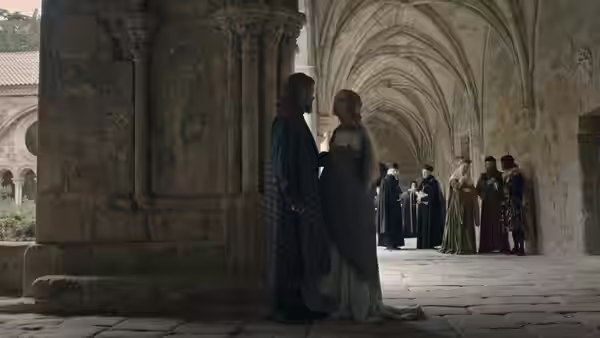
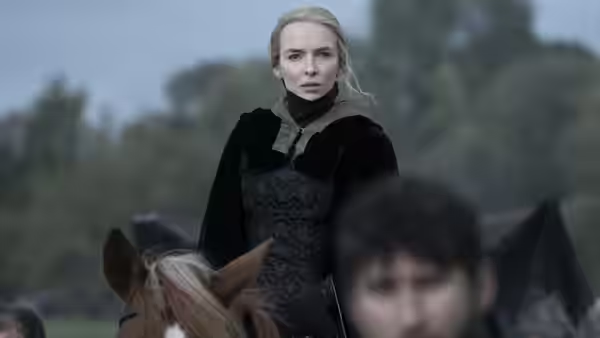
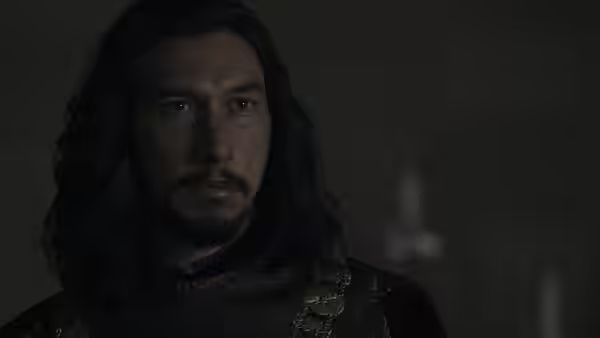
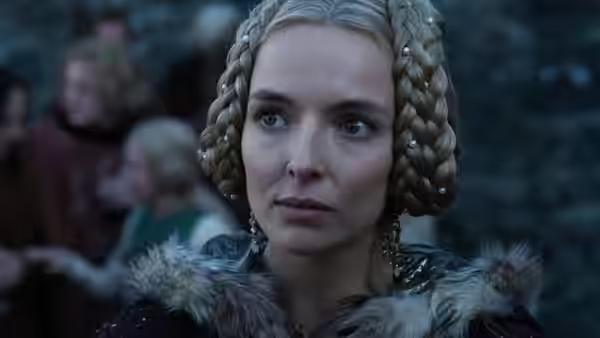
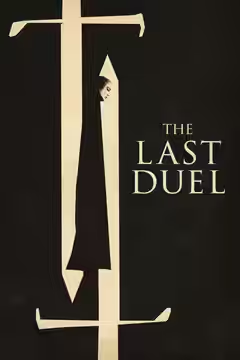
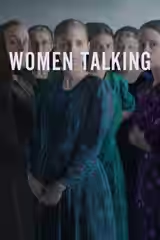
A man and woman stand beneath a stone archway as attendants gather in the corridor
Film review

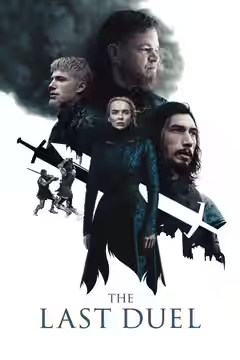
The Last Duel

2021 · Directed by Ridley Scott · 2h 33m · KAVI K-16

In a sentenceMatt Damon has a mullet, Ben Affleck has a goatee and Jodie Comer has the film

Normandy, 1386. The squire Sir Jean de Carrouges (Matt Damon) returns from campaign to be told by his wife, Marguerite (Jodie Comer), that while he was away Jacques Le Gris (Adam Driver), once his friend and now the favourite of Count Pierre d’Alençon (Ben Affleck), raped her. Carrouges has lost land, a captaincy and the count’s goodwill to Le Gris; the first chapter follows the years of soldiering and slights that led there, including his marriage to Marguerite, daughter of Sir Robert de Thibouville (Nathaniel Parker). With no hope of justice from Pierre, Carrouges takes his case to the boy king Charles VI (Alex Lawther) and demands a duel to the death, God to decide. Two more chapters follow, one for Le Gris and one for Marguerite.

Plays from YouTube when you press play; nothing loads from them until then.

Fi1m review

Ridley Scott tells one accusation three times, and only the third telling, Jodie Comer’s, earns the method. The rest is handsome, blunt and too long, with a final duel savage enough to make you forget, briefly, whose story this was.

Ridley Scott’s The Last Duel goes to Normandy in the 1380s for the story of a squire, his wife, his former friend and the trial by combat that settled the matter between them. The screenplay, by Matt Damon, Ben Affleck and Nicole Holofcener, tells it three times: as Jean de Carrouges remembers it, as Jacques Le Gris does, and as Marguerite de Carrouges does. The idea is sound. The film is 153 minutes long, and those two facts are at odds for most of the evening. It is worth seeing for the third chapter and for the fight at the end, and it makes you sit through a good deal to reach either.

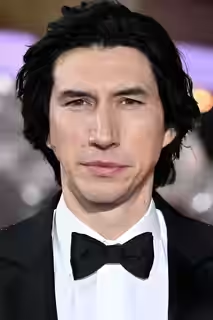
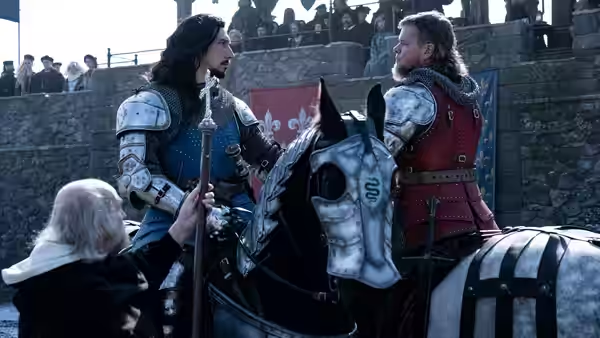
Chapter one belongs to Damon’s Carrouges, played as a man permanently owed something: a scar down the cheek, a mullet, a jaw set against the world. The script understands that a medieval grievance is about land and money before it is about honour, and it keeps count of both. Adam Driver’s Le Gris is the clever one, the count’s man who reads Latin and keeps his accounts, and Driver gives him a stillness that reads as good manners here and as something else later. Affleck’s Count Pierre, blond, bored and cruel for sport, is the one performance that knows it is allowed to be enjoyed, and we enjoyed it.

Chapter two runs the same years again through Le Gris’s eyes, and Claire Simpson cuts the repeated scenes so the small differences register as corrections: a look held a beat longer, a kiss at a reconciliation that in his memory Marguerite returns. That much of the method works. Then the chapter shows the assault, at length, and the third chapter shows it again. We understood the argument, that the second version is a man’s lie about himself and the third is what happened. We still felt, sitting there, that the film had decided it could show us the thing twice and so it did.

The third chapter is the reason to see the film. Marguerite has been standing at the edge of the frame for two chapters, and Jodie Comer makes it clear how much was going on there: the estate she runs while Jean is away at war, the rents she collects more efficiently than he did, the mother-in-law (Harriet Walter) who keeps the house like a garrison, the friend Marie (Tallulah Haddon). Comer plays her as clever, watchful and tired of being discussed, and when she tells her husband what happened to her, his first thought is for himself, and she notices. The chapter’s title card holds on the words “the truth” a second after the rest has faded. It is the film’s best joke and its only quiet one.

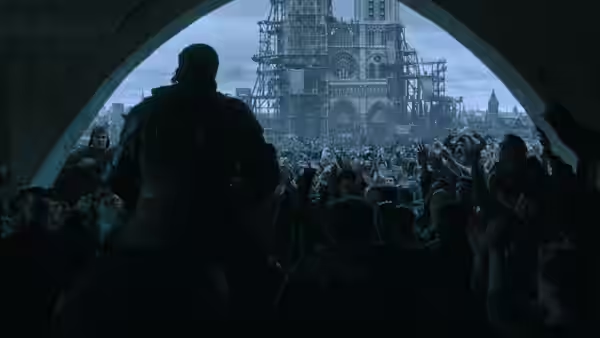
Dariusz Wolski shoots it all under a low grey sky, mud and wet stone outside, candlelight through slit windows inside, and after two hours we were tired of it. Arthur Max builds the Paris lists as a timber box on frozen ground, ringed with stands. Janty Yates does the sharpest work in the film: Marguerite’s gowns change cut and colour depending on which man is remembering her, and you can tell the chapter by her neckline. Harry Gregson-Williams keeps the score to low drums and a choir and mostly stays out of the way. The dialogue is flatter than the pictures, plain modern English that sits oddly in a French court, and the accents wander from scene to scene.

The duel itself is superb and ugly. Scott stages it as horses first, then axes, then two exhausted men in armour rolling in frozen mud, and he lets it take as long as it takes. We flinched more than once. Then we noticed Marguerite in the stands with nothing to do for ten minutes but watch two men decide her fate, which is the history, and is also the film forgetting for a while whose story it had just told us it was.

Scott’s first film, The Duellists (1977), was about two men who could not let a quarrel go, and this one is closer to that than to Gladiator (2000): more intelligent, less fun, longer than both. See it for Comer and for Affleck, and consider watching at home, where a pause after the second chapter costs nothing and the third arrives fresher. It carries an 18 certificate and it earns it.

Critical consensus AI synthesised

62
Positive
15
Mixed
10
Negative
6

Most critics come down cautiously in favour of The Last Duel. Jodie Comer’s Marguerite is the performance singled out again and again: restrained, intelligent, and the film’s conscience once her own account arrives in the final chapter. Ben Affleck’s sly, corrupt Count Pierre draws a second cluster of praise, and several reviews credit the three-part structure with exposing how the men’s accounts flatter themselves. The brutal closing duel is admired even by some who dislike the rest.

The reservations gather around length and repetition. Many find the structure delays Marguerite’s story too long and makes the rape scene, shown more than once, feel repetitive rather than clarifying; others think the modern relevance is pressed too hard. The spread is wide, from warm festival raves to outright rejection. The New Yorker calls it exploitative, faulting Scott for showing the assault rather than trusting Marguerite’s testimony, and The Guardian finds it overlong and buried under spectacle.

Sight and Sound
5 November 2021
85*

The critic considers the film one of Ridley Scott’s most successful period works, praising its nuanced storytelling on an epic scale. They single out Jodie Comer’s performance as the character who ultimately finds her own voice.

Read the full review →
Vulture
15 October 2021 · Bilge Ebiri
85*

Ebiri finds the film unexpectedly entertaining and sees it as a forceful denunciation of patriarchal power. He especially praises Ben Affleck’s sly, funny performance as the corrupt Count Pierre.

Read the full review →
IndieWire
10 September 2021 · B+ · Ben Croll
83

Croll finds the film an intelligent, daring epic, though its shifts in tone and style can feel awkward. He praises Ben Affleck’s performance and the film’s collaborative storytelling, while noting Jodie Comer finally gets room to shine in the last chapter.

Read the full review →
Total Film
10 September 2021 · ★★★★ · James Mottram
80

The review finds the film thought-provoking and dexterous, though its long running time becomes unwieldy. It singles out Jodie Comer as the cast’s standout and the film’s emotional center.

Read the full review →
Los Angeles Times
13 October 2021 · Justin Chang
77*

Chang finds the film an ingenious, darkly funny indictment of patriarchy, though its perspective-shifting structure can make the rape scene feel repetitive. He praises Jodie Comer’s intelligent, empathetic performance, which makes Marguerite the film’s conscience.

Read the full review →
The AV Club
12 October 2021 · B · A.A. Dowd
77

Dowd finds the film’s perspective-shifting structure ultimately makes a forceful case against treating the truth as unknowable. He praises its blunt, era-crossing outrage, while noting that Marguerite remains dramatically underdeveloped until the final chapter.

Read the full review →

Straight answers AI written, from our review

Is The Last Duel worth watching?
The Last Duel is worth watching for Jodie Comer's third chapter and for the brutal fight at the end, and we scored it 65. It is 153 minutes long, and much of the first two hours repeats itself under a low grey sky. Consider a pause after the second chapter, so the third arrives fresher.
How long is The Last Duel, and what is it rated?
The Last Duel runs 2h 33m and is rated K-16 by the KAVI in Finland. It is a drama and history film.
Where can I watch The Last Duel in Finland?
The Last Duel is streaming on Disney+ in Finland, and it is also available to rent from Amazon Prime Video from €3.99. Availability is checked daily; the links above go straight to each service.
How violent or frightening is The Last Duel, and is it suitable for children?
The Last Duel carries an 18 certificate in the UK and earns it, and it is not for children. The rape at the centre of the story is shown at length, twice, and the final duel is savage: horses, axes, and two exhausted men in armour rolling in frozen mud. The squeamish should know this before they sit down.
How does The Last Duel compare to Rashomon?
The Last Duel borrows the method of Rashomon, one crime told from several accounts, but Kurosawa's film is the tighter and more gripping of the two. Scott's version only earns the repetition in its third chapter, Marguerite's, where the small corrections finally matter. Watch Rashomon for the idea done sharply; watch The Last Duel for Comer.
What should I watch after The Last Duel?
After The Last Duel, try Rashomon (1950, Fi1m 92): Kurosawa tells one crime four ways and started every film like this. Then The Nightingale (2018, Fi1m 78): A woman pursues her attackers across colonial Tasmania; harder to watch and harder to shake; and Women Talking (2022, Fi1m 76): The women of a religious colony decide what to do; almost no men, all consequence.

Cast

If you liked this, try…

  1. Rashomon (1950, Fi1m 92)Kurosawa tells one crime four ways and started every film like this.

  2. The Duellists (1977) · not on Fi1m yetScott’s first film, two Napoleonic officers who cannot stop fighting, and eighty minutes shorter.

  3. The Nightingale (2018, Fi1m 78)A woman pursues her attackers across colonial Tasmania; harder to watch and harder to shake.

  4. Women Talking (2022, Fi1m 76)The women of a religious colony decide what to do; almost no men, all consequence.

  5. The Passion of Joan of Arc (1928, Fi1m 94)One medieval Frenchwoman, one tribunal of men, and a face the camera never leaves.

The Last Duel (2021) review: three tellings, one worth the wait (Finland) | Fi1m