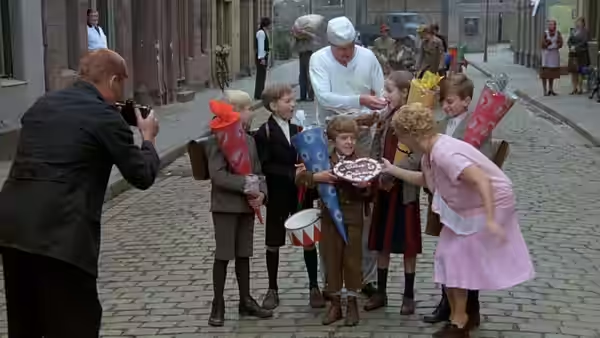
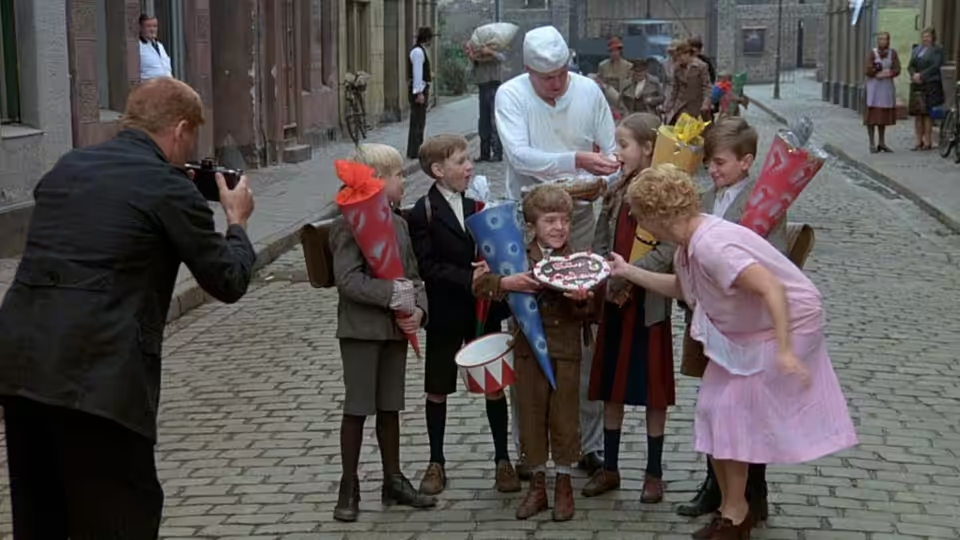
A photographer captures schoolchildren gathered around a cake on a cobbled street
Film review

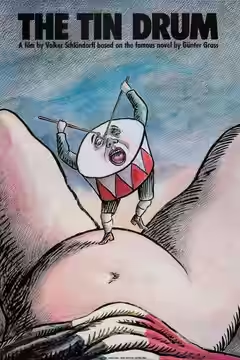
The Tin Drum

1979 · Directed by Volker Schlöndorff · 2h 42m · MK 15+

In a sentenceA three-year-old refuses to grow up while an entire city does the same

A potato field outside Danzig, around the turn of the century. Anna Koljaiczek (Tina Engel) hides a fugitive, Joseph Koljaiczek (Roland Teubner), under her four skirts while the police walk past. The daughter who results, Agnes (Angela Winkler), grows up to marry the grocer Alfred Matzerath (Mario Adorf) while keeping her cousin Jan Bronski (Daniel Olbrychski), a Pole at the post office, as her lover. Their son Oskar (David Bennent) is given a tin drum on his third birthday, decides he wants nothing more to do with the adult world, and throws himself down the cellar stairs so he will never grow another inch. When anyone tries to take the drum, he screams and glass shatters. In the shop and the flat above it, brown uniforms begin to appear.

Fi1m review

Volker Schlöndorff’s film of Günter Grass’s novel is one of the strangest things ever made about the Nazi years and, for two hours, one of the best. David Bennent’s Oskar is unrepeatable. The last forty minutes run out of road.

Oskar Matzerath is given a tin drum on his third birthday and decides, there and then, to stop growing. He throws himself down the cellar stairs so the adults have an explanation, and stays the size of a small child, beating his drum, while Danzig walks into the Third Reich. Volker Schlöndorff’s film of Günter Grass’s novel, written with Jean-Claude Carrière and Franz Seitz Jr., is one of the strangest films ever made about the Nazi years, and for most of its length one of the best. It is also 162 minutes long and it feels it. We recommend it, with that warning attached.

The film belongs to David Bennent. He plays Oskar from three to roughly twenty without changing, and his face does most of the work the novel gave to its narrator: the large pale eyes, the mouth that never settles, the way he looks at adults as if he has already read the end of their story. When he screams, glass breaks, a teacher’s spectacles, a clock face, a window across the street, and Schlöndorff plays it straight, no music, no reaction shot, just the sound and then the falling. We have seen nothing like him before or since.

Igor Luther keeps the camera low, at Oskar’s eye level, so the grocer’s shop and the flat above it loom and grown-ups are mostly trouser legs and hands. Nikos Perakis has built a Danzig of browns and dirty creams: shop counters, a kitchen with the stove always going, a party rally on a field with the bunting hung slightly wrong. That rally is the scene people remember. Oskar crawls under the grandstand, sets up beneath the band and shifts the beat, and the brass march turns, bar by bar, into a waltz. The uniforms pair off. We laughed out loud, and then noticed the film had shown us the whole machinery of a Nazi parade and made it look silly without once telling us it was.

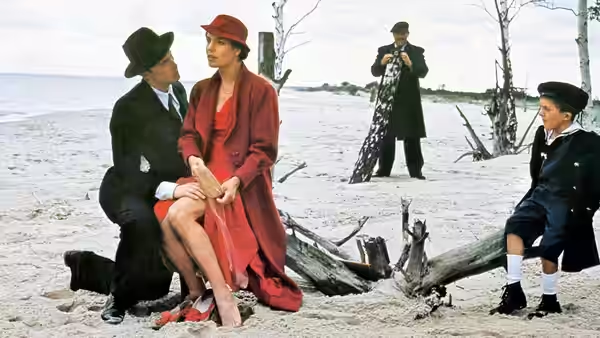
It can also horrify, and it did. On a grey beach Oskar’s family watches a fisherman haul a horse’s head from the sea and pull eels out of its mouth and ears. Suzanne Baron does not cut away. She holds while Angela Winkler’s Agnes retches and Oskar drums, and holds after, and we sat with a hand over our mouth. It is the ugliest thing in the film and no Nazi is responsible for it. That is the argument, if the film has one: the rot was there first.

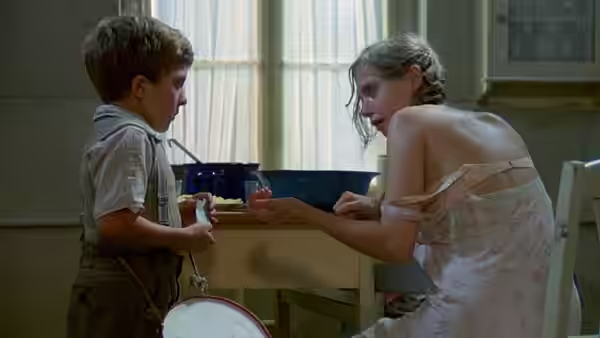
Around the boy, three adults share a life. Mario Adorf’s Alfred Matzerath is a Rhineland grocer, loud and decent enough, who joins the party because the shop is doing well and the uniform fits. Daniel Olbrychski’s Jan Bronski is Agnes’s cousin, a Pole at the Danzig post office, softer and more frightened. Winkler carries the sadness between them without a speech. Their card games at the kitchen table, knees touching under the cloth, are as good as anything here, and Schlöndorff lets the radio bring Hitler’s voice into the kitchen during one of them without anyone looking up. Maurice Jarre’s score stays out of these scenes almost entirely, which was the right call.

Then comes a turn we will not describe, and after it the film loses the thread. Grass wrote in Oskar’s voice, and without that voice the second half is a string of episodes: a travelling troupe of performers, a war going badly offstage, Katharina Thalbach arriving as Maria. Each scene is well made and none of them pulls the next one along. The Time Out reviewer thought the film simply could not match the novel’s scale, and for the last forty minutes we agreed. For the first two hours we did not.

It is not a film for children, whatever its lead looks like, and one scene between Oskar and Maria has been argued over for decades; you will know it when it comes. See it in a cinema if one will show it, because Luther’s darks turn to mud on a small screen. If not, turn the lights right down and do not eat anything with a head on it.

Critical consensus AI synthesised

74
Positive
6
Mixed
2
Negative
1

Most critics admire Schlöndorff’s adaptation of Günter Grass’s novel, and the praise gathers in two places: the look of the film and David Bennent as Oskar. Reviewers repeatedly describe the imagery as bizarre and unsettling, and treat that strangeness as the source of the film’s force rather than a distraction from it. The big set pieces draw particular notice, with Variety singling out the staging of the Danzig Post Office attack and the Party Day crowd. Bennent’s stare and screams are credited by several with carrying the boy’s protest against the adults around him.

The reservations are almost all about the book. Several critics find the film thinner than its source, lacking the novel’s scale and its inner voice; The AV Club calls it fascinating but superficial, and Time Out judges it plainly inferior to Grass. Variety, alone, thinks Bennent misses the character. The spread is wide, from Slant’s full marks for the director’s cut to Time Out’s dismissal, but the middle holds steady at warm approval.

Slant Magazine
19 September 2012 · ★★★★/4 · Ela Bittencourt
100

The review finds that the director’s cut deepens some subplots without fundamentally changing the story. It praises Oskar’s distinctive characterization as a figure caught between two nations and implicated in their tragedy.

Read the full review →
Empire
1 January 2000 · William Thomas
80*

Thomas finds the film disturbing, powerful and visually beautiful, with a cruelly precise view of German complicity. He singles out its bizarre, unsettling scenes as a source of its force.

Read the full review →
Evening Standard
10 April 2012
80*

The critic regards the film as a work of lasting, inflammatory power. They praise its bizarre visuals and Schlöndorff’s restraint in portraying a society bent on self-destruction.

Read the full review →
Radio Times
★★★★ · David Parkinson
80

The review praises the film’s visual bravado despite its reduced thematic complexity and occasional expressionist excess. It particularly singles out David Bennent’s performance as the boy who protests adult complicity through his screams and drum playing.

Read the full review →
The AV Club
6 February 2013 · B · Mike D'Angelo
77

D’Angelo finds the adaptation fascinating but ultimately superficial, with its long runtime and lack of interior narration weakening its impact. He praises David Bennent’s performance, whose unsettling stare helps fill the gaps left by the novel’s missing inner thoughts.

Read the full review →
Los Angeles Times
13 December 1990 · GUILLERMO TORRES
65*

The critic finds the film an often quirky, symbol-heavy portrait of a society gone mad. He singles out the scene where Hitler’s voice enters the family home as especially telling and forceful.

Read the full review →

Straight answers AI written, from our review

Is The Tin Drum worth watching?
The Tin Drum is worth watching for anyone who can sit through 162 minutes of strange, often ugly drama about the Nazi years, and we scored it 78. David Bennent's Oskar, the boy who stops growing at three, is unlike anything else in cinema, and the first two hours are among the best films made on the subject. The last forty minutes lose the thread.
How long is The Tin Drum, and what is it rated?
The Tin Drum runs 2h 42m and is rated 15+ by the MK in Czechia. It is a drama and history film.
Where can I watch The Tin Drum in Czechia?
The Tin Drum is not on any streaming or rental service in Czechia at the moment. It is available in 7 other countries; change your country at the top of the page to see where. Availability is checked daily.
How violent or frightening is The Tin Drum, and is it suitable for children?
The Tin Drum is not a film for children, whatever the age of its lead; it has no UK certificate and is rated R in the United States. The most disturbing scene is a fisherman pulling eels from a horse's head on a beach, held without a cut, and one scene between Oskar and Maria has been argued over for decades. The squeamish should be warned.
How does The Tin Drum compare to Pan's Labyrinth?
The Tin Drum and Pan's Labyrinth both put a child inside a fascist household, but Schlöndorff's film has no fairy tale to escape into: Oskar's only magic is a scream that breaks glass, and the horrors are the adults'. Del Toro's film is the shapelier and warmer of the two; Schlöndorff's is the stranger and, for two hours, the stronger, before it runs out of road.
What should I watch after The Tin Drum?
After The Tin Drum, try Pan's Labyrinth (2006, Fi1m 87): A child, a fascist household and monsters that are easier company than the adults. Then Come and See (1985, Fi1m 92): A boy ages twenty years in a fortnight of the war in Belarus; unbearable and necessary; and Fanny and Alexander (1982, Fi1m 92): Bergman’s family saga at a child’s eye level, warmer than Grass but no less watchful.

Cast

Awards

Academy Awards, 1980

Won
Best International Feature Film

International Submission to the Academy Awards, 1980

Nominated
International Submission to the Academy Awards

Cannes Film Festival, 1979

Won
Palme d'Or

If you liked this, try…

  1. The Marriage of Maria Braun (1979) · not on Fi1m yetFassbinder’s same-year account of the Germany that came after, told through one woman’s ledger.

  2. Pan's Labyrinth (2006, Fi1m 87)A child, a fascist household and monsters that are easier company than the adults.

  3. Come and See (1985, Fi1m 92)A boy ages twenty years in a fortnight of the war in Belarus; unbearable and necessary.

  4. Fanny and Alexander (1982, Fi1m 92)Bergman’s family saga at a child’s eye level, warmer than Grass but no less watchful.

  5. Cabaret (1972, Fi1m 88)Berlin dancing with its eyes shut while the uniforms fill the back of the club.