Volker Schlöndorff’s film of Günter Grass’s novel is one of the strangest things ever made about the Nazi years and, for two hours, one of the best. David Bennent’s Oskar is unrepeatable. The last forty minutes run out of road.
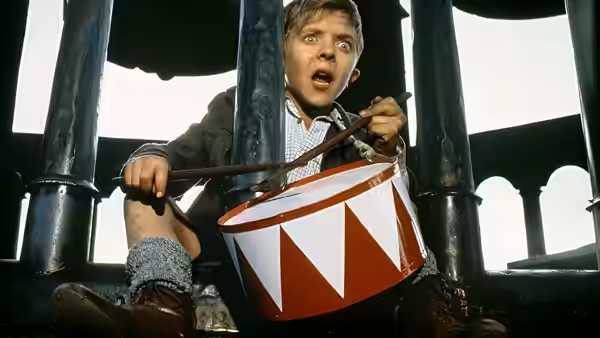
Oskar Matzerath is given a tin drum on his third birthday and decides, there and then, to stop growing. He throws himself down the cellar stairs so the adults have an explanation, and stays the size of a small child, beating his drum, while Danzig walks into the Third Reich. Volker Schlöndorff’s film of Günter Grass’s novel, written with Jean-Claude Carrière and Franz Seitz Jr., is one of the strangest films ever made about the Nazi years, and for most of its length one of the best. It is also 162 minutes long and it feels it. We recommend it, with that warning attached.
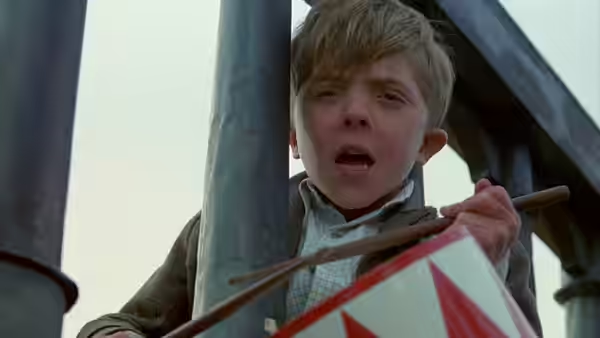
The film belongs to David Bennent. He plays Oskar from three to roughly twenty without changing, and his face does most of the work the novel gave to its narrator: the large pale eyes, the mouth that never settles, the way he looks at adults as if he has already read the end of their story. When he screams, glass breaks, a teacher’s spectacles, a clock face, a window across the street, and Schlöndorff plays it straight, no music, no reaction shot, just the sound and then the falling. We have seen nothing like him before or since.
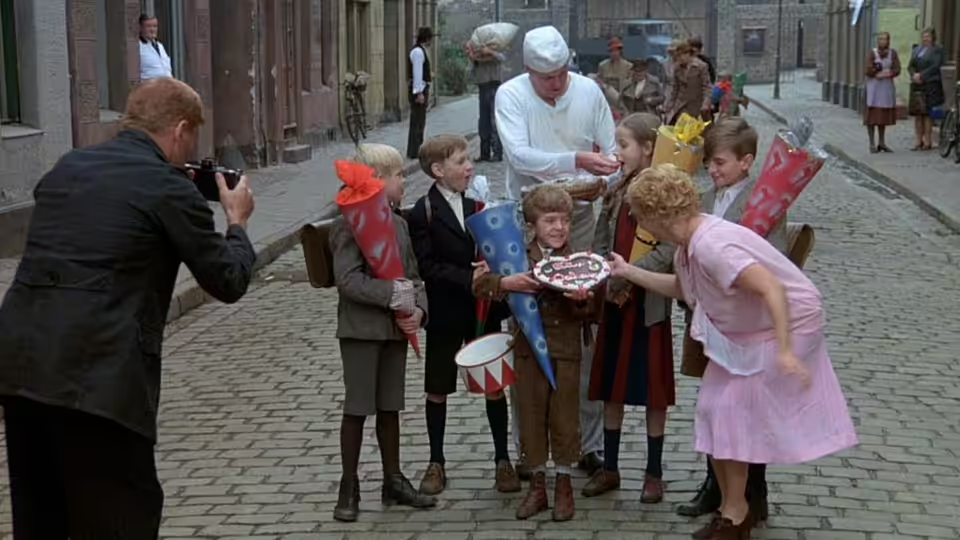
Igor Luther keeps the camera low, at Oskar’s eye level, so the grocer’s shop and the flat above it loom and grown-ups are mostly trouser legs and hands. Nikos Perakis has built a Danzig of browns and dirty creams: shop counters, a kitchen with the stove always going, a party rally on a field with the bunting hung slightly wrong. That rally is the scene people remember. Oskar crawls under the grandstand, sets up beneath the band and shifts the beat, and the brass march turns, bar by bar, into a waltz. The uniforms pair off. We laughed out loud, and then noticed the film had shown us the whole machinery of a Nazi parade and made it look silly without once telling us it was.
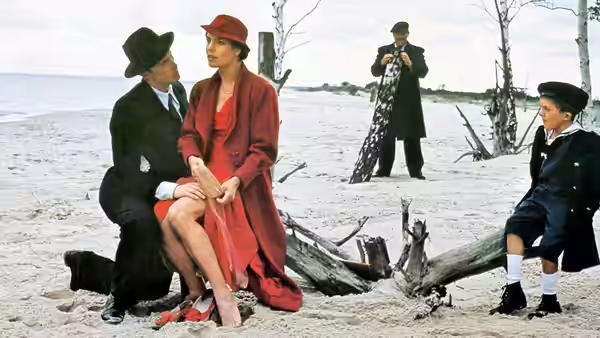
It can also horrify, and it did. On a grey beach Oskar’s family watches a fisherman haul a horse’s head from the sea and pull eels out of its mouth and ears. Suzanne Baron does not cut away. She holds while Angela Winkler’s Agnes retches and Oskar drums, and holds after, and we sat with a hand over our mouth. It is the ugliest thing in the film and no Nazi is responsible for it. That is the argument, if the film has one: the rot was there first.
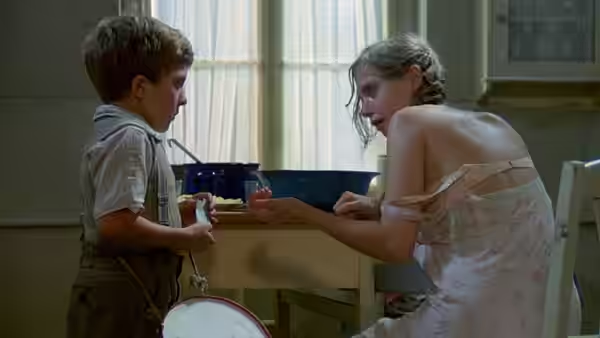
Around the boy, three adults share a life. Mario Adorf’s Alfred Matzerath is a Rhineland grocer, loud and decent enough, who joins the party because the shop is doing well and the uniform fits. Daniel Olbrychski’s Jan Bronski is Agnes’s cousin, a Pole at the Danzig post office, softer and more frightened. Winkler carries the sadness between them without a speech. Their card games at the kitchen table, knees touching under the cloth, are as good as anything here, and Schlöndorff lets the radio bring Hitler’s voice into the kitchen during one of them without anyone looking up. Maurice Jarre’s score stays out of these scenes almost entirely, which was the right call.
Then comes a turn we will not describe, and after it the film loses the thread. Grass wrote in Oskar’s voice, and without that voice the second half is a string of episodes: a travelling troupe of performers, a war going badly offstage, Katharina Thalbach arriving as Maria. Each scene is well made and none of them pulls the next one along. The Time Out reviewer thought the film simply could not match the novel’s scale, and for the last forty minutes we agreed. For the first two hours we did not.
It is not a film for children, whatever its lead looks like, and one scene between Oskar and Maria has been argued over for decades; you will know it when it comes. See it in a cinema if one will show it, because Luther’s darks turn to mud on a small screen. If not, turn the lights right down and do not eat anything with a head on it.