Benioff, Weiss and Woo have made Liu Cixin’s supposedly unfilmable novel into eight lucid, handsome episodes. The 1960s scenes and the game inside the headset are superb; the present-day scientists are thin, and they get most of the screen.
David Benioff, D. B. Weiss and Alexander Woo have taken Liu Cixin’s novel The Three-Body Problem and made eight episodes that someone who has never opened it can follow. That is the achievement, and it is a real one. They have moved the present-day story from China to Oxford and London and left the 1960s where Liu put them. What they have made is handsome, clear and often exciting. It also spends too much of its length with the characters it invented and too little with the ones it inherited.
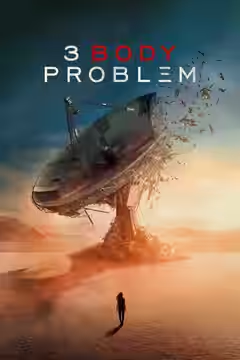
The opening minutes are the best in the series. China, in the 1960s: a physics professor is hauled on to a stage and beaten for refusing to give up the Big Bang, and his daughter Ye Wenjie watches from the stands. It shook us, and what shook us was how plainly it is staged: a chant from the crowd, no music to speak of, a girl who will not look away. At Red Coast, Deborah Riley’s production design gives us a great dish on a mountainside and rooms of green metal and cold light, and Rosalind Chao, playing Ye in later life, brings a stillness the rest of the series never matches.
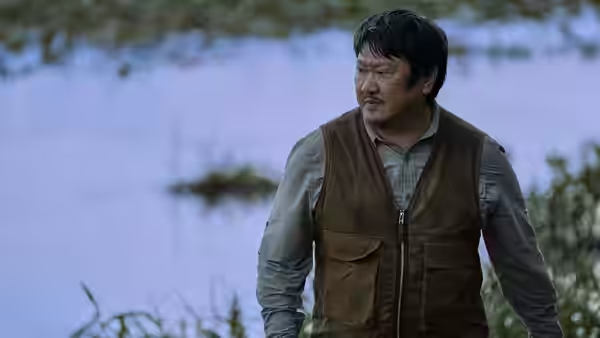
Then the story comes forward and cools. In London, scientists are dying and Detective Clarence ‘Da’ Shi (Benedict Wong) is asking why, for a spymaster called Thomas Wade (Liam Cunningham). Wong is the series’ great pleasure, rumpled, eating in his car, unimpressed by physicists, and Cunningham plays Wade as a man who has never once needed to raise his voice.
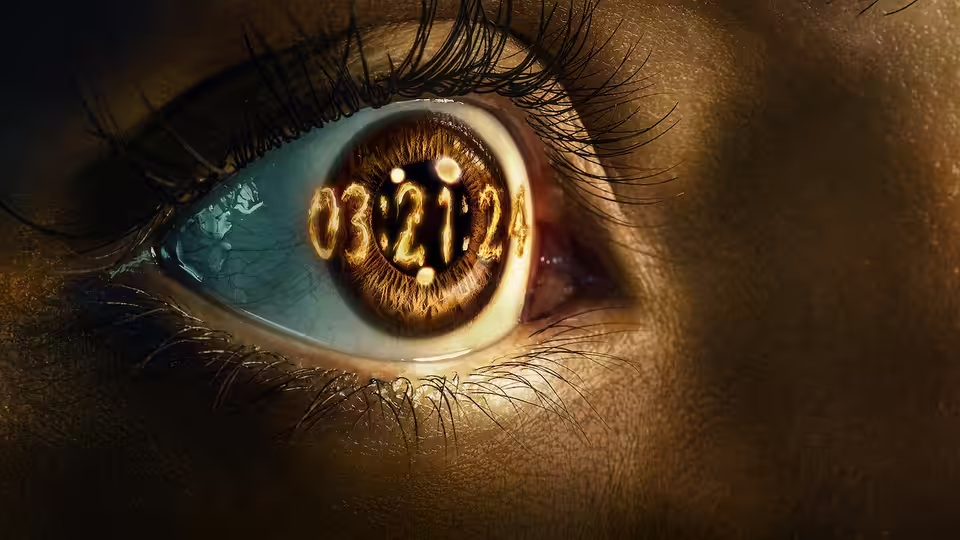
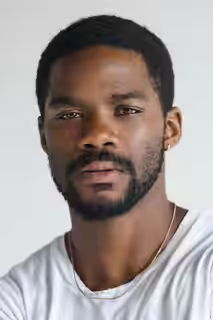
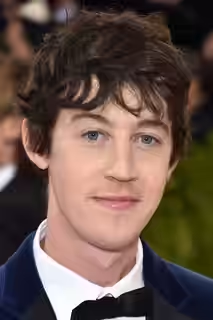
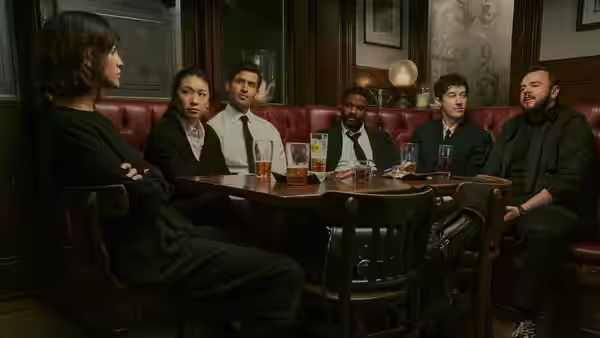
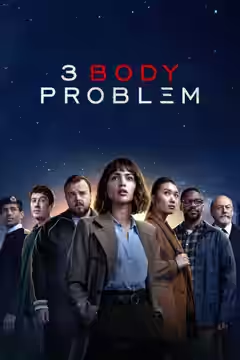
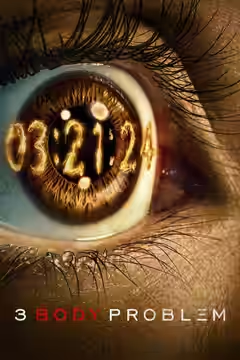
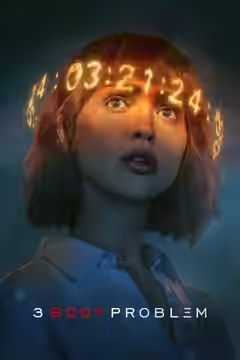
Instead it is about five friends who studied physics at Oxford. Jess Hong’s Jin Cheng, the theorist, is the best of them: the cleverest person in any room and not pleased about it. Eiza Gonzalez’s Auggie Salazar has the most frightening idea in the series, a countdown burning across her sight, and the script gives her little to do with it beyond drink and shout. Jovan Adepo’s Saul Durand drifts, and the series takes most of the run to decide what he is for. Alex Sharp’s Will Downing, a schoolteacher, has the one storyline that later moved us. They spend a great deal of time in a pub, and it was in the pub that we caught ourselves counting the episodes left.
The game inside the silver headset is where the series stops being expensive and becomes strange. A plain of cracked earth under two suns. A pendulum the height of a cathedral. An emperor’s court where the players must predict when the next sun will rise, and followers who dry out into sheets of leather to be rolled up and carried away. Sea Shimooka plays Sophon, the guide, with a courtesy that never warms. The four cinematographers, P.J. Dillon, Jonathan Freeman, Richard Donnelly and Martin Ahlgren, shoot these worlds in bleached whites and one furious orange, and Ramin Djawadi’s score is at its best here, a slow pulse that makes a sunrise feel like a threat. In London it swells over conversations that have not earned it.
The other trouble is explanation. Nobody in this series says a thing once. The stars blink, and then three people tell each other that the stars blinked. The science is real, a solar system with three suns in which no orbit can be predicted, and the writers, Rose Cartwright and Madhuri Shekar among them, plainly love it. Katie Weiland, Simon Smith, Anna Hauger and Michael Ruscio, the four editors, keep it moving; it is only that what moves is often a seminar.
Benioff and Weiss’s last big series made a mass audience care about a dozen strands at once. Here there are as many strands and far less to care about. Liu’s novel is cold on purpose; the series has tried to warm it and got it lukewarm. It also finishes as a prologue, with most of its promises still to keep.
Eight episodes, a 15 certificate, first shown on 21 March 2024. Watch the first two. If the struggle session and the countdown do not hold you, nothing later will change your mind. If they do, you will put up with the pub, and there is a good deal of pub.