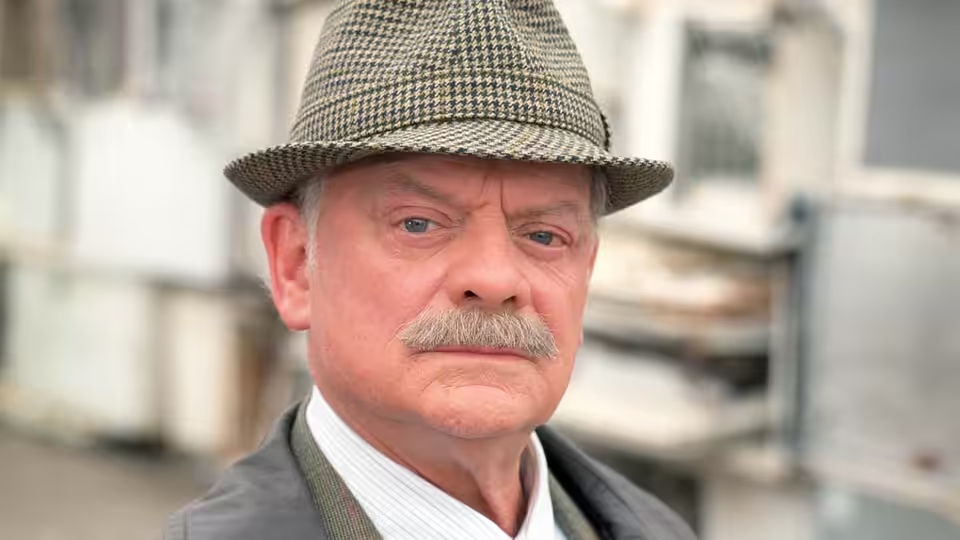
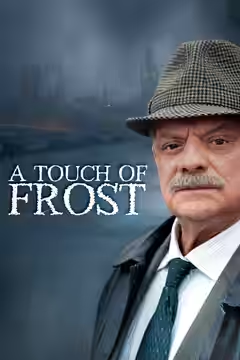
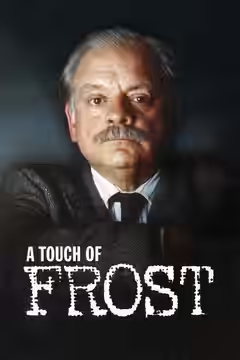
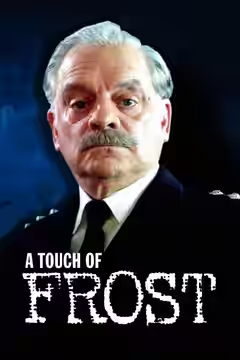
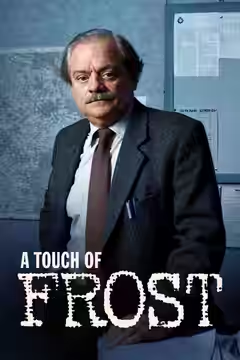
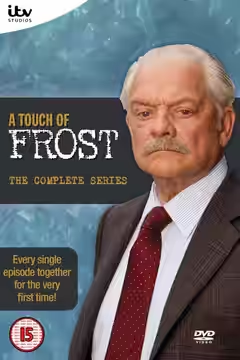
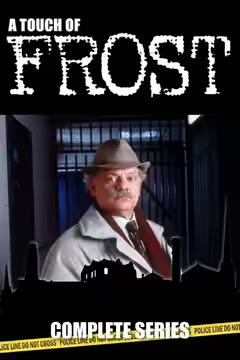
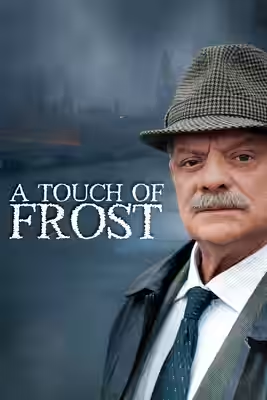
David Jason plays a grieving, insubordinate, badly dressed detective in a police drama that never looks like much and ran for eighteen years because of him. The cases are ordinary. The man working them is not, and that is enough.
David Jason was, when this began, best known as Del Boy in Only Fools and Horses, and the idea of him as a police detective sounded like a stunt. The first episode went out on 5 December 1992 and the fifteenth and last series in 2010, and somewhere in those eighteen years the stunt turned into one of the more durable things British television has made. Richard Harris and a long list of other writers adapted R. D. Wingfield’s novels about DI Jack Frost, a scruffy, chain-smoking detective who solves cases mostly by being too tired to go home. Jason is the reason it lasted, and he is the reason to watch it now.
The first episode puts Frost’s wife in a hospital bed and sends him out to find a missing child, and it is in the gap between those two things that Jason makes the character. He goes from the ward to the incident room and back without changing his face. There is no speech about grief and no music telling us how to feel. We expected a sitcom star doing a serious turn and got something quieter and more painful: a man who is better at other people’s trouble than his own, and knows it. It moved us more than a police procedural has any business doing.
Around him the series builds the station it will live in for the rest of the run. Bruce Alexander’s Superintendent Norman Mullett is the boss every copper has had, a man more worried about the chief constable’s dinner than the body on the slab, and the two of them keep up a running argument about paperwork that is the most reliable comedy in the thing. We laughed every time Mullett straightened his tie. John Lyons’s DS George Toolan gets the jokes a beat late and does the legwork. Paul Moriarty’s Sgt Wells minds the desk, and David McKail’s Dr David McKenzie turns up at the bodies. None of them is given much to do, and all of them play it as if they were.
It never looks like much, and that is a decision rather than an accident. Peter Jackson, the cinematographer, and not the New Zealander, shoots the town in flat grey weather, car parks and corridors and front rooms, and does not light Jason to look like a star. David Aspinall cuts at walking pace, which suits a detective who gets there by asking the same question three times. Sixteen directors are credited across the run, Don Leaver and David Reynolds among them, both of whom also produced, and you cannot tell their episodes apart.
The cases are the weakness. The scripts run two or three strands at once, so an episode will have a missing child, a burglary and a body, and the strands come together with a tidiness that wears thinner the longer you watch. Later series shrink to one or two episodes apiece, and the mysteries shrink with them. The guest parts are often the liveliest thing on screen, and the run is a roll-call of faces who went on elsewhere: Danny Dyer turns up as a lad called Shaun Everett, Jake Wood as a private soldier, Derren Litten as a constable. Spot them and feel old.
Against Inspector Morse, which had the better scenery, Frost looks cheap, and it is. It is also warmer. Morse was a man you admired from across a quad; Frost is one you would lend a tenner to and not expect back. Jason never cleans him up, never lets him win an argument with Mullett he should lose, and never asks us to find the mess charming. We do anyway, which is the trick.
It is a 15 certificate. Take it one episode at a time; three in a row and the raincoat starts to smell.