Paxton carries Ben through a school hallway lined with lockers
Series review

Never Have I Ever

2020 · Created by Mindy Kaling, Lang Fisher · Series · NMHH 16

In a sentenceA girl shouts at her mother across a kitchen counter while John McEnroe commentates; somehow this works

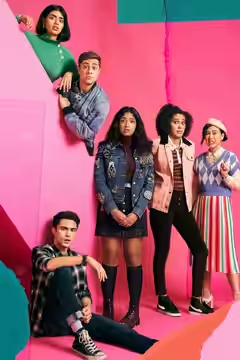
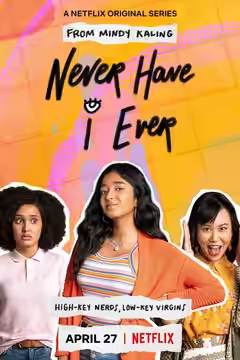
Devi Vishwakumar (Maitreyi Ramakrishnan) starts a new school year with a plan. This year she intends to be cool and to have a boyfriend. Her candidate is Paxton Hall-Yoshida (Darren Barnet), the swimmer nobody like her is meant to speak to. In her way stand Ben Gross (Jaren Lewison), her rival for top of every class; her friends Fabiola Torres (Lee Rodriguez) and Eleanor Wong (Ramona Young), who have troubles of their own; her mother, Dr. Nalini Vishwakumar (Poorna Jagannathan), a doctor with rules; and her cousin Kamala (Richa Moorjani), who has moved in and is better at everything. John McEnroe narrates, for reasons the first episode explains.

Plays from YouTube when you press play; nothing loads from them until then.

Fi1m review

Mindy Kaling and Lang Fisher’s high-school comedy is loud, quick and warmer than it first lets on. The jokes are fine. The mother and daughter arguing in the kitchen are the reason to keep going, across all four seasons.

Never Have I Ever is an American high-school comedy of a familiar shape: a clever girl wants the handsome boy, her friends have subplots, a rival turns out to be more than a rival. Mindy Kaling and Lang Fisher have put an Indian-American family in the middle of that shape and grief underneath it, and the result, over four seasons of ten episodes between 2020 and 2023, is a good series that is at its best when it stays at home. The school is where the jokes are. The house is where the show is.

Maitreyi Ramakrishnan plays Devi as rude, greedy for attention and quick to anger, and the writers never sand her down into somebody easier to like. She lies to her friends, shouts at her mother and asks a boy she has barely met to sleep with her, and Ramakrishnan makes all of it read as grief looking for somewhere to go. It is a proper lead performance. The narration by John McEnroe is the gamble, and the first episode gives its reason, which we will leave it to give. A man famous for losing his temper on a tennis court describing a girl who cannot keep hers is a better joke than it sounds, and it settles into something almost tender. When the series hands the microphone to a guest narrator for an episode, as it does in the second season, the trick shows its workings and we missed him.

Poorna Jagannathan is the reason we kept watching. She plays Nalini as a woman holding a household together by refusing to sit down. Her arguments with Devi in the kitchen are the sharpest writing the show has; both of them are right and both of them are cruel and nobody apologises properly. We had settled in for a sitcom, and the grief the first episode carries underneath the jokes caught us off guard. We were not ready to be upset by this show, and we were, and it happened again whenever those two were alone in a room. Richa Moorjani’s Kamala, the beautiful cousin who has moved in, gives the house a third woman to argue about what a good daughter is.

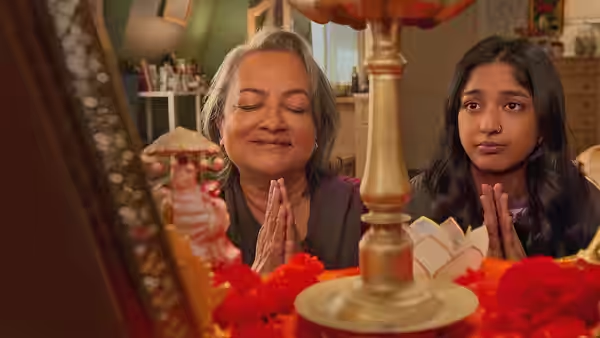
Rhet Bear shoots the suburb in flat, bright sunshine, so that even the sad scenes happen under a blue sky, and the school corridors are lit like an advertisement. Kathleen Widomski’s Vishwakumar house is the better set: a prayer room with a garland on a photograph, a kitchen with too many things on the counter, a bedroom that a teenager and her mother have plainly fought over. Salvador Pérez Jr. and Glinda Suarez dress Devi in loud prints that are trying slightly too hard and Paxton in the same plain shirts, which tells you who is comfortable. Joseph Stephens’s music does little and is not asked to; the pop songs carry the montages.

What does not hold is the triangle. Darren Barnet plays Paxton as a boy who has noticed that being handsome is not a plan, and he is better than the part needs him to be. Jaren Lewison’s Ben is a rich, lonely, needling boy who grows on us as he grows on Devi. But by the third season the back-and-forth between them has run out of road, and the series starts telling us Devi has changed, in narration and in therapy scenes, rather than showing her do anything differently. An early storyline about disability is played for a laugh the show has not earned, and it is the one thing most critics who liked the series also picked at. Lee Rodriguez and Ramona Young are good company, though their storylines are switched on and off as the episode count requires.

Most teen comedies of this kind are about the school. This one is about a family that happens to contain a teenager, and it is a better series every time it remembers that. It carries a 12 certificate and it is brisk; each season can be seen in a few evenings, and the fourth ends the thing properly, which is rarer than it should be. Watch it with someone who has a mother.


Critical consensus AI synthesised

71
Positive
7
Mixed
1
Negative
2

Most critics warm to Never Have I Ever, and seven of the ten reviews are positive. The praise gathers around Maitreyi Ramakrishnan, whose lead performance is called charismatic and vulnerable, and around the show’s portrayal of an Indian-American family, with the mother-daughter relationship and the handling of Devi’s grief singled out repeatedly. Several reviewers say it takes familiar teen-comedy conventions and makes them feel fresh, and the second season is generally thought as good as or better than the first.

The reservations are more scattered. Some find the early episodes overpacked and awkward. The narration divides opinion: Variety calls the McEnroe and Hadid voiceovers flat and unnecessary, while NME finds McEnroe charming. The two negative reviews, from Digital Spy and Paste, both cover the third season and say the romances lose their tension and Devi’s growth is told rather than shown. The AV Club, reviewing the final season, thinks it ends well. The spread is wide.

Vulture
23 April 2020 · Kathryn VanArendonk
90*

The critic finds the series a fantastic, welcome teen rom-com, with one early plot point as a distracting misstep. She especially praises Devi’s complexity and the show’s deft, nuanced portrayal of her Indian-American identity.

Read the full review →
The AV Club
8 June 2023 · B+ · Saloni Gajjar
83

Gajjar finds the final season joyful and charming, bringing the series to a fitting close. She especially praises its nuanced, multigenerational portrayal of South Asian family life, while criticizing Jeff Garlin’s stiff performance.

Read the full review →
IndieWire
17 April 2020 · B · Kristen Lopez
77

Lopez finds the series an awkward but emotionally resonant comedy that becomes magical once it finds its stride. She particularly praises Maitreyi Ramakrishnan’s charismatic performance, while criticizing the show’s handling of disability as a gimmick.

Read the full review →
The Hollywood Reporter
21 April 2020 · Inkoo Kang
70*

Kang finds the series smart, moving and nuanced, though its early episodes feel exhausting and overpacked. She praises the emotional depth of Devi’s grief and the slow-building romantic relationships.

Read the full review →
Variety
20 July 2021 · Caroline Framke
65*

Framke finds the series an entertaining teen comedy, though its voiceovers are a frustrating flaw. She particularly faults McEnroe and Hadid for flat, unnecessary narration that undercuts the stronger performances of the young cast.

Read the full review →
Collider
15 July 2021 · A- · Carly Lane
90

Lane finds the second season just about as excellent as the first, balancing heartfelt emotion with humor. She especially praises Maitreyi Ramakrishnan’s vulnerable performance and the thoughtful exploration of grief.

Read the full review →

Straight answers AI written, from our review

Is Never Have I Ever worth watching?
Never Have I Ever is worth watching for anyone who likes a high-school comedy with a family underneath it, and we scored it 74. The jokes at school are fine; the arguments between Devi and her mother in the kitchen are the reason to keep going. Four short seasons, and the last one ends the story properly.
How long is Never Have I Ever, and what is it rated?
Never Have I Ever is rated 16 by the NMHH in Hungary. It is a comedy and drama series.
Where can I watch Never Have I Ever in Hungary?
Never Have I Ever is streaming on Netflix in Hungary. Availability is checked daily; the links above go straight to each service.
How violent or frightening is Never Have I Ever, and is it suitable for children?
Never Have I Ever carries a 12 certificate in the UK and contains no violence to speak of; its subjects are a teenager's grief, temper and sex life, discussed frankly but not shown. Younger children will find little in it for them, and one early storyline about disability is played for a laugh the show has not earned. Teenagers and their parents are the audience.
How does Never Have I Ever compare to Derry Girls?
Never Have I Ever and Derry Girls are both comedies about a loud girl and an exhausted mother, but the American series is warmer and sadder, with a death under its jokes, while the Irish one is faster and ruder and has the Troubles in the background. Derry Girls is the funnier and better acted of the two; Never Have I Ever has the stronger family drama and runs out of road sooner in its romance.
What should I watch after Never Have I Ever?
After Never Have I Ever, try Derry Girls (2018, Fi1m 83): Another loud girl, another exhausted mother, and a town with worse problems than school. Then Lady Bird (2017, Fi1m 86): The mother-daughter arguments here are the ones Kaling and Fisher are reaching for; and Freaks and Geeks (1999, Fi1m 88): One season, no gloss, and the best American school series ever cancelled.

Cast

If you liked this, try…

  1. Derry Girls (2018, Fi1m 83)Another loud girl, another exhausted mother, and a town with worse problems than school.

  2. Lady Bird (2017, Fi1m 86)The mother-daughter arguments here are the ones Kaling and Fisher are reaching for.

  3. Bend It Like Beckham (2002) · not on Fi1m yetA British Indian girl wants something her family cannot see the point of.

  4. Freaks and Geeks (1999, Fi1m 88)One season, no gloss, and the best American school series ever cancelled.

  5. PEN15 (2019, Fi1m 80)Thirteen is far worse than fifteen, and this shows it without mercy.