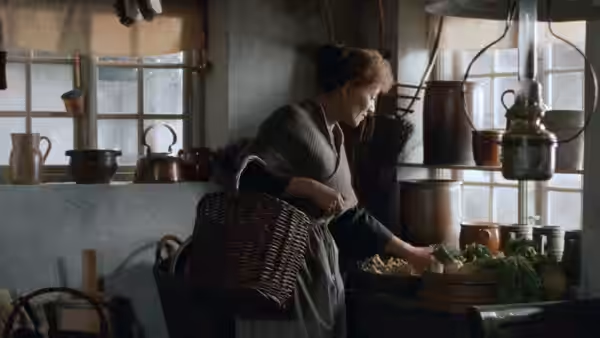
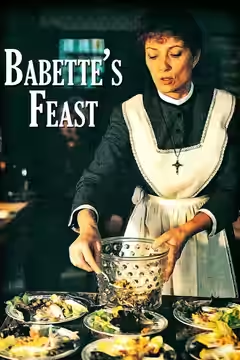
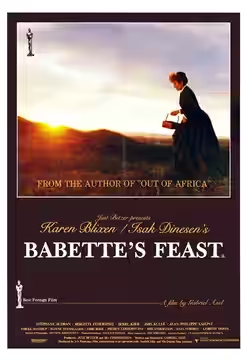
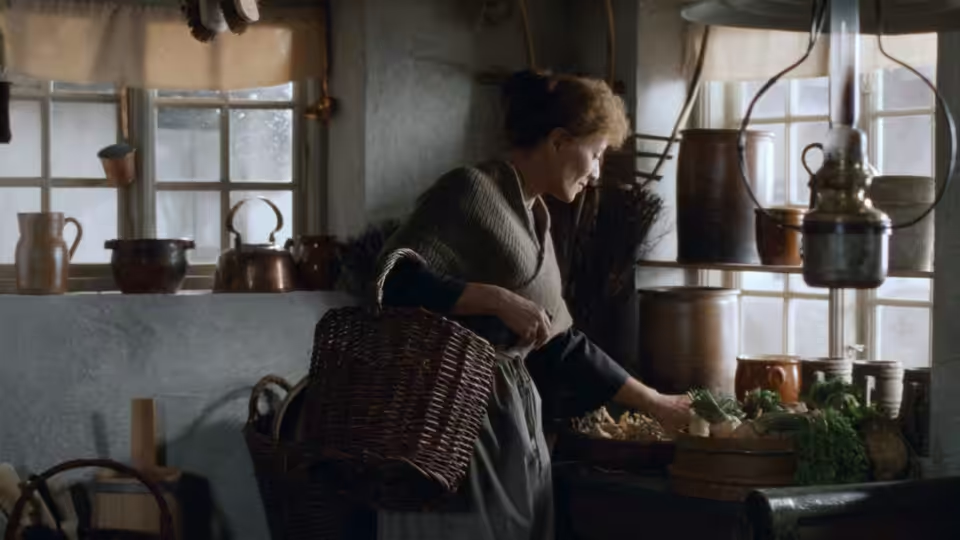
Babette (Stéphane Audran) gathers ingredients in the kitchen beside pots and baskets
Film review

Babette's Feast

1987 · Directed by Gabriel Axel · 1h 44m

In a sentenceFourteen years of split cod and ale-bread in grey Jutland, and then a live turtle arrives by boat

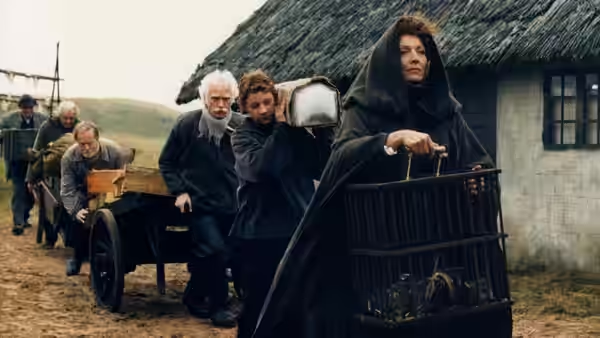
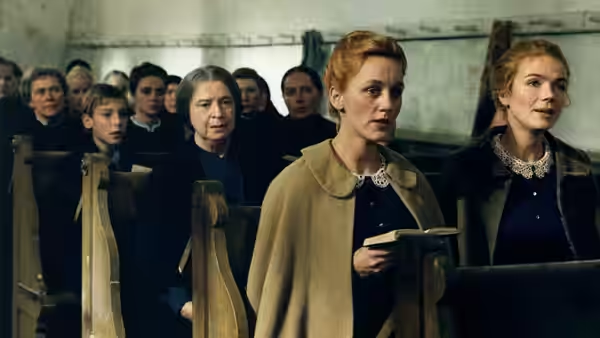
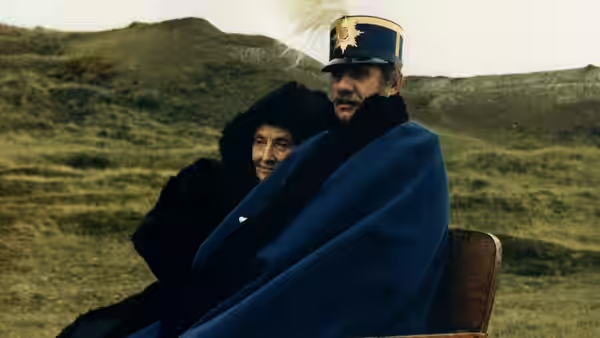
On the west coast of Jutland in the nineteenth century, two elderly sisters, Martine (Birgitte Federspiel) and Filippa (Bodil Kjer), keep house in the fishing village where their late father founded a small, austere Lutheran sect. In their youth (Vibeke Hastrup and Hanne Stensgaard) each had a suitor: Martine a young cavalry officer, Lorens Löwenhielm (Gudmar Wivesson), staying with an aunt nearby; Filippa a Paris opera singer, Achille Papin (Jean-Philippe Lafont), who hears her sing in church and offers to make her famous. Both men leave. Then one night in 1871 a Frenchwoman, Babette (Stéphane Audran), arrives at their door in the rain with a letter from Papin. She has fled Paris and asks for shelter. The sisters cannot pay her, so she cooks and cleans for nothing and learns to make split cod and ale-bread soup.

Plays from YouTube when you press play; nothing loads from them until then.

Fi1m review

Gabriel Axel’s film of Karen Blixen’s story about a French cook in a pious Danish village is patient, dry and finally overwhelming. The first half leans on narration; the dinner, when it comes, is as good a stretch about eating as we have seen.

Babette’s Feast is about people who have made a religion of going without, and a woman who decides, once, to give them everything. Gabriel Axel adapted Karen Blixen’s story with Annemarie Aaes, and he keeps its shape: a long, plain account of a village on the Danish coast, and then a dinner. It is a fine film and we recommend it warmly, with the caveat that it does not hurry. For its first forty minutes it is content to tell you things.

Most of that telling is done by Ghita Nørby’s narration, and there is more of it than the pictures need. We are told that the pastor’s daughters are beautiful and that the village men look at them in church; Henning Kristiansen’s camera has already shown us both. The two suitors are dispatched briskly. Gudmar Wivesson’s young Lorens Löwenhielm sits at the pastor’s table, cannot get a word out, and rides away. Jean-Philippe Lafont’s Achille Papin hears Hanne Stensgaard’s Filippa sing a hymn, sees the Paris Opera in front of him, and is sent away just as quietly. Finn Henriksen cuts these flashbacks cleanly, but the young versions of the sisters are pretty and a little blank, and we were glad when the film came back to the old ones.

Then Babette arrives, and the film finds its footing. Stéphane Audran says almost nothing for an hour. She learns to make split cod and ale-bread soup by watching the sisters make it, haggles with the fishmonger in Danish she has picked up, and walks the dunes alone. Axel lets fourteen years go past in a few minutes of this, and Audran carries them without a line of dialogue we can remember. The performance is in how she holds a basket and how she looks at a pot.

Kristiansen shoots the village in grey and straw colour: slate sea, thatched roofs, dunes, and interiors that Sven Wichmann has kept to whitewashed walls, low beams and brown wood. The costumes, credited to Annelise Hauberg, Pia Myrdal and Karl Lagerfeld, are black and grey with white collars, so that the whole congregation looks like one garment. Per Nørgård’s score is hardly there. The music you remember is the hymns, sung slightly out of tune by a dozen old voices, and that is the right call; this is a place where the only art anyone permits themselves is a psalm.

The dinner takes up the last third, and it is why the film has lasted. The ingredients come in by boat first: a live turtle in a crate, cages of quail, cases of wine, a block of ice. Birgitte Federspiel’s Martine takes one look at the turtle and goes to warn the congregation, and their response is one of the film’s best jokes. Then Henriksen and Kristiansen change everything. The light goes to candle-gold, the cutting goes pot, plate, face, pot, plate, face, and the consensus slowly warms. What moved us, more than we expected, was not the turtle soup or the quails in pastry but a row of elderly faces trying hard not to enjoy themselves and failing, one by one. We will not describe what happens around the table. We will say that Jarl Kulle’s general, the one guest who knows what he is eating, is given the film’s only real speech and earns every word of it.

The film is gentle, and some viewers will find it too gentle. The villagers’ feuds are settled a shade too neatly, and beyond the sisters and the general the congregation is a set of types: the two who once wronged each other, the old woman who talks. There is no cruelty in it anywhere. Against other films about food, though, it wins on the thing that matters. It is about the people eating, not the person cooking, and it understands that a meal is something done to you as much as for you.

It runs 104 minutes and holds a U certificate. Eat first, or watch it hungry and discover what fourteen years of ale-bread soup does to a person.

Critical consensus AI synthesised

82
Positive
8
Mixed
2
Negative
0

Most critics warm to Babette’s Feast, and the reviews are strikingly steady across the twenty-five years they span. The praise gathers around the same table: the banquet itself, which several reviewers describe as sumptuous and regenerative, and the way Axel lets it become a quiet reckoning for villagers who have spent their lives refusing pleasure. Audran’s performance draws particular admiration, as do the restraint of the storytelling and the film’s handling of exile, self-sacrifice and thwarted love. More than one critic insists it is a parable rather than middlebrow comfort.

The reservations are few and mild. Time Out finds the film cosy and appetising but slightly complacent, pitched at less adventurous viewers, and that is the nearest thing to a dissent. Nobody argues the film is bad; the spread runs from admiring to rapturous, and the gap is mostly a matter of how much weight a gentle drama can be asked to carry.

Radio Times
★★★★★ · Robyn Karney
100

Karney says the film deserved its Oscar and reached audiences beyond the limits of subtitles. She praises its ability to capture the imagination of cinema-goers everywhere.

Read the full review →
Los Angeles Times
25 March 1988 · SHEILA BENSON
90*

Benson gives the film an enthusiastic, deeply appreciative verdict, presenting it as a tribute to artistic expression. She especially praises Axel’s delicate storytelling and the sumptuous staging of the feast.

Read the full review →
Sight and Sound
90*

The critic finds the film serenely joyous, poignant and funny. They especially praise Audran’s performance and the lavish banquet’s mouthwatering, regenerative effect.

Read the full review →
Empire
21 November 2012 · David Parkinson
85*

Parkinson gives the film a warmly positive verdict, calling it sensual and intoxicating. He singles out its impeccable production and performances for praise.

Read the full review →
The Independent
13 December 2012 · Anthony Quinn
85*

Quinn finds the film’s gentle drama still enchanting and says it is especially strong on exile, self-sacrifice and thwarted love. He also praises its evocative depiction of food, particularly the feast.

Read the full review →
Slant Magazine
22 July 2013 · ★★★★ · Bill Weber
80

Weber regards the film as a sublime, transporting parable rather than sentimental middlebrow fare. He praises the climactic dinner sequence for making Babette’s artistry a source of grace and emotional clarity.

Read the full review →

Straight answers AI written, from our review

Is Babette's Feast worth watching?
Babette's Feast is worth watching for anyone who can sit through forty patient minutes of narration to reach one of the best dinner scenes on film, and we scored it 86. Gabriel Axel's account of a French cook in a pious Danish village does not hurry, and the young flashbacks are a little blank. The last third repays the wait, and we were moved more than we expected.
How long is Babette's Feast, and what is it rated?
Babette's Feast runs 1h 44m. It is a drama and history film.
Where can I watch Babette's Feast in Azerbaijan?
Babette's Feast is not on any streaming or rental service in Azerbaijan at the moment. It is available in 13 other countries; change your country at the top of the page to see where. Availability is checked daily.
How does Babette's Feast compare to Tampopo?
Babette's Feast is the quieter and tighter of the two films, while Tampopo is the funnier and the looser. Axel's film is about the people eating, watching a row of elderly faces slowly give in to pleasure; Itami's is about learning to cook, and it laughs far more often. Choose Babette's Feast for restraint and a slow reward, Tampopo for a happier evening.
Is Babette's Feast based on a true story or a book?
Babette's Feast is fiction, adapted from a story by Karen Blixen, not a true story. Gabriel Axel and Annemarie Aaes keep the shape of Blixen's telling: a long, plain account of a village on the Danish coast, and then a dinner. You do not need to have read Blixen to follow the film, which does its own telling, and then some, through narration.
What should I watch after Babette's Feast?
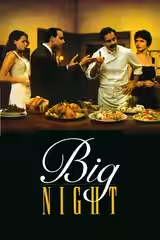
After Babette's Feast, try Tampopo (1985, Fi1m 84): A Tokyo noodle western that takes eating exactly as seriously as Babette does, and laughs more. Then Big Night (1996, Fi1m 84): Two brothers, one restaurant, one dinner that has to save everything; and Ordet (1955, Fi1m 86): Dreyer’s Jutland village of stern believers, thirty years earlier and far less forgiving.

Cast

Awards

Academy Awards, 1988

Won
Best International Feature Film

International Submission to the Academy Awards, 1988

Nominated
International Submission to the Academy Awards

If you liked this, try…

  1. Tampopo (1985, Fi1m 84)A Tokyo noodle western that takes eating exactly as seriously as Babette does, and laughs more.

  2. Eat Drink Man Woman (1994) · not on Fi1m yetAng Lee’s Taipei chef feeds three daughters who cannot say what they want.

  3. Big Night (1996, Fi1m 84)Two brothers, one restaurant, one dinner that has to save everything.

  4. Ordet (1955, Fi1m 86)Dreyer’s Jutland village of stern believers, thirty years earlier and far less forgiving.

  5. The Taste of Things (2023, Fi1m 82)Binoche cooks, Magimel eats, and the camera stays in the kitchen for two hours.