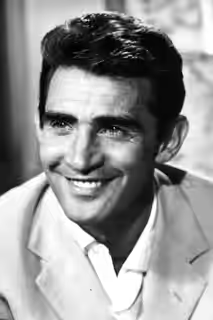
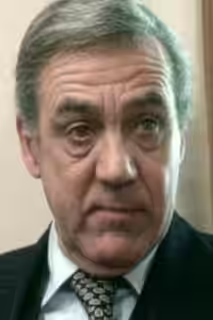
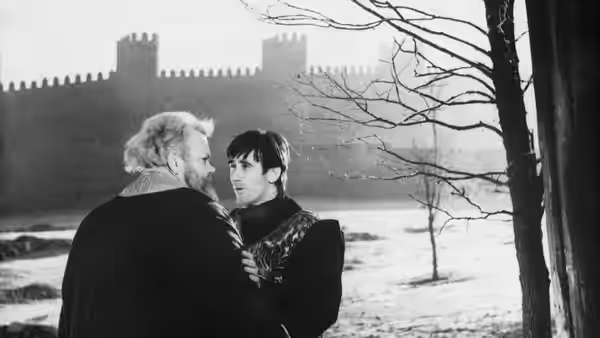
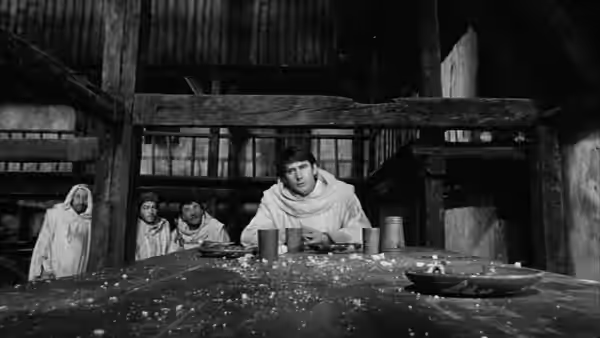
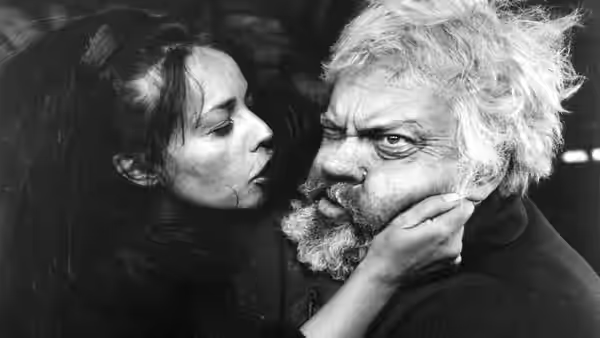
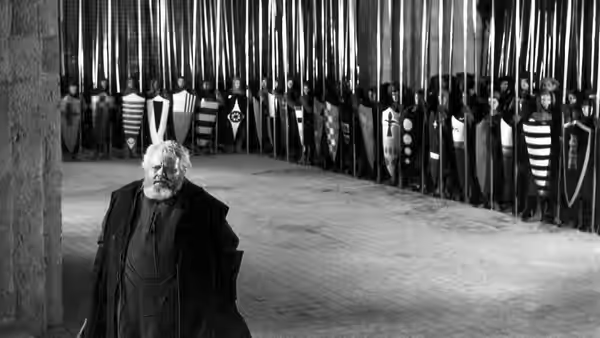
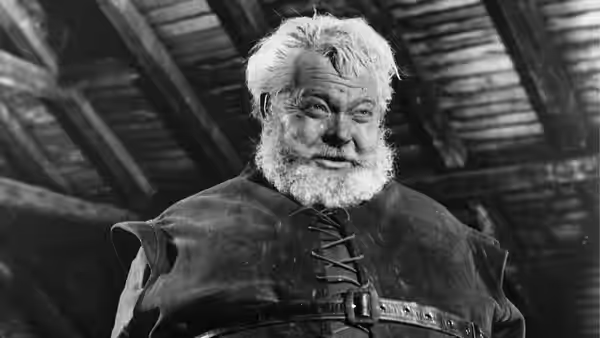
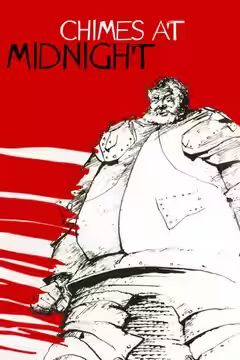
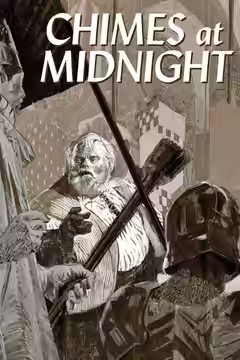
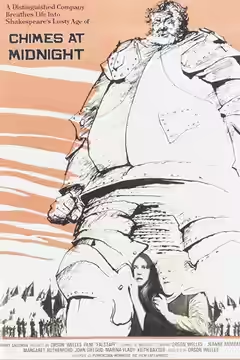
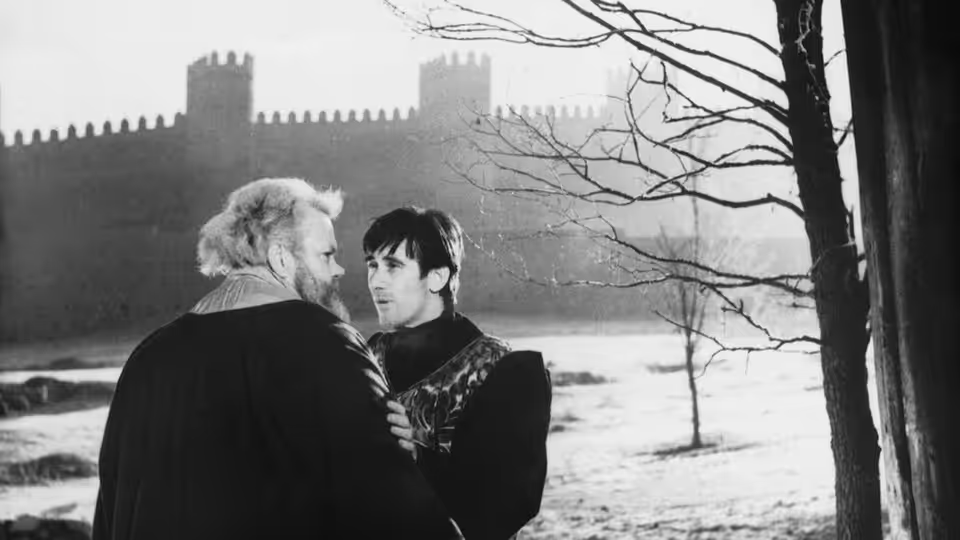
Falstaff (Orson Welles) and Prince Hal (Keith Baxter) face each other in a snowy castle courtyard
Film review

Chimes at Midnight

1965 · Directed by Orson Welles · 1h 55m

In a sentenceWelles gives himself the best part in Shakespeare and for once nobody can accuse him of hogging it

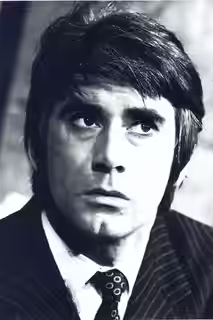
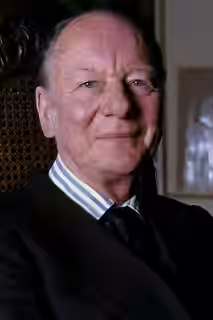
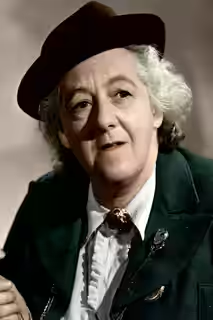
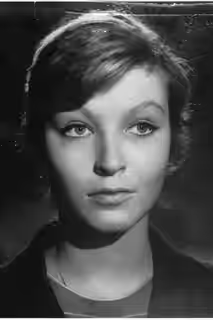
England, early in the fifteenth century. Henry IV (John Gielgud) has taken the crown from Richard II and holds it uneasily, with the Percy family rising against him in the north under the hot-headed Hotspur (Norman Rodway). His heir, Prince Hal (Keith Baxter), spends his nights in a London tavern with Sir John Falstaff (Orson Welles), a fat, broke, elderly knight who drinks on credit and lies for pleasure. Mistress Quickly (Margaret Rutherford) runs the house, Doll Tearsheet (Jeanne Moreau) works in it, and Ned Poins (Tony Beckley) helps Hal rob Falstaff after Falstaff has robbed some travellers on the road. The king summons his son to court. Hal knows he will have to choose between the two old men, and so does Falstaff.

Fi1m review

Welles cuts five plays down to one story about a prince with two fathers, and plays the fat one himself. The sound is rough and the money ran short, but the battle in the mud and the faces in the tavern are as good as anything he made.

Orson Welles takes the two parts of Henry IV, borrows scraps from Richard II, Henry V and The Merry Wives of Windsor, and cuts the lot to 115 minutes about one thing: a young man deciding which of two old men to belong to. Welles wrote the screenplay, directed it, designed the costumes and plays Falstaff. It was made in 1965 and did not reach British cinemas until 23 March 1967, which tells you something about how it was received at the time. We think it is the finest film of his later years. It is also a mess in ways you can hear, and we will come to those.

The film opens in snow, with Falstaff and Justice Shallow (Alan Webb) tottering towards a fire and remembering that they have heard the chimes at midnight. That line is usually buried in the second play. Welles puts it first, so that everything that follows is already a memory. Edmond Richard shoots the tavern from the floor, with a wide lens, so the beams press down and Welles fills the frame like furniture. The court is the opposite: bare stone, a high chair, light falling in shafts from windows we never see. Nothing has been built that did not need to be.

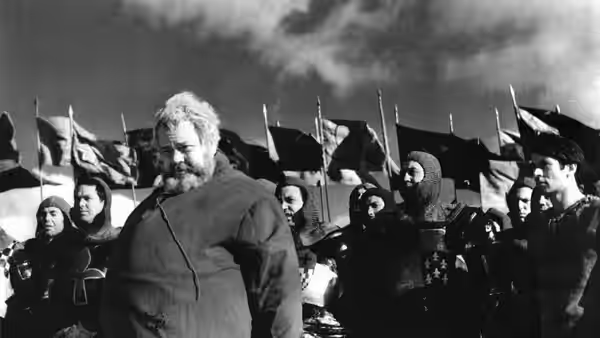
The Battle of Shrewsbury is the reason the film is still talked about. It starts almost as comedy, with knights winched onto their horses by pulley, and it ends with men in armour lying in slurry, stabbing at whatever is nearest. Elena Jaumandreu and Frederick Muller cut it into shots too short to tell one side from the other, and Angelo Francesco Lavagnino’s drums and brass drop away until there is mostly grunting and metal. We were horrified, and we had gone in expecting to be. What did it was the mud: it gets into the lens, onto the faces, and by the end nobody on screen looks like a person who could have a name.

Welles’s Falstaff is quieter than you expect. The lies, the belly and the roar are all there, but the eyes keep going to Hal, checking. In the scene where the two of them play at being king and prince for the tavern, Hal, still in the game, tells him that he will be banished, and Welles simply stops. It is a face waiting to be told it was a joke. Keith Baxter plays Hal as a man who, most critics think, has already half left the play and is ashamed of how easy he finds it. John Gielgud speaks the king’s verse as if reading his own accounts, cold, exact and frightened, and he is the best thing in the film after the battle. Margaret Rutherford is warm and slightly baffled as Quickly, and Norman Rodway’s Hotspur is played for laughs in the bath and then not.

Now the trouble. The dialogue was recorded afterwards, and lips and voices part company often enough that we stopped noticing and then noticed again. Several of the smaller parts speak in a voice that sounds suspiciously like the director’s. Jeanne Moreau is billed fourth and has perhaps four minutes; Marina Vlady’s Kate Percy has fewer. Scenes end a beat early, as though the money did. Shot in Spain on little of it, the film wears its poverty in the court scenes, which are a chair and a shaft of light and a great actor doing the rest.

Set against Welles’s other Shakespeare, this is far ahead of his Macbeth and his Othello, both of which are all mood and mist. Here the mood serves the people. The ending is where the plays end, and we will not describe it, except to say that Welles has built the whole film so that you watch it coming and cannot look away.

Watch it with the subtitles on and the volume up. The verse fights the soundtrack all the way through, and the verse should be allowed to win.
Critical consensus AI synthesised

84
Positive
9
Mixed
1
Negative
0

Most critics regard Chimes at Midnight as one of Welles’s major works, and the praise gathers in two places. The first is his own Falstaff, described as mercurial and moving, with several reviews noting the lonely pride and fear beneath the swagger. The second is the Battle of Shrewsbury, singled out again and again for its staging, its rhythmic editing and its refusal to make violence look handsome. Gielgud’s performance draws mention, as does the poignancy of Falstaff’s treatment by Hal, and more than one review credits Welles with making a great deal from a small budget.

The reservations are mild and remarkably consistent: distracting flaws, an unfinished feel, an occasional lack of coherence. Nobody lets these lower the verdict beyond a shrug. The spread is narrow, and the only mixed notice is also the earliest, from Variety in 1965, which admires the performance more than the film around it. The warmest reviews arrive with the 2016 restoration.

Slant Magazine
29 August 2016 · ★★★★★ · Chuck Bowen
100

Bowen presents the restoration as a revelatory release and calls the film Welles’s ultimate masterpiece. He especially praises the Battle of Shrewsbury for its inventive staging and unglamorous portrayal of violence.

Read the full review →
The New Yorker
8 January 2016 · Richard Brody
95*

Brody celebrates the film as a major work by Welles and a landmark in cinema. He singles out Welles’s performance and the play-acting scene’s piercing self-recognition for particular praise.

Read the full review →
Los Angeles Times
1 January 2016 · Kenneth Turan
90*

Turan presents the film as a major, deeply affecting achievement, rich in melancholy and humor. He especially praises John Gielgud’s performance and the battle scenes’ imagery and rhythmic editing.

Read the full review →
Empire
30 March 2006 · David Parkinson
85*

Parkinson calls the film a melancholic masterpiece despite some distracting flaws. He especially praises Welles’s performance and the Battle of Shrewsbury sequence.

Read the full review →
The Independent
30 April 2015 · Geoffrey Macnab
85*

The review is strongly positive, calling the film a moving and rewarding work. It singles out Welles’s performance as Falstaff and the poignancy of Falstaff’s rejection by Hal.

Read the full review →
The Guardian
28 June 2015 · Philip French
80*

French calls the film a rich, elegiac masterpiece despite its flaws and unfinished feel. He especially praises Welles’s editing of the Battle of Shrewsbury and his mercurial performance as Falstaff.

Read the full review →

Straight answers AI written, from our review

Is Chimes at Midnight worth watching?
Chimes at Midnight is worth watching for anyone who can take Shakespeare with the sound slightly out of step, and we scored it 88. Orson Welles plays Falstaff as a quieter, more watchful man than usual, and the battle in the mud is as good as anything he made. Keep the subtitles on; the verse and the soundtrack fight all the way through.
How long is Chimes at Midnight, and what is it rated?
Chimes at Midnight runs 1h 55m. It is a comedy and drama film.
Where can I watch Chimes at Midnight in Azerbaijan?
Chimes at Midnight is not on any streaming or rental service in Azerbaijan at the moment. It is available in 3 other countries; change your country at the top of the page to see where. Availability is checked daily.
How violent or frightening is Chimes at Midnight, and is it suitable for children?
Chimes at Midnight carries a UK PG certificate, and the only hard stretch is the Battle of Shrewsbury, where knights in armour lie in slurry stabbing at whatever is nearest. It is grim rather than gory, with no blood to speak of, but it horrified us. Older children who can follow Shakespeare will be fine; younger ones will be bored long before the fighting starts.
How does Chimes at Midnight compare to My Own Private Idaho?
Chimes at Midnight is the better film and the tighter one, cutting five Shakespeare plays into a single story about a prince choosing between two fathers. My Own Private Idaho moves the Falstaff story to Portland street hustlers and keeps the ache, but its Shakespearean passages can feel laboured. Watch Welles for the plays and the battle; watch Van Sant for River Phoenix.
Is Chimes at Midnight based on a true story or a book?
Chimes at Midnight is adapted from Shakespeare's plays, chiefly the two parts of Henry IV, with scraps of Richard II, Henry V and The Merry Wives of Windsor; the history behind them, Henry IV's uneasy reign and the rising in the north, comes down through Raphael Holinshed. Welles rearranges freely, opening on a line normally buried late in the second play. You need not know the source, but the verse is easier if you do.
What should I watch after Chimes at Midnight?
After Chimes at Midnight, try My Own Private Idaho (1991, Fi1m 82): Falstaff as a Portland street hustler; Van Sant keeps the ache intact. Then Ran (1985, Fi1m 92): Kurosawa’s Lear, with an old man discarded and a battle without glory; and Touch of Evil (1958, Fi1m 88): Welles fat, crooked and pitiable again, this time in a border town.

Cast

If you liked this, try…

  1. Henry V (1989) · not on Fi1m yetBranagh picks up where Hal leaves off, with a battle nearly as muddy.

  2. My Own Private Idaho (1991, Fi1m 82)Falstaff as a Portland street hustler; Van Sant keeps the ache intact.

  3. Ran (1985, Fi1m 92)Kurosawa’s Lear, with an old man discarded and a battle without glory.

  4. Touch of Evil (1958, Fi1m 88)Welles fat, crooked and pitiable again, this time in a border town.

  5. The Hollow Crown (2012) · not on Fi1m yetThe same plays at full length, with Simon Russell Beale’s Falstaff.

Chimes at Midnight (1965) review: Welles’s best Falstaff, rough sound (Azerbaijan) | Fi1m