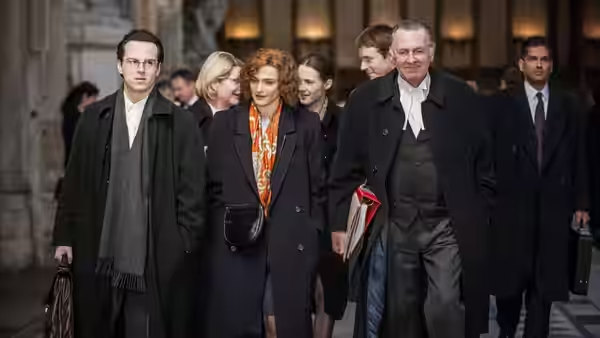
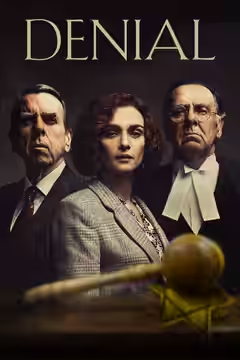
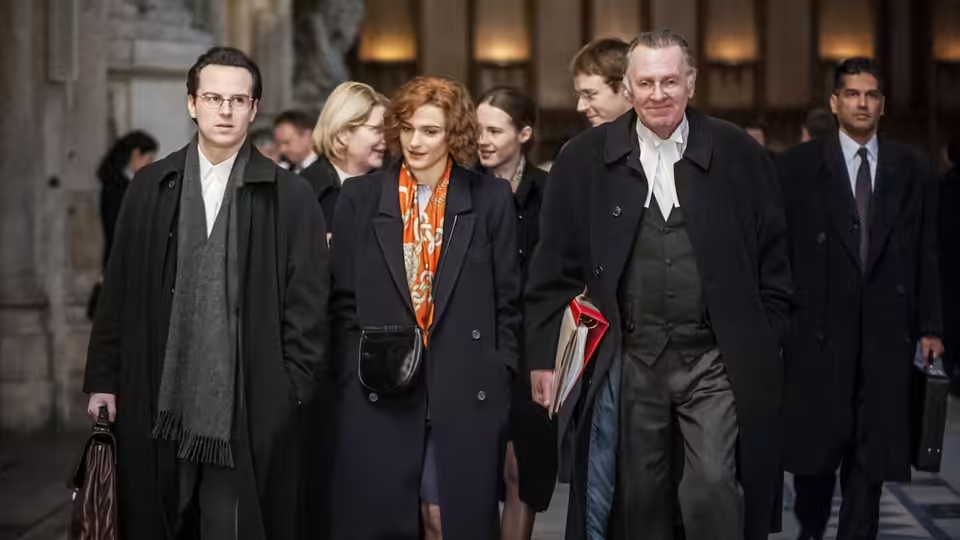
Deborah Lipstadt (Rachel Weisz) walks with her legal team through a courthouse
Film review

Denial

2016 · Directed by Mick Jackson · 1h 49m

In a sentenceA courtroom drama whose heroine’s big speech is the one she is told not to make

Atlanta, 1994. Deborah Lipstadt (Rachel Weisz), a historian at Emory University, is heckled mid-lecture by David Irving (Timothy Spall), the British writer she has called a Holocaust denier in print, who waves a thousand dollars at anyone who can produce Hitler’s written order. Irving sues her and her publisher for libel in London, where the law requires her to prove that what she wrote is true. Her solicitor Anthony Julius (Andrew Scott) and barrister Richard Rampton (Tom Wilkinson) set out the strategy: she will not give evidence, no survivor will take the stand, and the case will be fought on Irving’s own footnotes. Lipstadt wants her day in court. Her lawyers want her silent. Before the trial begins, Rampton takes her to Auschwitz in winter fog.

Plays from YouTube when you press play; nothing loads from them until then.

Fi1m review

Mick Jackson and David Hare turn the Irving libel trial into a sober, well-argued courtroom drama that is strongest when Tom Wilkinson is on his feet and flattest whenever it leaves the court. Worth an evening; do not expect to be swept away.

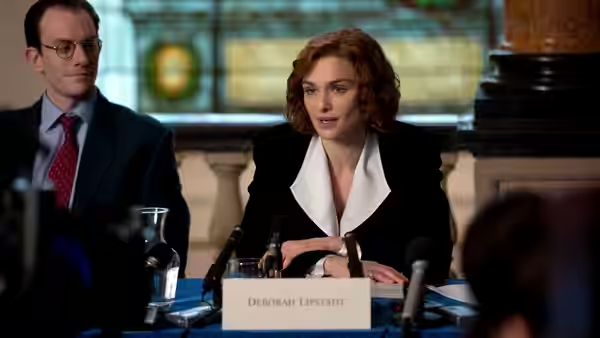
In 2000, in the High Court in London, David Irving sued the American historian Deborah Lipstadt for calling him a Holocaust denier, and because English libel law puts the burden of proof on the defendant, she had to show that the Holocaust happened and that he had lied about it. Mick Jackson’s film, from a screenplay by David Hare, takes Lipstadt’s own account of the case and makes 109 minutes of it. It is intelligent and decent and a little airless. The argument is made well; the drama around it is thinner.

Tom Wilkinson is the reason to see it. He plays Richard Rampton, the barrister, as a man who takes a glass of red at lunch, will not look Irving in the eye, and treats the whole thing as a job until, at Auschwitz, we see that it is not one. He walks the site in the fog asking where the barracks stood, how far, how long it would take, and the plainness of the questions upsets more than any speech could. Timothy Spall plays Irving pink and eager, hands folded, with a smile that arrives a second before the insult, and he never plays him as a fool. Their exchanges, with Irving representing himself and Alex Jennings’s judge watching from above, are the best stretch of the film.

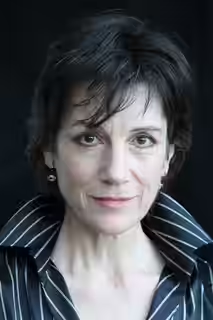
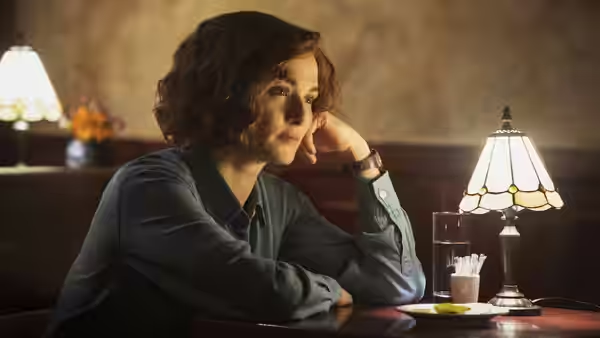
The difficulty is Lipstadt. Rachel Weisz gives her a Queens accent, a run along the Thames each morning and a temper, and then the script takes her voice away. Anthony Julius (Andrew Scott, brisk and expensive) tells her she will not testify and neither will any survivor; the case will be won on Irving’s footnotes or not at all. But the lawyers are right, the film knows they are right, and so for an hour its lead is a woman in a gallery being told to sit down. Harriet Walter, as a survivor who asks to speak and is turned away, has one scene and makes more of it than the film does.

Haris Zambarloukos shoots London in flat winter grey and the court in brown oak under even light, and keeps the camera well back at Auschwitz, which is tact and leaves the place to the actors. Andrew McAlpine’s sets are correct and unmemorable: chambers full of ring binders, a flat Lipstadt never seems to unpack. Odile Dicks-Mireaux dresses Irving a touch too well, a sharp detail. Howard Shore’s score stays out of the way and then lays strings under the camp scenes, where silence had already done the work. Justine Wright cuts the trial as short volleys with reaction shots to the gallery; it keeps things moving and looks like good television.

We were moved at Auschwitz more than we had braced for, and what did it was Wilkinson saying nothing and pacing out a distance while Weisz stood apart with her head bowed. We were also, by the second week of the trial, bored, and then uncomfortable about being bored by this of all subjects. The film has a case to make about the tedium of proving the obvious, and Hare half makes it, but Jackson never makes slow work look like anything but slow work.

Mark Gatiss, as the Auschwitz expert Robert Jan van Pelt, and John Sessions, as the historian Richard Evans, who went through Irving’s citations line by line, each get one piece of evidence and a paragraph. There is one question from the bench that unsettles the whole court, and we will not describe it; it is the film’s one jolt of real suspense.

Jackson made Threads for television in 1984; he knows how to make an audience feel dread without a word of explanation. Here he explains the law twice and the strategy three times. Hare’s screenplays for The Hours and The Reader had the same virtues and the same ceiling: literate, honourable, fair, never quite alive.

Watch it at home, with someone who likes to argue about evidence. It carries a 12A and runs 109 minutes. It will remind you that facts are established by people with footnotes and tape measures, and that this is slow, necessary work that does not photograph well.

Critical consensus AI synthesised

65
Positive
11
Mixed
6
Negative
3

Most critics come away respecting Denial more than they are stirred by it, but the lean is positive. The praise gathers around the courtroom and the people in it: Rachel Weisz as Deborah Lipstadt, Tom Wilkinson’s restrained barrister and Timothy Spall’s unsettling David Irving are each singled out repeatedly. Several reviews also credit the film for refusing to treat Holocaust denial as one side of a debate, and almost all of them call it timely.

The reservations are about the filmmaking rather than the case. Many find Mick Jackson’s direction flat and televisual, the drama tamer than its subject, and Lipstadt, kept silent by her own legal team, too passive a lead. The spread is wide: Deadline finds it urgent and rewarding, while Variety calls it awkward and muddled and The Guardian finds it hammy. Between those poles sit a crowd of three-star verdicts that admire the argument and wish the film around it had more life.

Evening Standard
12 September 2016 · festival review · David Sexton
80*

Sexton finds Denial an efficient, compelling courtroom drama with a somber edge. He especially praises Tom Wilkinson’s commanding performance as barrister Richard Rampton.

Read the full review →
Little White Lies
25 January 2017 · 3/4/3 · Trevor Johnston
80

Johnston finds the film well-meaning but ungainly, though its courtroom finale gives it a strong final-reel rally. He praises the taut courtroom performances and the force of its insistence on documented truth.

Read the full review →
The Hollywood Reporter
11 September 2016 · festival review · THR Staff
80*

The critic finds the courtroom drama compelling and forceful, with few missteps. They single out Rachel Weisz’s riveting performance and the film’s balance of humor with its weighty subject.

Read the full review →
IndieWire
12 September 2016 · B · David Ehrlich
77

Ehrlich finds the courtroom drama compelling and urgently relevant, though he considers it middle-brow and not great cinema. He praises Tom Wilkinson’s restrained performance and the film’s refusal to treat Holocaust denial as a legitimate debate.

Read the full review →
Slant Magazine
27 September 2016 · ★★★/4 · Oleg Ivanov
75

The review praises Denial as a passionate defense of reason and factual truth, though it finds the film deeply sober. It singles out Rachel Weisz’s lively, camp-tinged performance and the film’s portrayal of both Lipstadt and Irving as outsiders shaped by hardship.

Read the full review →
Los Angeles Times
29 September 2016 · Kenneth Turan
70*

Turan finds the film effective when its serious themes matter, despite awkward direction and stretches of standard-issue drama. He praises the script’s emphasis on Lipstadt’s struggle to accept the legal strategy of remaining silent.

Read the full review →

Straight answers AI written, from our review

Is Denial worth watching?
Denial is worth an evening for anyone who likes a courtroom argument made carefully, and we scored it 64. Tom Wilkinson's barrister and Timothy Spall's David Irving are the reason to see it; Rachel Weisz's Lipstadt spends an hour being told to sit down, and the film sags with her. Watch it at home, with someone who enjoys arguing about evidence.
How long is Denial, and what is it rated?
Denial runs 1h 49m. It is a drama and history film.
Where can I watch Denial in Serbia?
Denial is not on any streaming or rental service in Serbia at the moment. It is available in 28 other countries; change your country at the top of the page to see where. Availability is checked daily.
How violent or frightening is Denial, and is it suitable for children?
Denial is a 12A courtroom drama with no violence on screen; its subject is the Holocaust, argued over in a London libel trial and visited once, at Auschwitz in winter fog. The camp scenes are quiet rather than graphic, and the distress comes from a barrister pacing out distances. It is too slow and too talky for younger children, but fine for teenagers.
How does Denial compare to Shoah?
Denial is a tidy 109-minute drama about proving in court that the Holocaust happened; Shoah is nine hours of testimony and landscape that simply shows it did, and it is far the greater film. Denial is the easier evening, with proper actors and a tidy argument. Shoah is punishing, sometimes bullying, and the one to see if you only see one.
What should I watch after Denial?
After Denial, try Shoah (1985, Fi1m 93): Nine hours of testimony and landscape, no archive footage; the evidence Rampton would have wanted. Then Judgment at Nuremberg (1961, Fi1m 82): The older courtroom model: long speeches, big stars, and a judge who actually agonises; and Spotlight (2015, Fi1m 85): Another film about documents and footnotes that finds the drama in the paperwork.

Cast

If you liked this, try…

  1. Conspiracy (2001) · not reviewed yetNinety minutes of men around a table at Wannsee; the banality is the horror.

  2. Shoah (1985, Fi1m 93)Nine hours of testimony and landscape, no archive footage; the evidence Rampton would have wanted.

  3. Judgment at Nuremberg (1961, Fi1m 82)The older courtroom model: long speeches, big stars, and a judge who actually agonises.

  4. Spotlight (2015, Fi1m 85)Another film about documents and footnotes that finds the drama in the paperwork.

  5. The Zone of Interest (2023, Fi1m 91)Auschwitz heard but never shown, over a garden wall; the camera kept further back still.