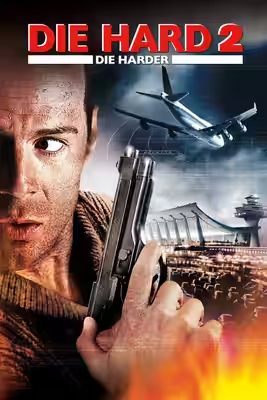
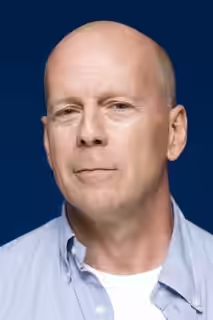
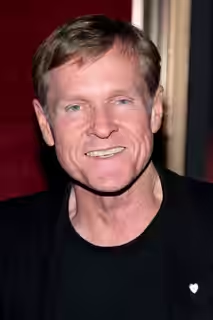
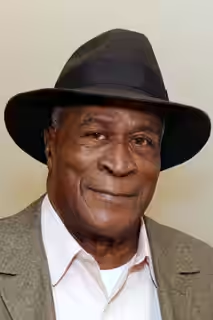
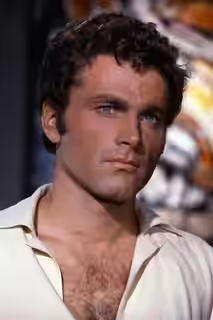
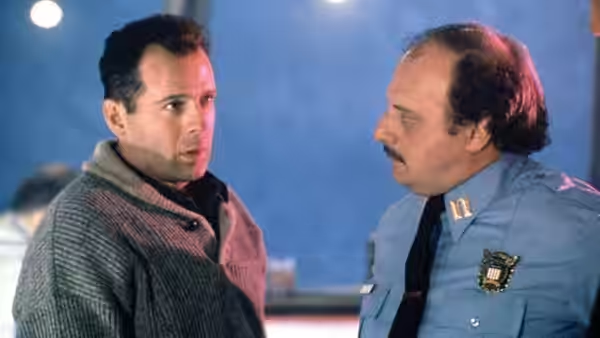
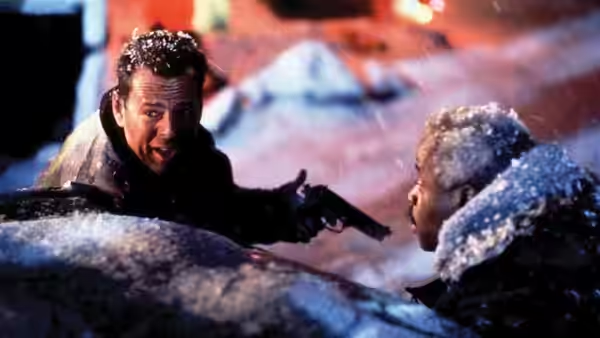
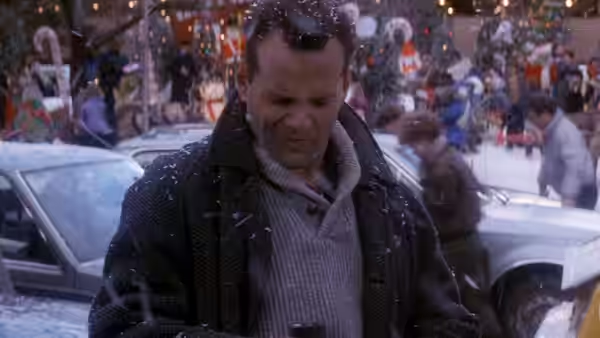
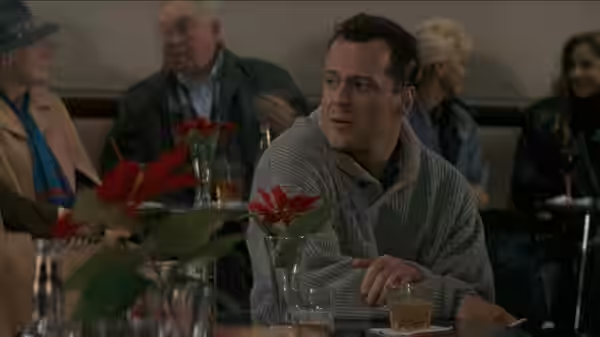
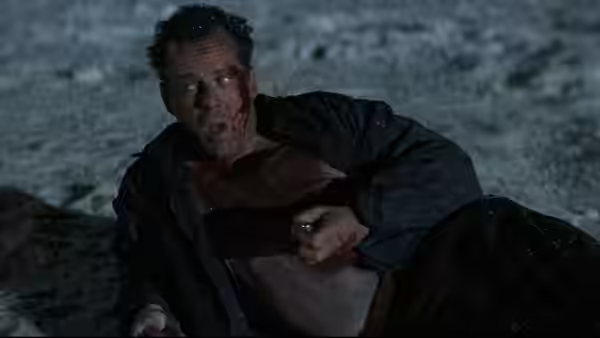
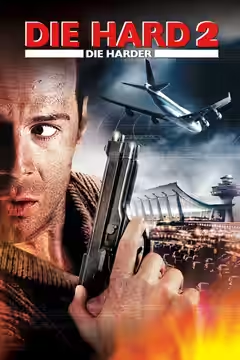
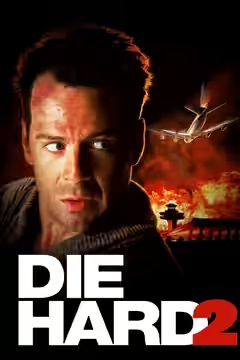
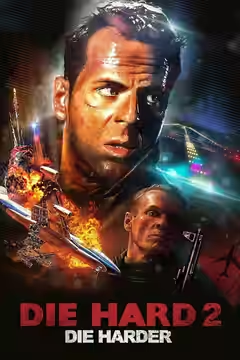
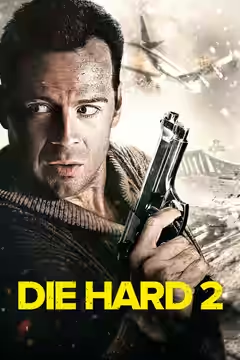
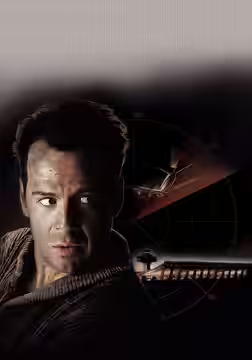
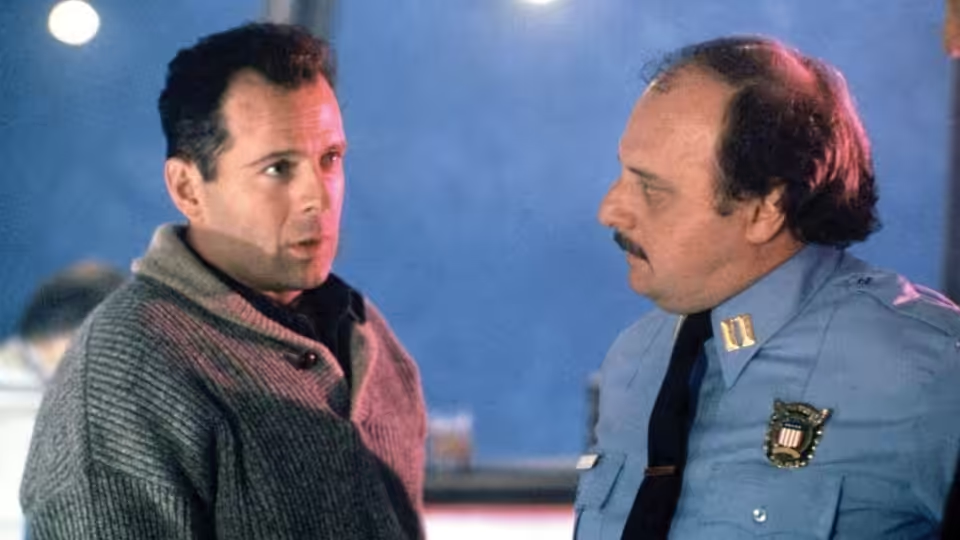
John McClane (Bruce Willis) facing Capt. Carmine Lorenzo (Dennis Franz) indoors
Film review

Die Hard 2

1990 · Directed by Renny Harlin · 2h 04m

In a sentenceMcClane gets an airport, a blizzard and twice the explosions, and misses Alan Rickman as much as we do

Christmas Eve, Washington. Off-duty New York detective John McClane (Bruce Willis) waits at Dulles International Airport for his wife Holly (Bonnie Bedelia), whose plane from Los Angeles is circling in a snowstorm. Two men in the terminal look wrong to him; he follows them into the baggage tunnels and comes out with a corpse and no thanks from the airport police captain, Carmine Lorenzo (Dennis Franz). Meanwhile a team of former soldiers led by Stuart (William Sadler) seizes control of the airport’s runway lights and radios from a church nearby, leaving tower chief Trudeau (Fred Thompson) and engineer Leslie Barnes (Art Evans) blind. They want General Ramon Esperanza (Franco Nero), a Latin American strongman being flown in to stand trial, landed and set free. Overhead, Holly’s plane has fuel for only so long.

Fi1m review

Renny Harlin swaps the tower block for an airport and the battle of wits for a blizzard of explosions. It is fast, well built and good fun, and it never finds a villain worth Bruce Willis’s trouble.

John McTiernan’s Die Hard kept its hero in one building. Renny Harlin, taking over for the sequel, has been handed an airport, a blizzard and roughly twice the explosives, and he uses all of them. Die Hard 2 puts John McClane back in trouble on Christmas Eve, at Dulles in Washington, while his wife’s plane circles overhead in the snow, and it knows exactly what it is: the same thing again, louder. It is fast, well built and good fun for 124 minutes, and about half as clever as the film it copies. If the first one is yours, this is worth an evening. Do not expect to remember much of it by Boxing Day.

Steven E. de Souza and Doug Richardson’s script, from a novel by Walter Wager, sets a team of former soldiers under a man called Stuart to seize the airport’s landing systems and free a general being flown in for trial. The writers know the first film as well as we do and let McClane say so; his complaint about the same thing happening to the same guy twice is the best joke in the picture and also a confession. Obstructive local cop, smug reporter, wife in danger, crawling through ducts: all present, all a size larger. The film mostly gets away with it because it moves too fast to be caught.

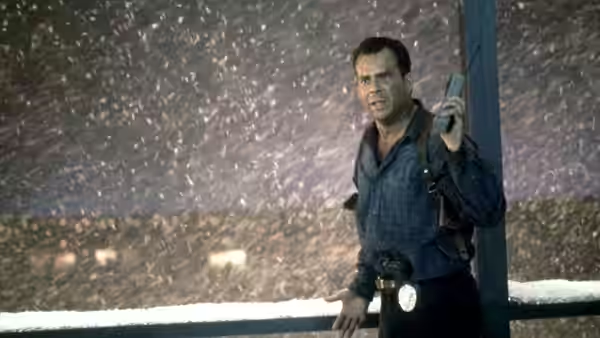
Oliver Wood shoots the whole thing at night in falling snow, and it is the film’s best decision. The runways are black, the lights amber and blue, and every explosion has a white backdrop to bloom against. John Vallone’s production design gives the villains a church annex full of monitors and the control tower the look of a room that has been worked in for years. Michael Kamen, who scored the original, brings back his sleigh bells and low brass and adds a carol. Stuart Baird and Robert A. Ferretti cut the fistfights hard and quick; when Harlin drops into slow motion for the bigger stunts, which he does more than once, the energy runs out of the frame until he stops.

Willis is why it works as well as it does. He plays McClane as a man who is cold, tired and faintly embarrassed to be doing this again, and he apologises to the people he inconveniences, which is funnier than most of the written jokes. We laughed more than we expected to in the baggage tunnels, and it was his face that did it, not the lines: a man hitting someone while plainly wishing he were somewhere warm with a drink. Bonnie Bedelia has less to do than last time, stuck in a seat beside William Atherton’s Richard Thornberg, the reporter from the first film, and plays it as a woman quietly reconsidering the marriage.

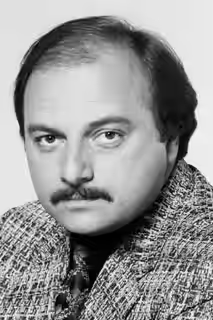
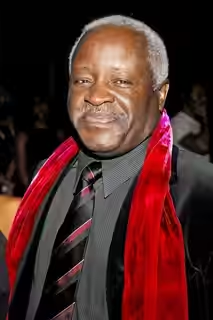
The trouble is who he is fighting. William Sadler’s Stuart is introduced exercising naked in a hotel room, a good joke and the last interesting thing about him. Sadler is cold, tidy and quick, but the script gives him orders to bark and nothing to want beyond the job, and the memory of Alan Rickman’s Hans Gruber hangs over every scene. Franco Nero’s General Ramon Esperanza is a cigar and an accent. Dennis Franz, as the airport police captain Carmine Lorenzo, shouts every line and is a pleasure for it, and John Amos arrives as Major Grant with a special forces unit and a jaw you could break rocks on. The most likeable person in the building is Tom Bower’s Marvin, a janitor who knows where everything is.

The plot does not bear looking at. The circling planes have exactly as much fuel as each scene needs. Sheila McCarthy’s television reporter Sam Coleman has a helicopter to hand at all times and the film treats it like a bus. And the last third leaves the terminal for snowmobiles and a chase along the runway, where the snow that has served the film so well becomes the thing that stops you telling who is shooting at whom.

Set against the first film it is plainly the lesser thing; it traded cleverness for volume and knew it. Set against the run of action sequels from the same years it sits high: it is made with real skill, it does not insult you, and it has a lead who understands the joke. Watch it in December with the curtains drawn, and forgive it the fuel.
Critical consensus AI synthesised

76
Positive
9
Mixed
2
Negative
0

Most critics like Die Hard 2, and few pretend it is anything more than a big, loud sequel. Nine of eleven reviews are positive, and the praise clusters in the same place: Renny Harlin’s set pieces, the speed at which they arrive, and Bruce Willis, whose one-liners and visible reluctance to get hurt again keep the film human. The 1990 notices are the warmest, with the plane sequences and the stunt work singled out, and several later writers credit the film with knowing exactly how absurd it is.

The reservations are just as consistent. Several critics find the villain a poor substitute for the first film’s, and more miss the original’s confined, claustrophobic tension, which Harlin trades for volume. Collider goes further, arguing the script misreads McClane’s motives and coasts on the first film’s goodwill. The spread is narrow, from 60 to 90, and the more recent the review, the cooler it tends to be.

RogerEbert.com
3 July 1990 · Roger Ebert
90*

Ebert finds the sequel a skillfully constructed and well-directed thriller that carries momentum past credibility gaps, calling it terrific entertainment and as much fun as the Bond pictures. He singles out for praise the convincing plane crash sequence and an exhilarating shot of Willis being catapulted toward the camera.

Read the full review →
The New York Times
3 July 1990 · Janet Maslin
90*

Maslin praises the film as the fastest, scariest action film of the summer, highlighting lean, edgy direction, astonishing stunts, and Willis's magnetic, self-effacing hero who regrets violence even as he excels at it. She singles out the character's clever drawing and the way the story accommodates his wife's career.

Read the full review →
Radio Times
★★★★ · John Ferguson
80

The critic calls it a hugely entertaining slice of action hokum. Director Renny Harlin piles on grand explosions and set pieces rather than recreating the original's battle of wits.

Read the full review →
Slant Magazine
29 June 2015
80*

The piece frames Die Hard 2 as a self-aware sequel that embraces its derivative, repetitive nature in the spirit of Nietzsche's eternal return, highlighting McClane's media-savvy myth-making and the film's Christmas setting. It praises the way it revels in absurdity while delivering solid action and character moments.

Read the full review →
Time Out
10 September 2012 · DW
80*

The critic notes the self-referential irony saves the film and praises Willis's one-liners and vulnerability. Harlin fails to match the original's claustrophobic tension but compensates with timing, speed and volume, succeeding magnificently as action.

Read the full review →
Los Angeles Times
3 July 1990 · Sheila Benson
70*

Benson calls it the most cheerfully preposterous film of a jaw-dropping summer and a lively three-ring circus, noting Harlin's crunchingly effective direction and technical flair despite the lack of logic. She singles out for complaint the weak villain compared to the first film's Alan Rickman character.

Read the full review →

Straight answers AI written, from our review

Is Die Hard 2 worth watching?
Die Hard 2 is worth an evening for anyone who liked the first film and wants the same thing again, louder, and we scored it 70. Renny Harlin keeps it fast and well built, and Bruce Willis is funnier than the script, but William Sadler's villain gives him nothing to push against. Do not expect to remember much of it afterwards.
How long is Die Hard 2, and what is it rated?
Die Hard 2 runs 2h 04m. It is an action and thriller film.
Where can I watch Die Hard 2 in Ecuador?
Die Hard 2 is streaming on Disney+ in Ecuador. Availability is checked daily; the links above go straight to each service.
How violent or frightening is Die Hard 2, and is it suitable for children?
Die Hard 2 is a 15 in the UK and an R in the US, and it earns them: it is a two-hour action film with a high body count, hard-cut fistfights and a great many explosions. It is loud rather than frightening, and there is nothing here to trouble an adult. It is not for young children, and the squeamish should expect blood.
How does Die Hard 2 compare to Die Hard?
Die Hard 2 is plainly the lesser of the two: it trades the first film's battle of wits for a blizzard of explosions and never finds a villain to match Alan Rickman's Hans Gruber. Die Hard is the tighter, cleverer film and the one to see first. The sequel suits those who want more of Bruce Willis's McClane and are not fussy about the plot.
Is Die Hard 2 based on a true story or a book?
Die Hard 2 is not a true story; it is adapted from a novel by Walter Wager, with a script by Steven E. de Souza and Doug Richardson. The film has been reshaped to fit John McClane and repeat the pattern of the first Die Hard, so knowing the book does not matter. Knowing the earlier film matters more.
Do you need to have seen the other Die Hard films before Die Hard 2?
Die Hard 2 is the second of five Die Hard films and can be followed without having seen the first, since the plot is self-contained and McClane explains the joke himself. Several returning characters, including his wife Holly and the reporter Thornberg, land better if you know them. We would still start with Die Hard, which is the better film.
What should I watch after Die Hard 2?
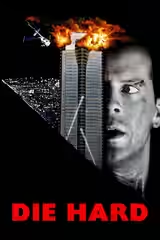
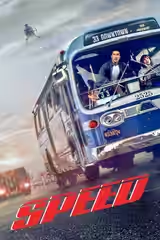
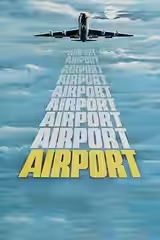
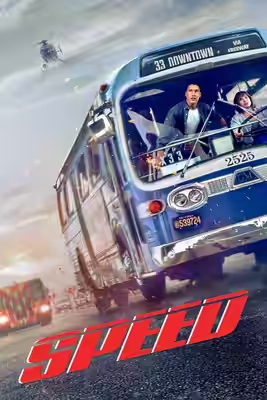
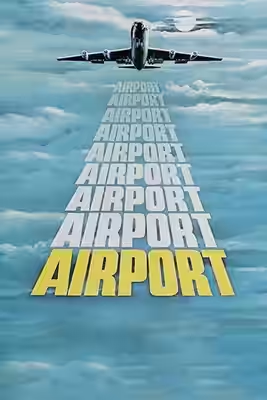
After Die Hard 2, try Die Hard (1988, Fi1m 89): The original, one building, one night, and a villain who could quote Plutarch. Then Speed (1994, Fi1m 86): A bus that cannot slow down, and a script that knows exactly how silly it is; and Airport (1970, Fi1m 56): The disaster-film grandfather: snowbound runways, stiff drinks and Burt Lancaster looking worried.
What order should I watch the Die Hard films in?
Release order is the safe choice for Die Hard, and it is the order our collection page lists them in. Die Hard 2 is number 2 of the 5 Die Hard titles on Fi1m; before it comes Die Hard and after it Die Hard: With a Vengeance. The full order.

Part of · 2 of 5

Die Hard

5 films on Fi1m · 1988–2013 · average 67 · best Die Hard 89

All 5 in order

Cast

Awards

Japan Academy Prize for Outstanding Foreign Language Film, 1991

Nominated
Japan Academy Prize for Outstanding Foreign Language Film

If you liked this, try…

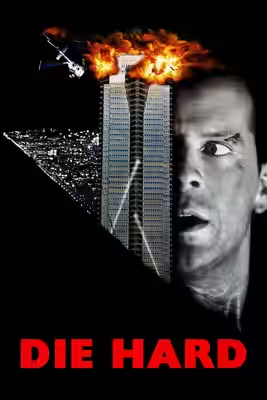
  1. Die Hard (1988, Fi1m 89)The original, one building, one night, and a villain who could quote Plutarch.

  2. Speed (1994, Fi1m 86)A bus that cannot slow down, and a script that knows exactly how silly it is.

  3. Airport (1970, Fi1m 56)The disaster-film grandfather: snowbound runways, stiff drinks and Burt Lancaster looking worried.

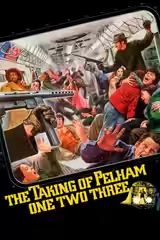
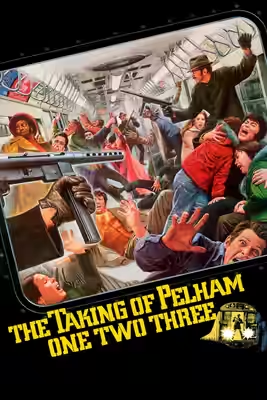
  4. The Taking of Pelham One Two Three (1974) · not reviewed yetHijackers under New York, a weary Walter Matthau and a clock.

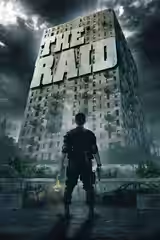
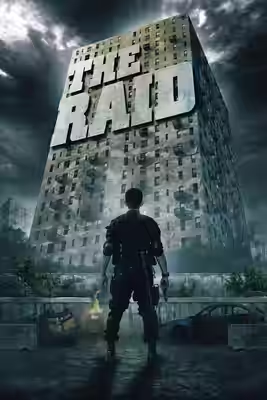
  5. The Raid (2011, Fi1m 83)One tower block, one squad, and fights that make Harlin’s look like a dinner dance.

Free account

Know what to watch tonight

Two lists that know where things are streaming, collections you can share, your own score beside ours, and Discover that remembers what you have seen.

  • Want to see, sorted by what is streaming now
  • Seen, with your score out of ten
  • No adverts, ever