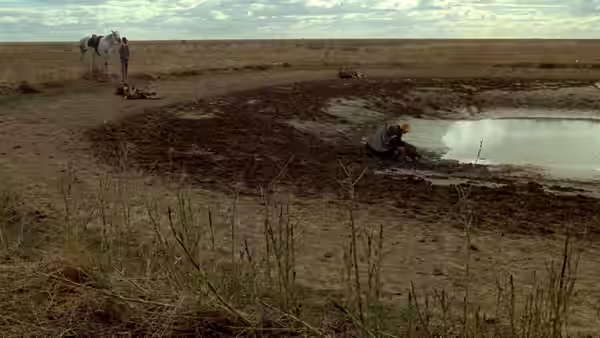
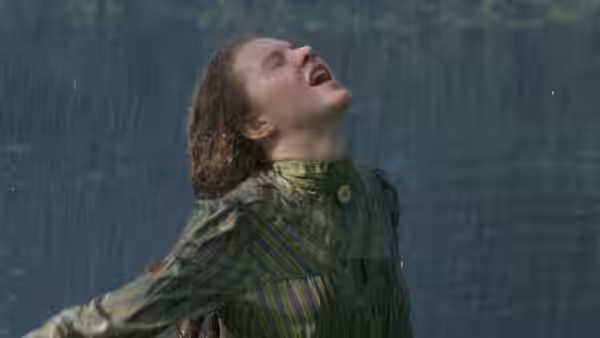
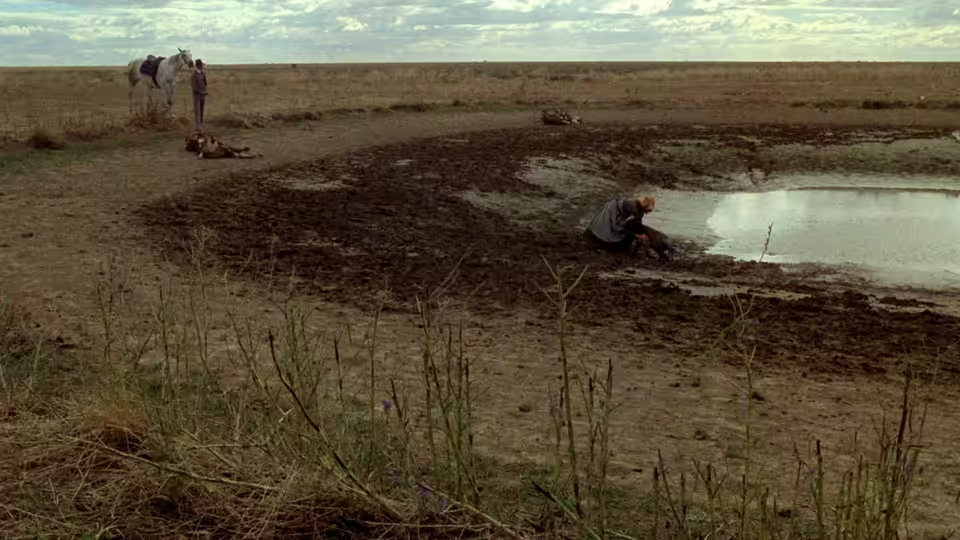
A person kneels beside a muddy pool as two figures stand near a horse in the distance
Film review

My Brilliant Career

1979 · Directed by Gillian Armstrong · 1h 40m

In a sentenceA girl in the wrong frock hits the handsomest man in the district with a pillow and means it

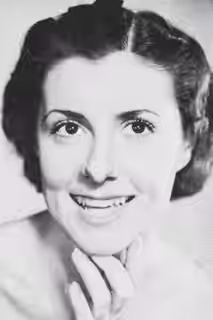
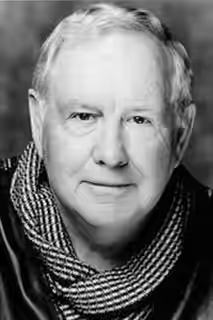
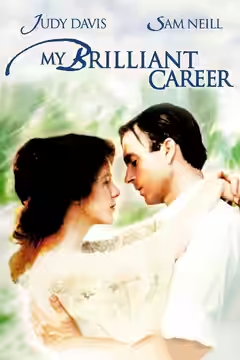
Possum Gully, New South Wales, 1897. Sybylla Melvyn (Judy Davis) is the eldest daughter of a failing dairy farmer (Alan Hopgood) and a worn-out mother (Julia Blake), and she has decided she is going to have a career, in writing or music or something, rather than a husband. A dust storm blows through the kitchen while she plays the piano. Her mother, defeated, sends her to Caddagat, the prosperous homestead of Grandma Bossier (Aileen Britton) and the widowed Aunt Helen (Wendy Hughes), to be made presentable. There she is taught to dress, meets Frank Hawdon (Robert Grubb), an English jackaroo who assumes she will be grateful for his attention, and rows across a lake with Harry Beecham (Sam Neill), the quiet owner of the neighbouring station, who watches her more carefully than anyone has before.

Fi1m review

Gillian Armstrong’s first feature gives Miles Franklin’s novel to Judy Davis and gets out of her way. It is warm, sharp and very well made, and it sags for a quarter of an hour in a farmhouse full of dirty children.

Gillian Armstrong’s first feature is a period romance in which the heroine spends the whole film deciding whether she wants the romance at all. It is adapted by Eleanor Witcombe from Miles Franklin’s novel, and it is carried, scene by scene, by Judy Davis, who was almost unknown when she made it and looks in every frame as if she knows exactly what she is doing. We liked it a great deal. It runs 100 minutes, it is handsome without being smug about it, and it has a lead performance that has not dated by a day.

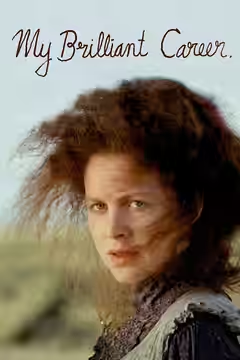
Davis plays Sybylla Melvyn as a girl who is rude before anyone can be rude to her. She has a cloud of red hair she cannot control, freckles she is told about, and a habit of laughing at the wrong moment in a room full of people who never laugh. In the early scenes at Possum Gully she stares into a mirror and announces that she is plain, and Davis says it as a fact she has decided to get in first with. Later, at Caddagat, she is put into a decent dress for the first time and does not know what to do with her arms. It is a performance built out of small physical embarrassments, and it never once asks us to feel sorry for her.

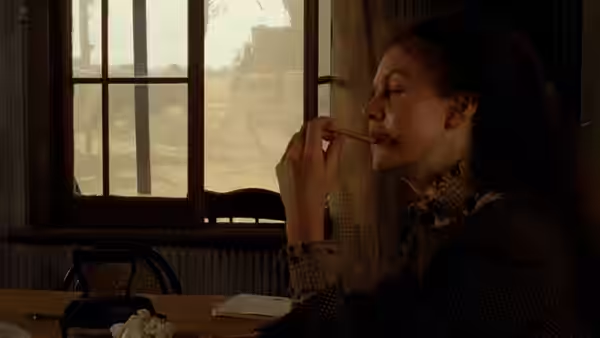
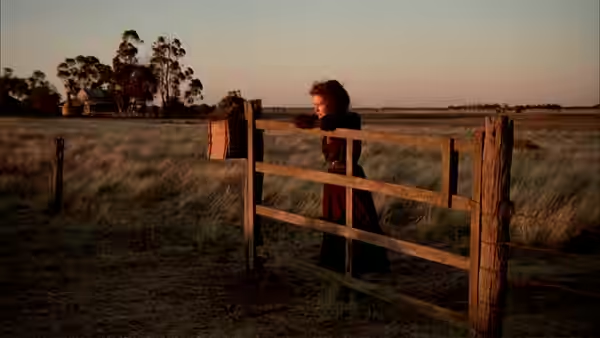
Donald McAlpine shoots the two worlds so that you could tell them apart with the sound off. Possum Gully is yellow dust, low sun and a kitchen where everything has a film of dirt on it. Caddagat is green shade, verandahs and lamplight on polished wood. Luciana Arrighi fills the grandmother’s house with the clutter of people who have never had to sell anything, and Anna Senior puts Sybylla in frocks that always fit a fraction wrong, at the shoulder or the waist, so that she looks borrowed even when she looks nice. Nathan Waks builds the music around Schumann’s Scenes from Childhood, which Sybylla plays herself at the piano, so the score is something she does rather than something done to her. Nicholas Beauman lets scenes run: the boat on the lake is held long enough that we start to notice the silence, which is the point.

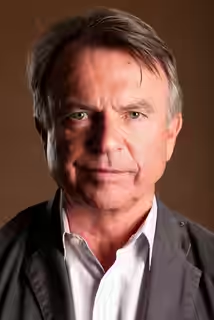
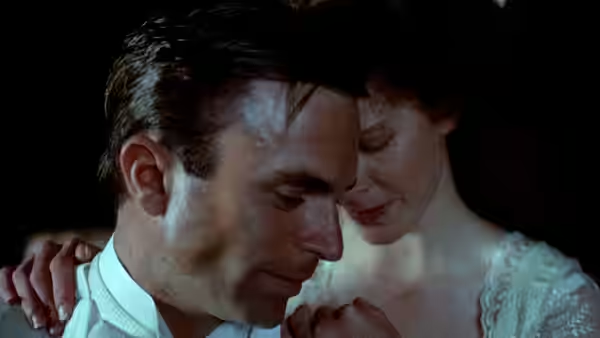
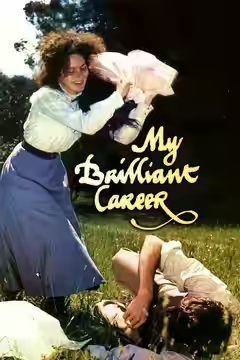
Sam Neill’s Harry Beecham is the film’s second best idea. He is rich, decent and quiet, and Neill plays him as a man who has never had to ask for anything and is puzzled to find himself asking. The pillow fight between them, which starts as a joke and turns into a chase through the house and out across the lawn, is the sequence we would show anyone who asked what the film was like. We laughed, and then we went quiet, because Davis’s face at the end of it shows a girl realising she is having a better time than she meant to. Nothing is said. Armstrong trusts us to have seen it.

The film’s weak stretch is the third quarter, when Sybylla is sent to the McSwatts to pay off a debt of her father’s. Max Cullen is fine as the head of that household, but the sequence is played as broad comedy, all grubby children and bad table manners, and it slows the film just when it should be tightening. Robert Grubb’s Frank Hawdon is the other lazy element, a cartoon Englishman there to be humiliated, and the humiliation is the one moment where the script takes the easy laugh. And Harry, for all Neill’s care, is written a little thin: the film wants us to feel the pull of him as strongly as Sybylla does, and it gives him perhaps two scenes in which to earn that.

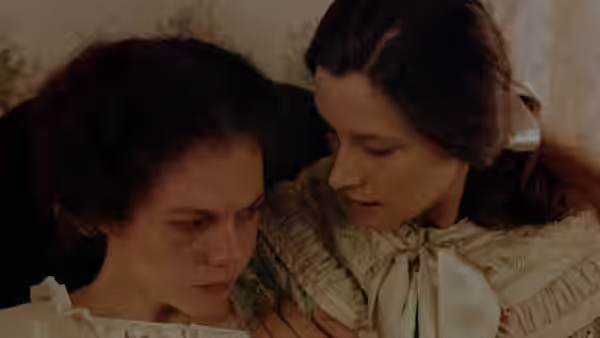
Wendy Hughes is quietly excellent as Aunt Helen, a woman whose own marriage went wrong and who teaches Sybylla how to be looked at without ever quite recommending it. Aileen Britton’s Grandma Bossier is the voice of what a girl is for. Together they make the case against Sybylla’s ambitions from inside the family, kindly, which is far more persuasive than any villain would have been.

Set beside Peter Weir’s Picnic at Hanging Rock (1975), the other period film that told the world Australian cinema had woken up, this is the smaller and the sturdier of the two. It has no mystery to hide behind, only a girl and a decision, and it stays honest about how much the decision costs. See it for Davis, for the pillow fight, and for a heroine who is allowed to be difficult without the film apologising for her.
Critical consensus AI synthesised

73
Positive
5
Mixed
1
Negative
0

Most critics are warm towards Gillian Armstrong’s film and treat it as a key work of the Australian New Wave rather than a curiosity from it. The praise clusters almost entirely on Judy Davis: the reviews call her assured, courageous, unsentimental and layered, and several regard the heroine’s refusal to be tamed as the film’s whole point. The wider case for it is that Armstrong handles a restrictive society and its taboos with confidence, and that the story of a young woman seeking independence remains engaging rather than dutiful.

The spread is narrow: five of six reviews lean positive and none is negative, so the reservations are scattered rather than shared. Radio Times finds the wealthy suitor hard to believe any woman would refuse. Slant Magazine is happier with the film than with its disc extras, while admiring the restoration’s colours and preserved grain. The New York Times review could not be read in full, so its verdict is unknown. Nobody argues against the film itself.

Radio Times
★★★★ · Angie Errigo
80

Errigo regards the film as a sensitive, key work of the Australian film renaissance. She praises Judy Davis’s assured performance, while noting that the wealthy suitor is difficult to believe any woman would refuse.

Read the full review →
The AV Club
7 June 2005 · Scott Tobias
80*

The critic finds the film an inspiring, powerful statement of purpose. He especially praises Judy Davis’s courageous, unsentimental portrayal of a fiercely independent heroine.

Read the full review →
Variety
31 December 1978 · Variety Staff
75*

The review finds the film charming and engaging in its depiction of a young woman seeking independence. It praises Judy Davis’s portrayal and the film’s confident exploration of a restrictive society and its taboos.

Read the full review →
Slant Magazine
26 June 2019 · ★★★½ · Keith Watson
70

Watson finds the film a compelling, feminist classic, though the Blu-ray extras disappoint. He singles out Judy Davis’s layered performance and the restoration’s vivid colors and preserved film texture for praise.

Read the full review →
Time Out
15 March 2012
70*

The page presents Armstrong’s film as a significant work of the New Wave. It singles out Judy Davis as a headstrong woman seeking to prove herself.

Read the full review →
The New York Times
6 October 1979
65*

The page appears to be a review of Gillian Armstrong’s film, but its verdict and specific praise or criticism are unavailable. The article text could not be accessed, so those details cannot be reliably summarized.

Read the full review →

Straight answers AI written, from our review

Is My Brilliant Career worth watching?
My Brilliant Career is worth watching for anyone who likes a period romance with a heroine who is allowed to be difficult, and we scored it 82. Judy Davis carries it scene by scene, Sam Neill is quietly good beside her, and the pillow fight alone is worth the evening. It sags for a quarter of an hour in a farmhouse full of dirty children, and Robert Grubb's Englishman is a cartoon.
How long is My Brilliant Career, and what is it rated?
My Brilliant Career runs 1h 40m. It is a drama and romance film.
Where can I watch My Brilliant Career in Canada?
My Brilliant Career is not on any streaming or rental service in Canada at the moment. It is available in 3 other countries; change your country at the top of the page to see where. Availability is checked daily.
How does My Brilliant Career compare to Picnic at Hanging Rock?
My Brilliant Career is the smaller and sturdier of the two, and Picnic at Hanging Rock the stranger and dreamier. Armstrong's film has no mystery to hide behind, only a girl and a decision, and it stays honest about what the decision costs. Weir's is the one to choose if you want to be unsettled; Armstrong's if you want to be warmed and answered back.
Is My Brilliant Career based on a true story or a book?
My Brilliant Career is based on Miles Franklin's novel of the same name, adapted for the screen by Eleanor Witcombe. It is not presented as a true story; it is a period drama about a fictional girl, Sybylla Melvyn, in 1890s New South Wales. You do not need to have read the book: Judy Davis's performance tells you everything the film wants you to know about her.
What should I watch after My Brilliant Career?
After My Brilliant Career, try Picnic at Hanging Rock (1975, Fi1m 88): The other film that announced Australian cinema; stranger, dreamier, just as sunlit. Then An Angel at My Table (1990, Fi1m 87): Jane Campion on a red-haired writer who will not be tidied up; and The Piano (1993, Fi1m 88): A mute woman, a colonial mud-bath and a piano that says everything.

Cast

Awards

Academy Awards, 1981

Nominated
Best Costume Design

AACTA Award for Best Actor in a Supporting Role, 1979

Nominated
AACTA Award for Best Actor in a Supporting Role

AACTA Award for Best Actress in a Leading Role, 1979

Nominated
AACTA Award for Best Actress in a Leading Role

AACTA Award for Best Actress in a Supporting Role, 1979

Nominated
AACTA Award for Best Actress in a Supporting Role

AACTA Award for Best Adapted Screenplay, 1979

Won
AACTA Award for Best Adapted Screenplay

AACTA Award for Best Cinematography, 1979

Won
AACTA Award for Best Cinematography

AACTA Award for Best Costume Design, 1979

Won
AACTA Award for Best Costume Design

AACTA Award for Best Direction, 1979

Won
AACTA Award for Best Direction

AACTA Award for Best Editing, 1979

Nominated
AACTA Award for Best Editing

AACTA Award for Best Film, 1979

Won
AACTA Award for Best Film

If you liked this, try…

  1. Picnic at Hanging Rock (1975, Fi1m 88)The other film that announced Australian cinema; stranger, dreamier, just as sunlit.

  2. An Angel at My Table (1990, Fi1m 87)Jane Campion on a red-haired writer who will not be tidied up.

  3. The Piano (1993, Fi1m 88)A mute woman, a colonial mud-bath and a piano that says everything.

  4. Portrait of a Lady on Fire (2019, Fi1m 89)Two women, an island and a career that cannot survive a marriage.

  5. Little Women (2019, Fi1m 83)Greta Gerwig’s Jo March is Sybylla’s American cousin, ink-stained and stubborn.