Film review

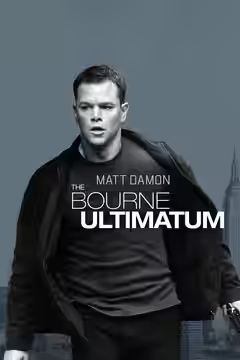
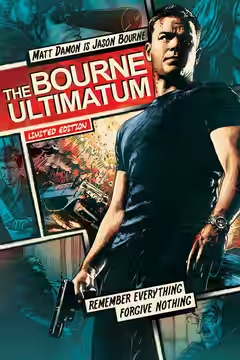
The Bourne Ultimatum

2007 · Directed by Paul Greengrass · 1h 55m · MPA PG-13

In a sentenceBourne outruns the CIA, the Moroccan police and, now and then, the camera operator

ActionDramaMysteryThriller

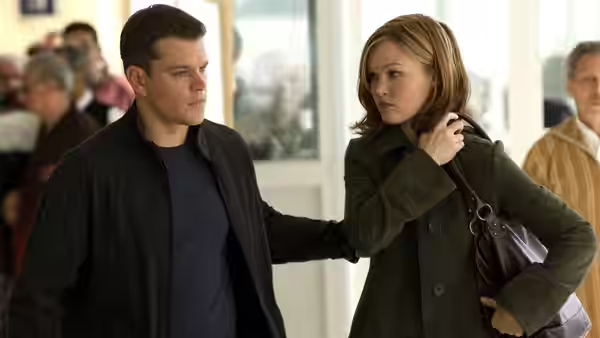
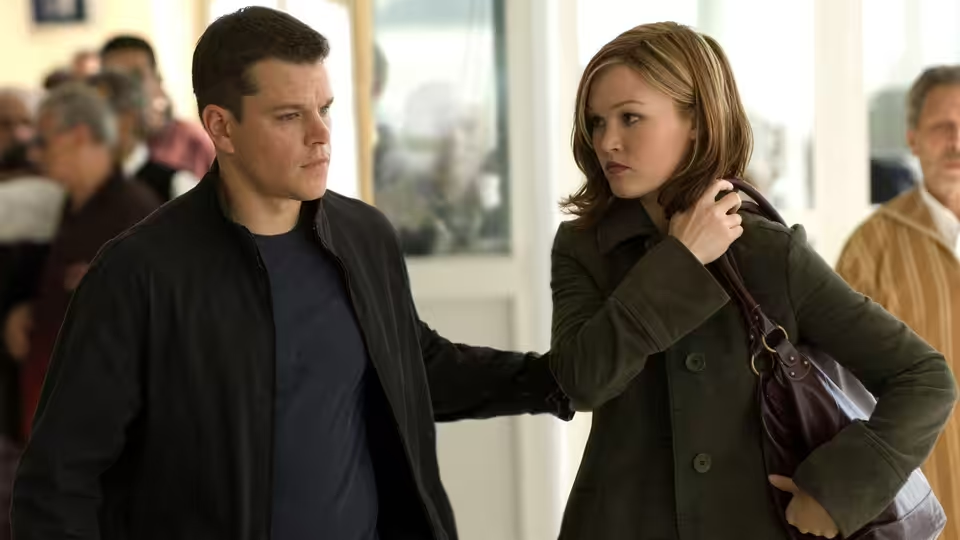
Jason Bourne (Matt Damon), a trained killer who cannot remember who he was, limps out of Moscow wounded, with one aim: to find the people who made him. In London, a journalist, Simon Ross (Paddy Considine), has been told by a source about a CIA programme called Blackbriar. Bourne reads his article and phones him. The call is picked up in New York, where Noah Vosen (David Strathairn) runs a room of screens and orders every camera in Waterloo Station turned on the two men. Pamela Landy (Joan Allen), who has hunted Bourne before, is brought in to advise. In Madrid, Nicky Parsons (Julia Stiles), an analyst who once handled him, finds him again, and the chase moves on to Tangier.

Fi1m review

Paul Greengrass closes the trilogy with a chase film so lean it barely stops to breathe, and neither did we. There is not much plot beneath the running and the camera sometimes loses its footing, but the Waterloo Station sequence alone earns the evening.

Paul Greengrass took over the series from Doug Liman for The Bourne Supremacy, and The Bourne Ultimatum is his second and the trilogy’s third. Jason Bourne (Matt Damon) still wants to know who turned him into a killer, and the CIA still wants him dead before he finds out. Tony Gilroy, Scott Z. Burns and George Nolfi have written it as one long pursuit through Moscow, London, Madrid, Tangier and New York, with the answers handed out in brief flashes between the running. It is the best of the three, it runs 115 minutes and it wastes none of them. We recommend it with a couple of reservations, which we will come to.

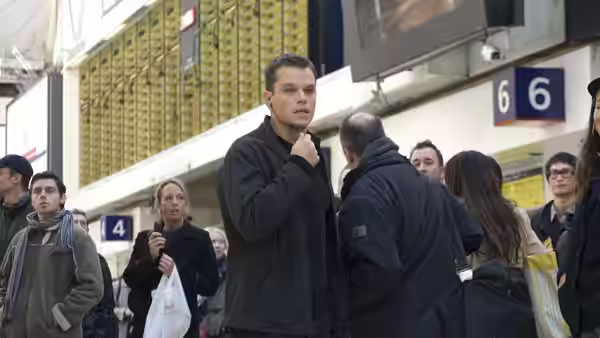
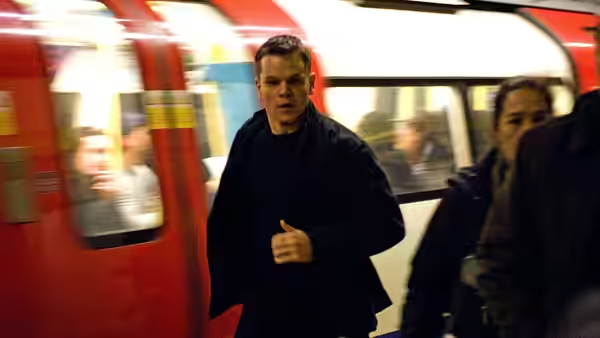
The Waterloo Station sequence comes early and is the reason to see the film. A journalist, Simon Ross (Paddy Considine), has written about a programme called Blackbriar. Bourne phones him, the call is picked up in New York, and Noah Vosen (David Strathairn), in a room of screens, orders the station’s cameras turned on both men. What follows is Bourne walking Ross across a crowded concourse by mobile, telling him which way to look and when to stop, while Vosen’s team tracks them and a man with a rifle waits. Christopher Rouse cuts between the three, and Oliver Wood’s camera is in the crowd rather than above it, so we see what Bourne sees a fraction before he does. We did not breathe properly for the whole of it, and when it ended our shoulders were up round our ears. Rouse put them there, because he never cuts to explain, only to keep up.

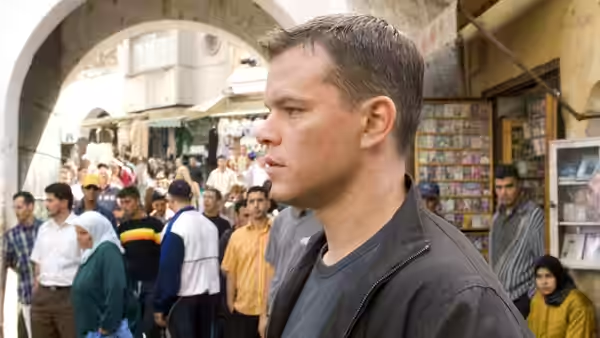
Tangier is the other set piece, a chase over rooftops and through other people’s flats that ends in a bathroom where Bourne fights Desh Bouksani (Joey Ansah) with a hardback book and a towel. It is brutal and short, and when it is over Greengrass holds on Damon’s face, and the look there is shame. Damon has spent three films taking things out of Bourne’s expression, and by now there is almost nothing left but tiredness and a strange politeness. John Powell’s score drives the chases with drums and hurried strings, then drops out entirely when a killing needs to register.

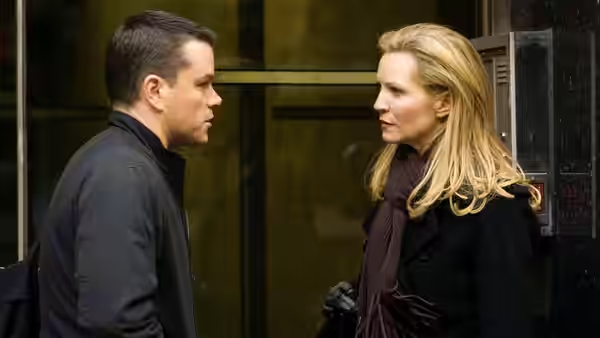
Peter Wenham’s production design gives the CIA a windowless New York room of glass partitions and wall screens, where men in shirtsleeves send other men to die by saying so into a headset; most of what the film has to say is in that set. Shay Cunliffe keeps Bourne in a dark jacket and a hood, so he could be anyone in any crowd. Strathairn plays Vosen as a man who has never been wrong in his own hearing and resents the suggestion, and he is a better villain than the film needs. Joan Allen’s Pamela Landy is brought back as the conscience and does much of the job into a telephone. Julia Stiles’s Nicky Parsons is given a line about a past with Bourne that the script then walks away from, and Albert Finney turns up late as Dr. Albert Hirsch and is quietly frightening.

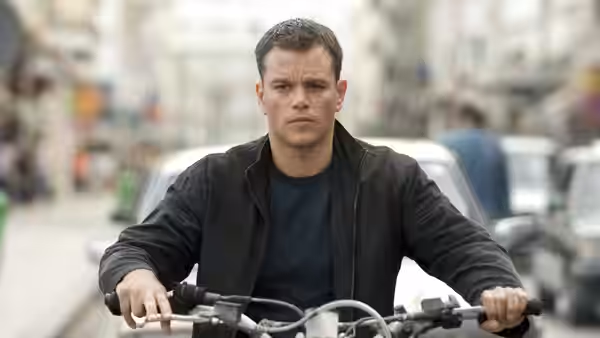
The reservations. Underneath the running there is not much plot, and the answer to who Bourne was is roughly the answer you would have guessed. Scott Glenn’s CIA Director Ezra Kramer exists to sign things. The politics amount to a hood over a head and a word like rendition said grimly; the film shows them, moves on, and seems pleased with itself for having shown them. And Wood’s handheld camera, which is right for Waterloo, loses its footing in the New York car chase, where for a stretch we could not have said which vehicle was which. Most critics forgave that more readily than we did. It costs the sequence some of its fear, because you cannot be frightened for a car you cannot find.

Set against the series, it is quicker and colder than Liman’s The Bourne Identity and less grieving than Supremacy, and it is the one where everything Greengrass had been working at comes off. The Bond films had already changed their manner in response by the time Casino Royale arrived, and this is still the leaner of the two.

Watch it with the sound up and the lights off, and do not expect to remember the story in the morning. You will remember the station.

Critical consensus AI synthesised

82
Positive
17
Mixed
0
Negative
1

The reviews are almost unanimous. Most critics find the film relentless and rate it the strongest entry in the trilogy, and the praise gathers around Paul Greengrass’s handheld direction, which they credit with giving the chases and fights an immediacy most action films lack. Matt Damon is singled out nearly everywhere for a Bourne who is both lethal and haunted, and several critics note that the film’s interest in guilt and government paranoia lifts it above standard genre fare.

The reservations are minor and scattered. A handful of critics find the plot preposterous or formulaic, though they enjoy the film anyway, and Screen Daily notes that the shaky camera wears thin in some sequences. The spread is narrow: seventeen positive reviews against a single negative. That dissent comes from Slant Magazine, which argues that the stunts and political posturing leave the film technically proficient but empty.

Radio Times
★★★★★ · Alan Jones
100

The review lauds the unrelenting pace, dazzling script, Damon's ownership of the role and Greengrass's handheld technique for immediacy and thrills. It calls the film a superbly crafted masterclass in intelligent action filmmaking that never loses grip or credibility.

Read the full review →
Empire
· James Dyer
90*

The critic praises Greengrass for delivering a more intense and technically proficient sequel than Supremacy, with an unrelenting pace, inventive screenplay and standout action sequences including a frenetic rooftop chase and visceral fight. Damon is highlighted for his convincing portrayal of a vulnerable yet lethal Bourne.

Read the full review →
The AV Club
2 August 2007 · A- · Scott Tobias
90

The critic commends the film's continuation of Bourne's character arc and Greengrass's handheld documentary style for delivering grounded realism, breathless chases, and a strong residue of anti-government paranoia within mainstream action cinema.

Read the full review →
The Hollywood Reporter
2 August 2007
90*

The review lauds the film's nonstop nervous energy and inventive chase sequences across global locations, highlighting Matt Damon's Hamlet-like portrayal of Bourne and the sharp intelligence in the screenplay amid the action spectacle.

Read the full review →
The New York Times
3 August 2007 · Critic’s Pick · Manohla Dargis
90*

Dargis calls the film fantastically kinetic and propulsive, with unusually smart action choreography. She singles out Matt Damon's haunted, brooding performance and the series' emphasis on remorse amid the violence.

Read the full review →
Total Film
17 August 2007
90*

The critic lauds the film's jaw-sagging action sequences, smart scripting and larynx-crushing martial arts, noting Greengrass's twitchy shaky-cam style injects the spy thriller with true class. Damon remains full of surprises as Bourne, and the film is commended for refreshing the genre with political edge despite some signs of franchise fatigue.

Read the full review →

Cast

Awards

Academy Awards, 2008

Won
Best Film Editing
Won
Best Sound
Won
Best Sound Editing

BAFTA Film Awards, 2008

Nominated
Best British Film
Nominated
Best Direction
Nominated
Best Special Visual Effects
Won
Best Editing
Won
Best Sound

MTV Movie Award for Best Fight, 2008

Nominated
MTV Movie Award for Best Fight

MTV Movie Award for Best Male Performance, 2008

Nominated
MTV Movie Award for Best Male Performance

SAG Awards, 2008

Won
Outstanding Performance by a Stunt Ensemble in a Motion Picture

Satellite Award for Best Editing, 2007

Nominated
Satellite Award for Best Editing

Satellite Award for Best Sound, 2007

Won
Satellite Award for Best Sound

Satellite Award for Best Visual Effects, 2007

Nominated
Satellite Award for Best Visual Effects

If you liked this, try…