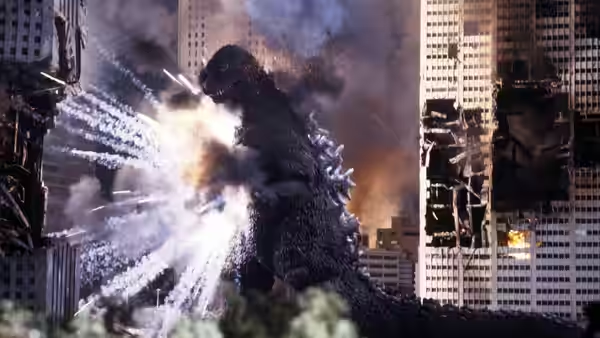
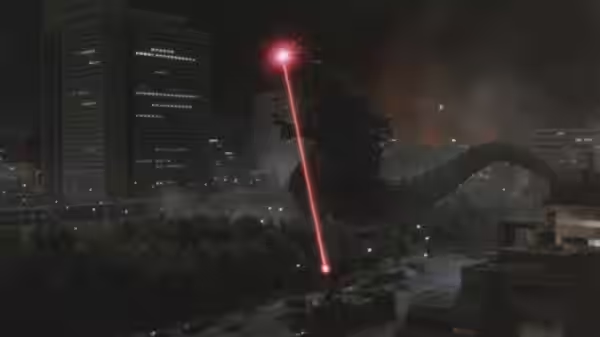
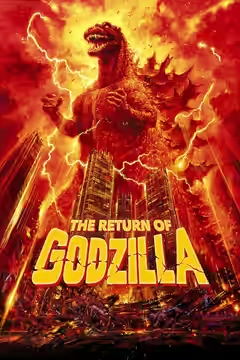
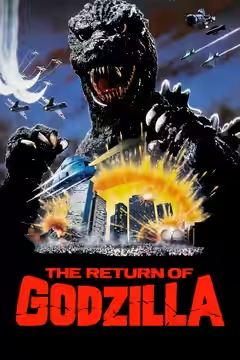
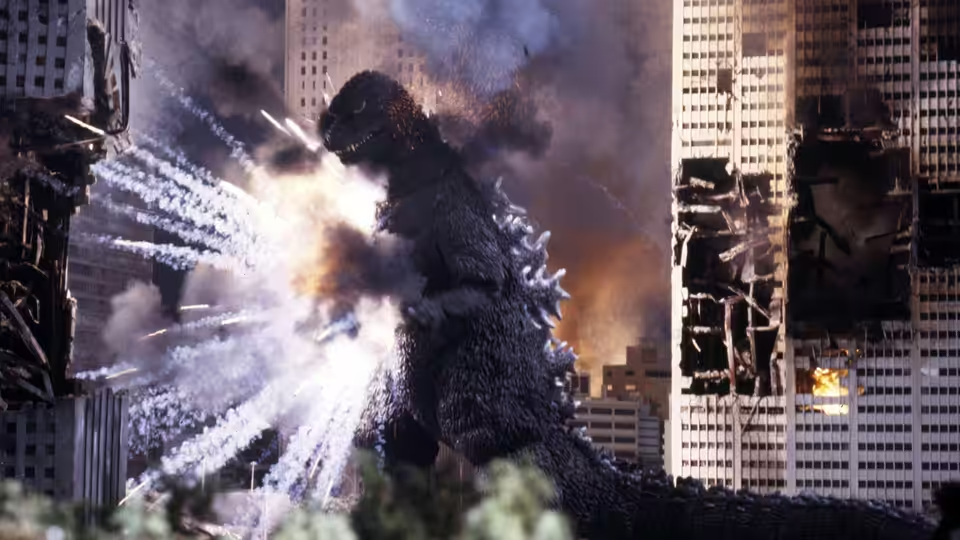
Godzilla towers between damaged city buildings as explosions erupt around him
Film review

The Return of Godzilla

1984 · Directed by Koji Hashimoto · 1h 43m

In a sentenceThirty years away, and Godzilla comes home to find the Cabinet more frightened of Washington and Moscow than of him

Japan, 1984. A fishing boat drifts back towards shore with its crew dead, and reporter Goro Maki (Ken Tanaka) boards it to find one survivor, Hiroshi Okumura (Shin Takuma), who says he saw Godzilla rise out of the sea. The government orders the story buried. Maki tracks down Hiroshi’s sister Naoko (Yasuko Sawaguchi) and Professor Makoto Hayashida (Yōsuke Natsuki), a scientist who lost his parents to the monster’s first attack thirty years earlier and has been waiting for the second. When a Soviet submarine is destroyed off the coast, Prime Minister Seiki Mitamura (Keiju Kobayashi) has to persuade Moscow and Washington that a monster, not a rival navy, is to blame, and that no nuclear weapon will be used on Japanese soil whatever comes ashore.

Fi1m review

Koji Hashimoto brings Godzilla back as a grave Cold War problem for a nervous Cabinet, and the meetings are better than the love story. The monster is handsome, the people are stiff, and the film sits halfway between a good idea and a good evening.

The Return of Godzilla is a fresh start. It ignores every sequel that came after the 1954 original and behaves as though the monster has been asleep for thirty years and Japan has spent that time getting on with things. Koji Hashimoto directs from Hideichi Nagahara’s script, with the story credited to Tomoyuki Tanaka, and the tone is set in the first minute: no wrestling, no children, no music you could hum. This is a disaster picture with a Cabinet in it, and it runs 103 minutes without once cracking a smile.

The opening is the best stretch. Kazutami Hara shoots the drifting trawler in wet greens and near-black, with a torch beam the only thing moving, and Hashimoto takes his time getting Goro Maki (Ken Tanaka) below deck. What he finds there is not the monster but something smaller that has come off it, and the shrivelled faces of the crew. We were more unsettled than we had bargained for from a PG film about a man in a rubber suit; the shot of a dead sailor lit from beneath stayed with us longer than any of the later explosions. Yoshitami Kuroiwa cuts the sequence slowly and lets the silence do the work.

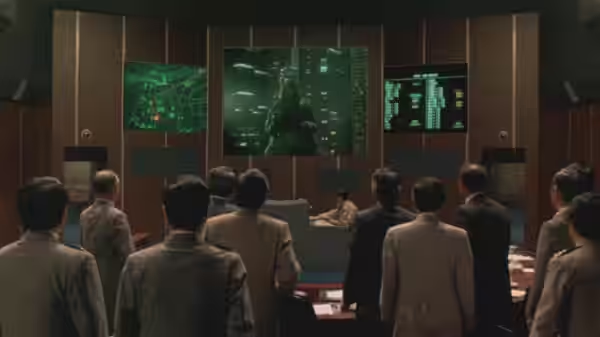
Then the film goes indoors, and to our surprise it stays interesting. Keiju Kobayashi plays Prime Minister Seiki Mitamura as a tired, decent man who has not slept, and the long scenes in which he refuses both superpowers the right to use a nuclear weapon on his coast have a real charge. Eitarō Ozawa, Taketoshi Naito, Nobuo Kaneko and Mizuho Suzuki fill the table as ministers who each want a different thing, and Nagahara gives them proper arguments rather than speeches. The film treats a monster as a diplomatic incident, and for twenty minutes that is a good idea well handled.

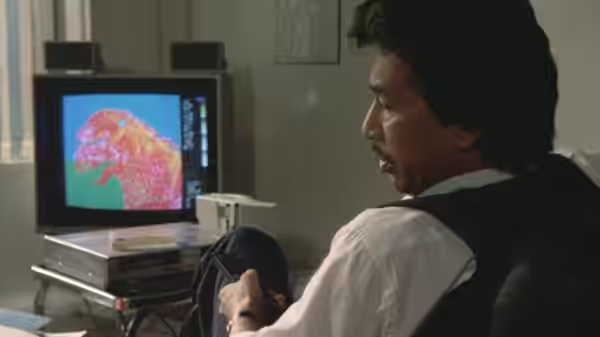
The trouble is everyone under the age of fifty. Tanaka’s reporter is handsome and has nothing to do once he has found the survivor. Yasuko Sawaguchi, as the sister Naoko, is given a scene of anger at being lied to and then a scene of being rescued, and not much between. Shin Takuma spends most of the film in a hospital bed. Yōsuke Natsuki fares better as Professor Hayashida, a man with a theory about birds and a private grief, but the romance between Maki and Naoko is so faint that we forgot it was happening. We were bored by it, and then we noticed we were checking the clock for the monster, which a Godzilla film should never let you do.

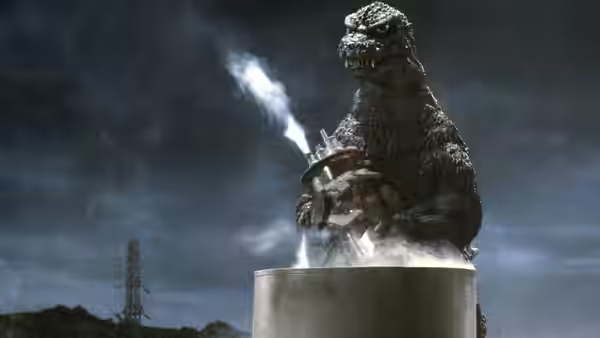
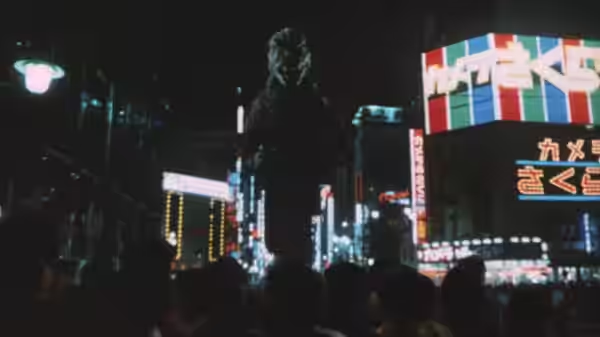
The monster, when he comes, is worth the wait. The suit is credited under costume design to Kenji Kawasaki, Tomoki Kobayashi and Nobuyuki Yasumaru, and it is the most expressive Godzilla in years: a big, sorrowful head with eyes that seem to be looking for something, and a heavy, unhurried walk. Mutsumi Toyoshima, Akira Sakuragi and Yasuyuki Inoue build a Tokyo of tall glass towers for him to lean on, and Hara shoots the city at night in searchlight white so the joins between model and man mostly stay hidden. Mostly. There are shots where the neck bends the wrong way and the buildings look like the kits they are. Reijirō Koroku’s score is a slow, mournful brass march, closer to a requiem than an adventure theme, and it is the thing that most clearly tells you what the film wants to be.

Against the 1954 original, which was made by people who had lived through the bombing and looked like it, this is a film about procedure rather than grief. Against the 1970s entries it is a relief: nobody is thrown by the tail, and the monster is frightening again. There is also a shorter version made for the West with new American scenes added, released as Godzilla 1985, and it is not the film reviewed here; the Japanese cut is longer, quieter and better.

Worth an evening if the idea of a monster film that spends half its time in committee appeals to you, as it did to us. If you want the fight, skip the first hour, which would be a shame, because the first hour is where the good film is hiding.

Critical consensus AI synthesised

1 of 6
Positive
0
Mixed
0
Negative
1
Radio Times
★★ · Alan Jones
40

Jones gives the film a low rating, describing its familiar monster-and-Cold-War spectacle. He singles out Raymond Burr’s return in footage added for western markets.

Read the full review →

Straight answers AI written, from our review

Is The Return of Godzilla worth watching?
The Return of Godzilla is worth an evening for anyone drawn to a monster film that spends half its time in Cabinet meetings, and we scored it 55. The opening on the drifting trawler and the Prime Minister's stand against two superpowers are good; the younger characters and their faint romance are not. If you only want the fight, this is not the one.
How long is The Return of Godzilla, and what is it rated?
The Return of Godzilla runs 1h 43m. It is a science fiction and action film.
Where can I watch The Return of Godzilla in Colombia?
The Return of Godzilla is streaming on MUBI and Amazon Prime Video in Colombia. Availability is checked daily; the links above go straight to each service.
How violent or frightening is The Return of Godzilla, and is it suitable for children?
The Return of Godzilla is a UK PG, and its frights come from mood rather than gore. The opening aboard a boat full of dead sailors, one lit from beneath, unsettled us more than we expected, and the city scenes are dark and sombre rather than playful. Older children who can take a grave tone should be fine; younger ones may find the first half slow and the trawler scene too much.
How does The Return of Godzilla compare to Godzilla?
The Return of Godzilla is a film about procedure where Godzilla is a film about grief, and the earlier one is the better of the two. Ishirō Honda's original was made by people who had lived through the bombing and its destruction hurts; the 1984 film treats the monster as a diplomatic incident, with tired ministers and a mournful brass score. Start with the original; come to this one if the idea of a monster in committee appeals.
What should I watch after The Return of Godzilla?
After The Return of Godzilla, try Godzilla (1954, Fi1m 88): The one this film is trying to remember, and the one with the grief in it. Then Godzilla vs. Biollante (1989, Fi1m 76): The direct sequel, stranger and more alive, with a monster made of roses; and Shin Godzilla (2016, Fi1m 74): The Cabinet-meeting version done properly, fast and furious about bureaucracy.

Cast

If you liked this, try…

  1. Godzilla (1954, Fi1m 88)The one this film is trying to remember, and the one with the grief in it.

  2. Godzilla vs. Biollante (1989, Fi1m 76)The direct sequel, stranger and more alive, with a monster made of roses.

  3. Shin Godzilla (2016, Fi1m 74)The Cabinet-meeting version done properly, fast and furious about bureaucracy.

  4. The Host (2006) · not on Fi1m yetA Korean family chases a river monster; funnier, sadder and better acted.

  5. Threads (1984, Fi1m 92)British television’s nuclear nightmare from the same year, without the monster to soften it.

The Return of Godzilla (1984) review: solemn, stiff, half works (Colombia) | Fi1m