Michael C. Hall’s serial killer is dug up for a fourth run, moved to New York and sat at a table of worse people. It is nimble, funny and better than it has any right to be, and it cannot stop looking over its shoulder at the original.
Michael C. Hall has now played Dexter Morgan across four series, and this one opens with him surviving something that was plainly meant to finish him. Clyde Phillips, credited as creator, has made a decision that Dexter: New Blood (2021) did not: this is a comedy. A dark one, with the plastic sheeting and the syringe, but a comedy. Moved to New York and seated among other murderers, Dexter is once again the most reasonable man at the table, and the show knows how funny that is. It is a lively ten episodes and it is also a show that cannot stop quoting itself.
Hall remains the reason to watch. The voiceover, which was always the franchise’s best instrument, is back to its old dry register, a man narrating his own worst behaviour in the tone of a nature documentary. What Hall adds this time is age. He moves more carefully, he tires, and when Harrison (Jack Alcott) looks at him with something between fear and need, Hall lets the face go slack in a way he never did in Miami. James Remar’s Harry is still there to argue with him, and the two of them bickering in a stranger’s spare room is as close as the show comes to a home life.
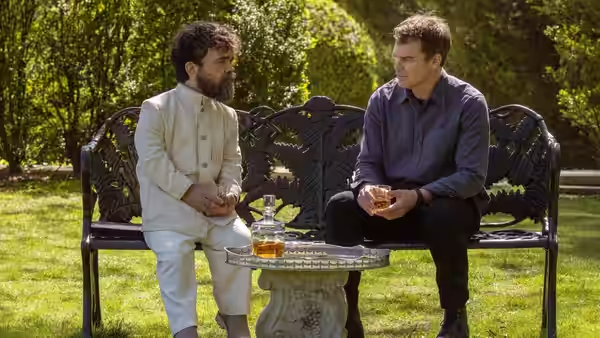
The supper club is where the season earns its keep. Peter Dinklage plays Leon Prater as a man who has bought everything and found that murderers are the only thing left that interests him, and he delivers his lines with the pleasure of a host showing off a wine cellar. Uma Thurman’s Charley runs his security with a stillness that suggests she has done worse than anyone at the table. Brian Cox turns up as the New York Ripper and is, for a couple of scenes, the most frightening thing in the show. We laughed a good deal at these dinners, at the etiquette and the small talk, and then we felt slightly grubby about it, which we suspect is the effect Phillips wanted and the only place the show has anything like an idea.
Three cinematographers are credited, Radium Cheung, Ramsey Nickell and Joe Collins, and between them they give New York a cold, flat light that is a long way from the orange of the old Miami episodes. Prater’s rooms are warm and gold; everything Dexter does alone is done in grey. Pat Irwin’s score keeps the sardonic little figures the show has always used to tell us a joke is coming. The editing, spread across five names, is where the seams show. The killings and the dinners are cut tight; the police scenes are not.
Those police scenes are the trouble. Kadia Saraf and Dominic Fumusa, as the detectives Claudette Wallace and Melvin Oliva, are given nothing to play but procedure, and the show keeps returning to them as if it had a quota. Harrison’s own strand, in a hotel with Elsa Rivera (Emilia Suárez), is meant to carry the season’s guilt and mostly carries its running time. Somewhere in the middle episodes we found ourselves counting how many were left, and we were irritated, because the same hours contained a dinner party we would happily have watched twice.
David Zayas is the one supporting player the show treats seriously. His Batista is heavier, sadder and more stubborn than the man we remember, and the scenes in which he closes in on an old friend are the only ones where the season seems to believe its own past rather than merely reference it. Elsewhere the references pile up. Old faces, old lines, old tricks, all delivered with a nudge. Once is a wink. By the fourth or fifth it is a habit, and a show that has found a new setting and a new joke should not need it.
Set against the franchise’s own record, this sits nearer the early pulp of Dexter (2006) than the severity of New Blood, and that is a fair place for it. It is not asking to be taken seriously and it should not be. Watch it with someone who knows the old show; half the pleasure is in the recognition, and half the irritation too. It carries an 18 certificate, and it earns it at the dinner table.