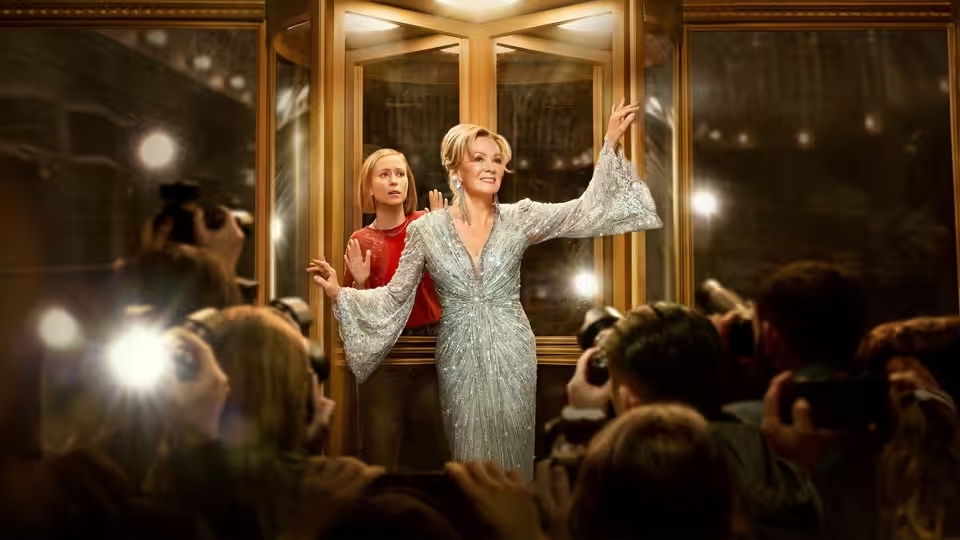
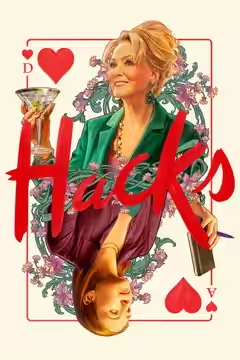
Hacks is a funny, sometimes moving comedy about two women who make a difficult job harder for each other. Jean Smart and Hannah Einbinder are excellent together, though the writing sometimes presses their generational differences too hard.
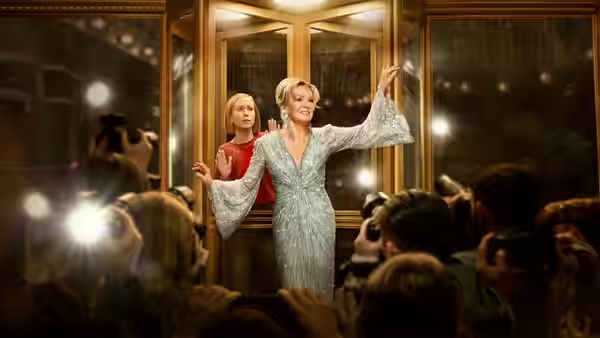
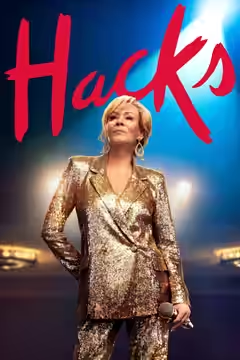
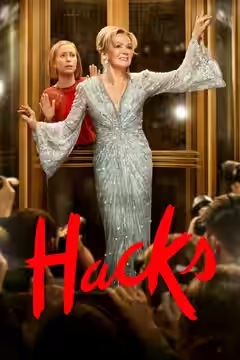
Hacks is a funny, warmly acted comedy-drama, and we recommend it despite some laboured writing about the gap between its leads. Jean Smart plays Deborah Vance, a veteran stand-up in Las Vegas who finds herself working with a young writer whose career has gone wrong. Hannah Einbinder’s Ava brings her own grievances to an arrangement neither woman seems equipped to make comfortable. The series gets considerable pleasure from their friction, then takes enough interest in both women to make the developing relationship matter.
Smart makes Deborah’s professional authority easy to accept, even when the woman herself is difficult company. She can make a disagreement entertaining without making Deborah seem fair, which is important in a series that asks us to spend so much time with her. We laughed at Deborah’s impatience, then felt unexpectedly protective of her. In her exchanges with Ava, Smart makes being good at the job seem like something she cannot afford to lose.
Einbinder has the less immediately rewarding part and deserves more credit than simply keeping up. Ava’s professional troubles put her at a disadvantage, yet Einbinder makes the younger woman’s readiness to challenge Deborah credible rather than merely convenient for the script. Their scenes work because each performer gives the impression of listening for something objectionable in what the other has just said. The warmth is welcome when it arrives, but the actors do not suggest that liking a colleague will cure the habit of arguing.
Writers including Lucia Aniello, Paul W. Downs and Jen Statsky are good at showing how easily a discussion about work becomes personal. The weaker exchanges lean too hard on the women’s ages, making their disagreements predictable before either has finished speaking. Ava suffers most from this, occasionally seeming to have been written to illustrate a complaint about younger people. Einbinder gives her more life than that, but the scripts sometimes need a less obvious objection for her to raise.
Adam Bricker’s cinematography is most effective when it lets the performances command our attention. Las Vegas could easily overwhelm a story so dependent on conversation, but the setting never becomes the main attraction for us. The production designers, including Jon Carlos and Rob Tokarz, make Deborah’s surroundings persuasive as the world of an established entertainer. Those surroundings help us accept her standing, though Smart does much of that work before we have had time to inspect them.
The editing team, including Susan Vaill and Jessica Brunetto, gives the verbal sparring a pleasing rhythm without making every exchange feel like a race to the punchline. We enjoy the pace most when irritation has time to linger between the jokes. Carlos Rafael Rivera and David Stal’s music is a modest pleasure beside the performances, supporting the more tender passages without insisting that we stop laughing. The conversations remain what we want to hear.
The series is also sensible about how far charm should excuse unpleasantness. A workplace comedy can become cosy by treating difficult people as harmless eccentrics; these two are allowed to remain troublesome. That makes the warmer passages easier to believe, because nobody has to become agreeable to earn them. Watch it with someone who enjoys a good argument and does not need either participant to win.