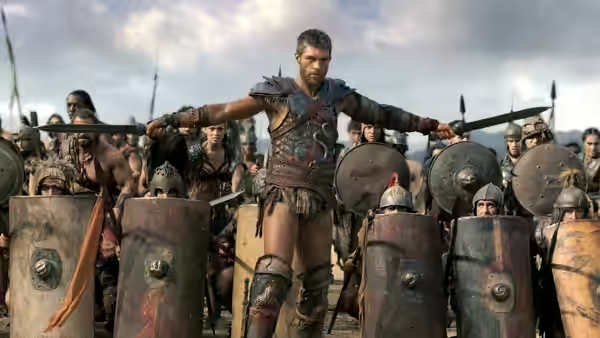
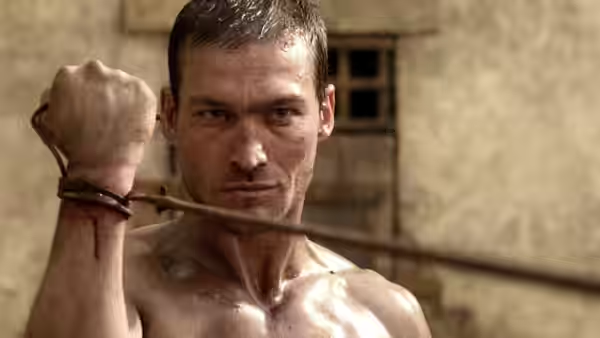
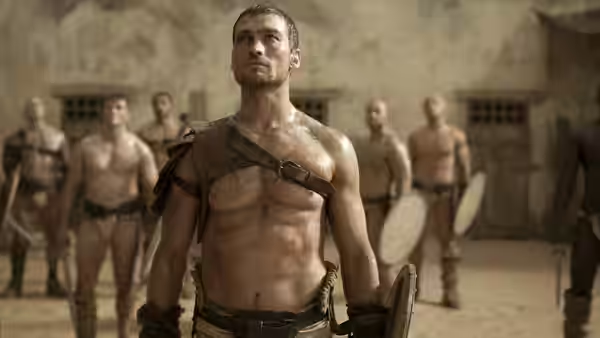
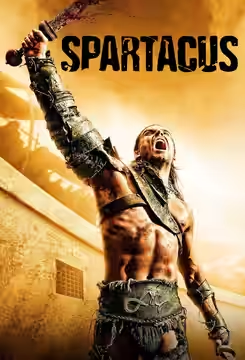
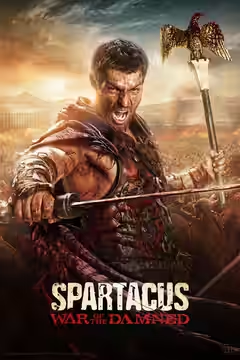
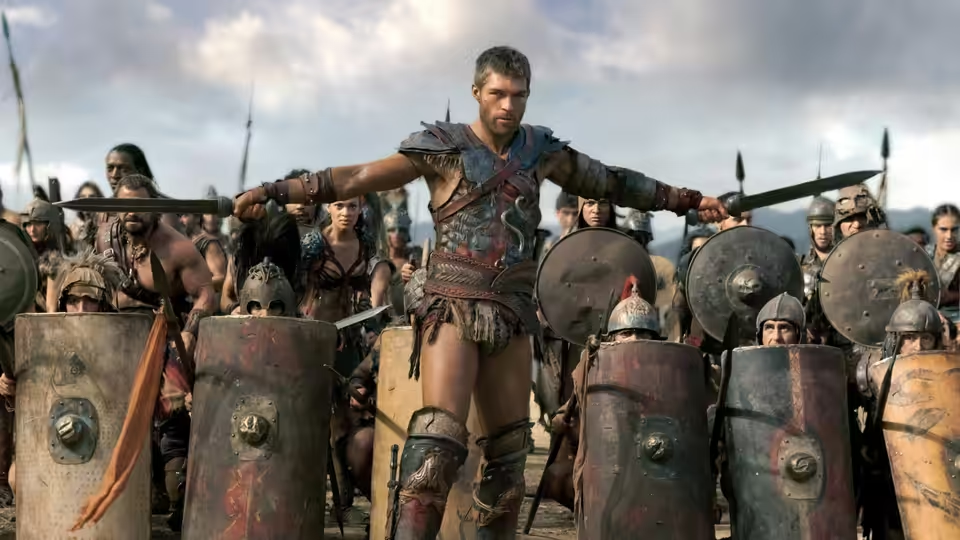
Spartacus (Andy Whitfield) stands with arms outstretched among his armed warriors
Series review

Spartacus

2010 · Created by Steven S. DeKnight · Series · 53m

In a sentenceJohn Hannah makes owning people look more appalling than all the flying blood does

In ancient Rome, Spartacus (Andy Whitfield) wants his freedom. Batiatus (John Hannah) and Lucretia (Lucy Lawless), the owners whose schemes surround him, have their own interests to protect. Fighting brings physical danger, while their manoeuvring makes survival depend on more than strength. Sex and violence are routine parts of this society, where the people who own others determine how those bodies are used. Spartacus has to contend with those who claim authority over his life as he struggles against a system that treats human beings as property.

Plays from YouTube when you press play; nothing loads from them until then.

Fi1m review

Strong performances and enjoyable scheming make Spartacus worth considering for devotees of lurid historical drama. Repetitive violence and thin plotting mean the blood is often doing work the writing should have done.

Spartacus is decent, unruly television for viewers prepared to tolerate repetitive graphic violence for the sake of some strong performances. Created by Steven S. DeKnight, it takes the brutality of ancient Rome as permission to be noisy, lewd and determinedly unsubtle. We have no objection to that approach: a drama about people owning other people has good reason to be unpleasant. The problem is how often another bout of excess has to cover for a story that has barely advanced.

Andy Whitfield gives Spartacus enough conviction to keep the central struggle for freedom from disappearing beneath the blood. He has the presence this material needs, even when the dialogue gives him little help. John Hannah as Batiatus and Lucy Lawless as Lucretia are more entertaining, largely because scheming gives them something to play beyond determination. Their owners make the business of controlling other lives unpleasantly enjoyable to watch. We wanted more time with these two whenever the series returned to another demonstration of how graphically it could injure someone.

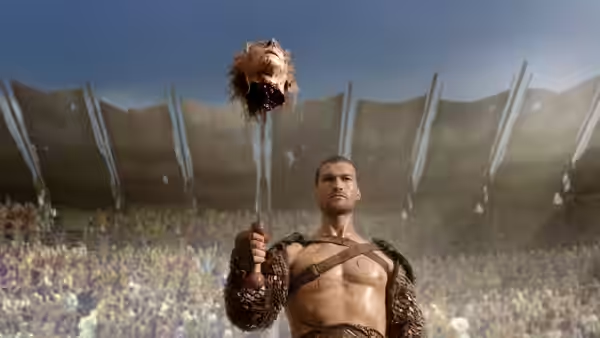
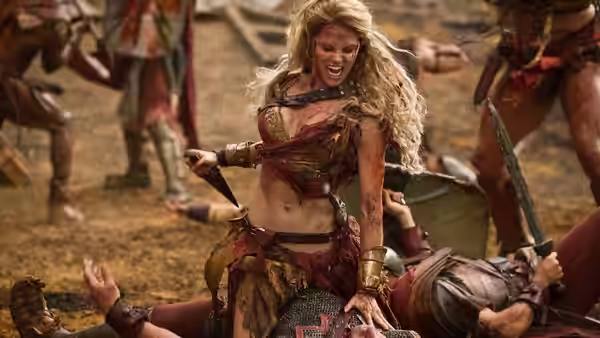
The fights have a peculiar problem: the more insistently the slow motion asks us to inspect the violence, the less convincing the wounds become. We laughed at the bloodshed because its cartoonish exaggeration makes the effort to shock so obvious. There is pleasure in that ridiculousness, and the programme sometimes seems quite willing to share it. As the fights accumulate, however, the emphasis on each impact becomes tiring, and the programme keeps using a device whose effects have already worn off.

The artificial-looking settings are less of a problem in themselves. A Roman drama need not convince us that somebody has rebuilt Rome, and the enclosed spaces can suit a story dominated by owners and their schemes. What weakens the effect is the combination of that conspicuous unreality with violence so keen to impress us with its physical detail. Joseph LoDuca provides the music, but the accompaniment cannot supply the restraint the staging lacks. Too much of the presentation insists on attention at once.

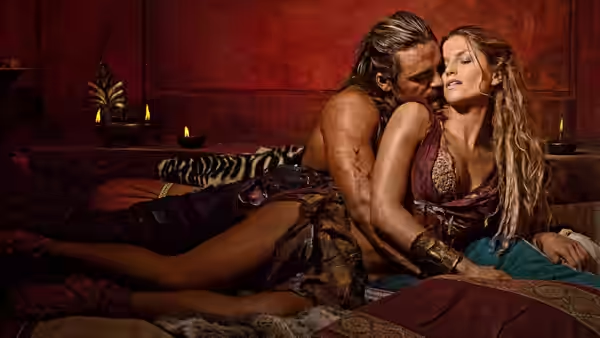
The writing is where patience becomes harder to justify. Thin individual stories are stretched around sex and injury, and too many characters remain simple enough to grasp before they have finished speaking. The series has a compelling subject in the fight for freedom, but it does not always find enough for its people to do between the displays of flesh. The sexual explicitness is not an objection in itself. It becomes one when another encounter delays rather than deepens our understanding of the people having it.

Against the demands of a sword-and-sandals drama, Spartacus delivers force, appetite and enough forward movement to make another episode tempting. It is less reliable at giving the violence consequences we can feel, which matters in a story built around human suffering. The performances keep it watchable, particularly when John Hannah and Lucy Lawless are allowed to scheme, but they cannot make every delay worthwhile. Try it for those two if lurid historical television is already a pleasure; a low tolerance for slow-motion blood will not improve with practice.

Critical consensus AI synthesised

51
Positive
2
Mixed
2
Negative
2

The reviews are evenly divided on Spartacus, with agreement about its excesses but little agreement about their value. Graphic violence, abundant sex and stylised action dominate the discussion. Admirers find an entertaining willingness to be ridiculous, while some reviews also credit the cast with giving the spectacle momentum. Praise for the performances centres on Andy Whitfield’s commanding lead and the scheming owners played by Lucy Lawless and John Hannah, though enthusiasm for the acting is not universal.

Reservations cluster around thin plotting, weak dialogue and artificial-looking production, with detractors finding too little substance to sustain a series. The spread is wide: Variety dismisses the sex and slow-motion violence as unconvincing imitation, whereas Paste’s later assessment praises a forceful story of rebellion that survives its lead’s departure. The central disagreement is whether the excess supplies sufficient entertainment or merely pads out underwritten stories.

Empire
28 April 2011 · Danny Graydon
70*

The series trades gravitas for breasts and loose historical accuracy, delivering 300-style violence mixed with aerobic sex. Andy Whitfield commands as Spartacus but is upstaged by Lucy Lawless and John Hannah as scheming owners; it is a guilty pleasure.

Read the full review →
The Guardian
26 May 2010 · John Crace
60*

The review finds the series' extreme sex and violence surprisingly jolly and entertaining in a trashy, computer-game-like way despite thin plotting and weak dialogue. It singles out the cartoonish gore, over-the-top sex scenes and self-aware comedy for note while dismissing the cast and story.

Read the full review →
The AV Club
23 January 2010 · C · Emily St. James
57

The critic finds the pilot overly focused on gratuitous sex and violence in a low-budget style reminiscent of 300, making it feel like it was designed for teenage boys. While acknowledging some compelling momentum and strong performances from the cast, the review notes it fails to fully deliver on its ambitions and is not broadly recommendable.

Read the full review →
The Hollywood Reporter
14 October 2010
30*

The review faults the series for padding thin, episodic stories with excessive sex and graphic violence, resulting in two-dimensional characters and an artificial, soundstage-bound production that works better as a film than an ongoing TV series.

Read the full review →
Variety
17 January 2010 · Brian Lowry
20*

The critic dismisses the series as a weak, laughable imitation of '300' and 'Gladiator' that fails to capture the spirit of its namesake, relying on graphic but unconvincing sex and slow-motion violence amid thin plotting and cheap-looking production values.

Read the full review →
Paste
8 April 2022 · Katy Kostakis
80*

The critic praises the Starz series for successfully continuing after its lead's departure and delivering a powerful story of rebellion and retribution. The graphic violence, nudity, and salty dialogue are singled out as capturing the hedonism and brutality of ancient Rome while highlighting the characters' fight for freedom.

Read the full review →

Straight answers AI written, from our review

Is Spartacus worth watching?
Spartacus is worth considering for devotees of lurid historical drama, though its strong performances and enjoyable scheming only take it to our score of 63. We find John Hannah and Lucy Lawless particularly watchable, but thin plotting, repetitive graphic violence and sexual encounters that delay the story make it harder to recommend beyond that audience.
How long is Spartacus, and what is it rated?
Spartacus has episodes of about 53m. It is a drama series.
Where can I watch Spartacus in Colombia?
Spartacus is streaming on Netflix, Amazon Prime Video and Apple TV in Colombia. Availability is checked daily; the links above go straight to each service.
How violent or frightening is Spartacus, and is it suitable for children?
Spartacus carries a UK 18 certificate and is unsuitable for children, with repetitive graphic violence and sexual explicitness making it adult viewing. We find the exaggerated slow-motion bloodshed more cartoonish than frightening, but its frequency makes this a poor choice for the squeamish; the treatment of human beings as property adds another source of unpleasantness.
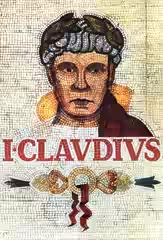
How does Spartacus compare to I, Claudius?
Spartacus offers more graphic spectacle, but we recommend I, Claudius more confidently for its writing, acting and disturbing Roman family politics. Both have conspicuously artificial settings; Spartacus leans on sex and slow-motion injury, while I, Claudius makes cruelty felt through wit and conversation, making it the better choice if the scheming interests you more than the fighting.
What should I watch after Spartacus?
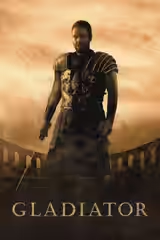
After Spartacus, try I, Claudius (1976, Fi1m 90): For those who prefer their Roman viciousness delivered through conversation. Then Gladiator (2000, Fi1m 84): Arena spectacle with a steadier emotional centre and less gleeful excess; and Ran (1985, Fi1m 92): Warring rulers and family betrayals, with violence that carries punishing weight.

Cast

If you liked this, try…

  1. Rome (2005) · not on Fi1m yetRoman power games with more patience for politics and complicated loyalties.

  2. I, Claudius (1976, Fi1m 90)For those who prefer their Roman viciousness delivered through conversation.

  3. Gladiator (2000, Fi1m 84)Arena spectacle with a steadier emotional centre and less gleeful excess.

  4. Ran (1985, Fi1m 92)Warring rulers and family betrayals, with violence that carries punishing weight.

  5. Queen Margot (1994) · not on Fi1m yetSex, power and religious bloodshed in a court crowded with enemies.