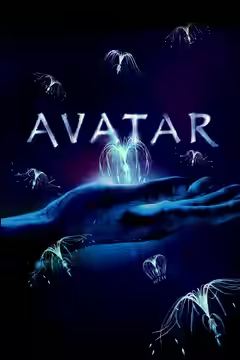
Cameron builds a moon with more care than anyone has built a place on screen, then fills it with a story he could have written in his sleep. The world is worth the 162 minutes; the script is not, and the two arrive in strict alternation.
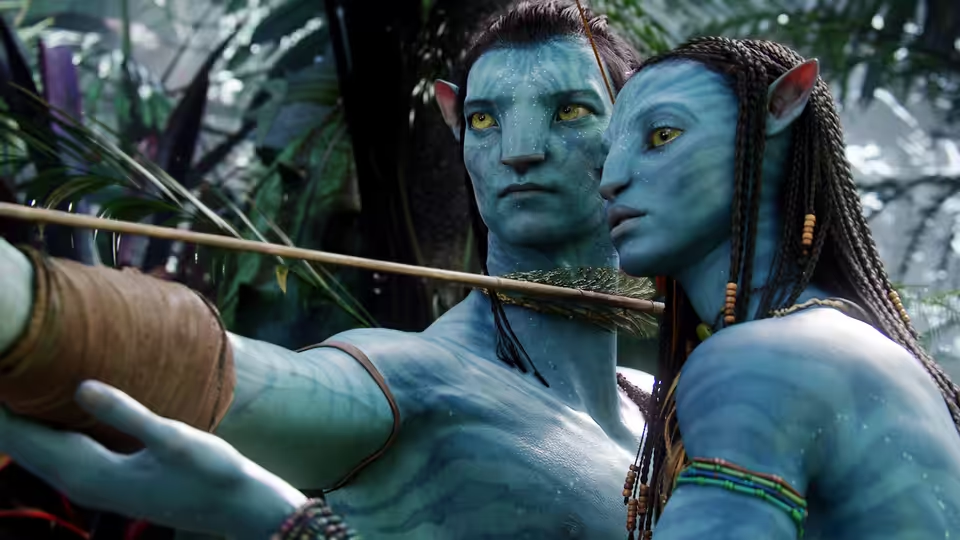
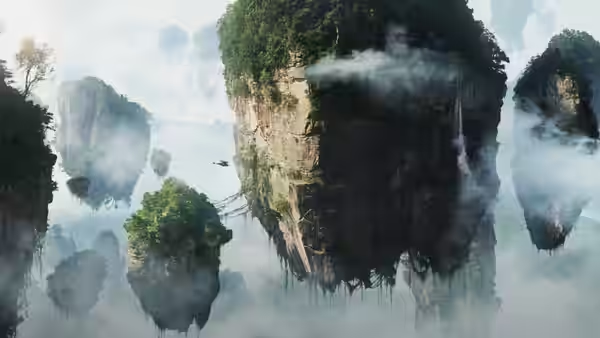
James Cameron has spent his career building machines and then breaking them: the drop ship in Aliens, the rig in The Abyss. Avatar is the first of his films in which the thing he has built is a whole place. Pandora is a moon of forests, floating mountains and six-legged animals, seen through the eyes of Jake Sully (Sam Worthington), a paraplegic ex-Marine who takes his dead twin’s place in a programme that puts human minds in bodies grown from the natives’ DNA. The world is the best thing Cameron has made. We came out after 162 minutes having believed every leaf and almost none of the lines.
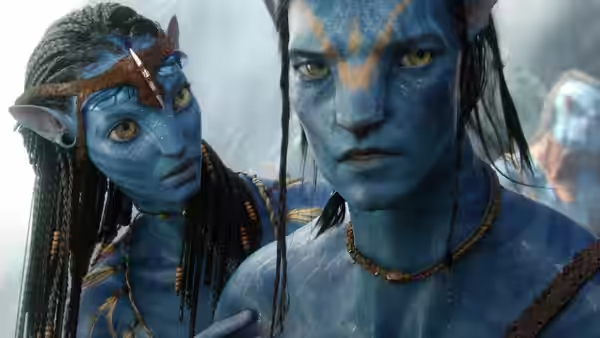
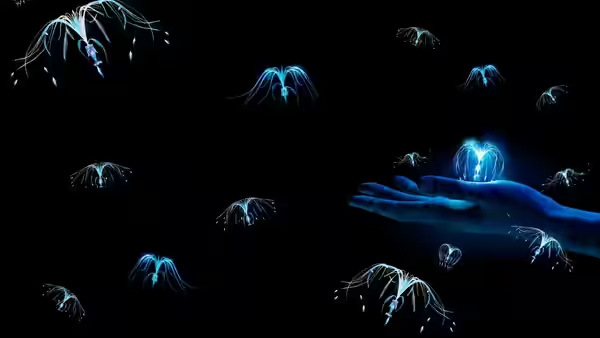
Rick Carter and Robert Stromberg’s production design splits the film into two worlds. The human base is grey metal, strip lighting and glass, with Parker Selfridge (Giovanni Ribisi) putting golf balls across the operations floor. The Na’vi live in a tree the size of a cathedral, and Mauro Fiore shoots the base cold and flat and gives the jungle every colour he has. The night sequence in which Neytiri (Zoe Saldaña) leads Jake through undergrowth that lights up blue and pink wherever a foot lands is the moment the film has you or does not. It had us. We had not felt that childish sort of wonder in years.
Saldaña is the reason the romance works at all. Neytiri is a computer drawing built over her performance, and what survives is her impatience: the hiss when Jake blunders, the ears flattening back, the way she looks at him as if he were a large stupid dog. Worthington is stolid, which suits a man learning to walk again and helps less when the film needs him moved. Sigourney Weaver plays Dr. Grace Augustine as a chain-smoking botanist who prefers plants to people. Stephen Lang’s Colonel Miles Quaritch is the best of the humans: a man with scars down his head who sips coffee while directing gunships, played without a flicker of doubt.
The trouble is the writing, and Cameron wrote it alone. The plot is the one in which a soldier is sent among the natives and learns their ways; Dances with Wolves did it in 1990. The mineral the company wants is called unobtanium, an engineer’s joke used as a name. Quaritch tells the new arrivals they are not in Kansas any more. The Na’vi speak of the energy that flows through all living things, and each of them is someone we have met in an earlier film. We were bored by the talking in a way we were never bored by the looking.
James Horner’s score leans on drums and a wordless choir and swells exactly on cue; it told us what to feel more insistently than the pictures did. John Refoua and Stephen E. Rivkin keep the long running time moving, and the flying sequences over the floating mountains are assembled so that you always know which way is down. The final stretch is a battle, and Cameron keeps the position of every gunship and every bow clear. There is a loss in the middle of the film we will not describe, and it got at us more than we expected, almost without dialogue.
Mayes C. Rubeo and Deborah Lynn Scott dress the Na’vi in beads and feathers and not much else, which is what a noble tribe has looked like in Hollywood for eighty years. The politics are of the same vintage: an army with American accents burns a forest to get at what lies under it, and the people who live there need an outsider to show them how to fight. Cameron means it as an apology. It comes out as the story it is apologising for.
See it on the biggest screen you can find, in 3D if one is going, because the depth of that forest is half of what Cameron has to offer. At home it shrinks to a well-made adventure with an extraordinary setting and a script nobody would have forgiven on a smaller film. We would still send you to it, for the forest at night.