Gore Verbinski’s third voyage has one sequence of real wonder and a battle in a whirlpool worth seeing, wrapped in an hour of pirates renegotiating their alliances in dim rooms. Some things here to admire; not enough to send you back to sea.
Gore Verbinski’s third Pirates of the Caribbean film runs 169 minutes and opens with a mass hanging, which is a bold way to begin a family film about a comedy pirate. The East India Trading Company has the sea by the throat, Davy Jones (Bill Nighy) is doing its work under protest, and Jack Sparrow (Johnny Depp) is dead and in the Locker. Ted Elliott and Terry Rossio have to bring him back, gather nine pirate lords, settle two romances, free a father and lift a curse, and they have chosen to do all of it at once.
The rescue is the best stretch. Verbinski puts the Black Pearl on a white salt flat under a hard sky, and Dariusz Wolski shoots it so flat and bright that the ship looks like a toy someone set down and forgot. Depp plays a whole crew of Jacks arguing over a peanut. Then the ship is lifted and carried to the water by a tide of crabs, and we felt something we do not expect from the third film of anything: surprise, and a small, unreasonable delight. Rick Heinrichs designed that shore, the Company’s boardrooms and a steaming Singapore bathhouse, and his work is the most consistent thing in the picture.
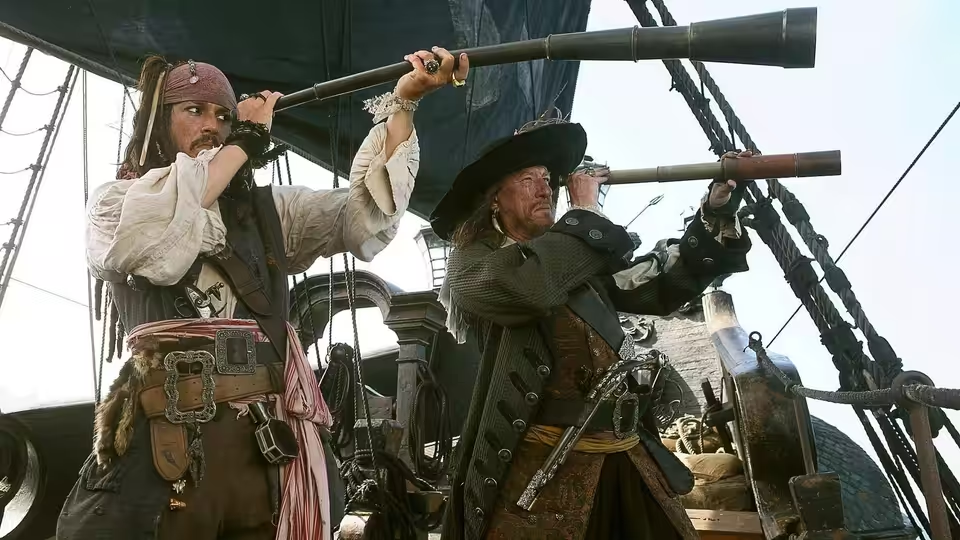
Geoffrey Rush is having the best time of anyone, rolling his lines and using the monkey as a prop, and Bill Nighy, under a beard of tentacles, plays Jones as a man who has been unhappy so long he has made a home of it. Depp has more to do than in the second film and is funnier for it, though the many-Jacks business comes back later and lands softer each time. Orlando Bloom and Keira Knightley are handed a romance built mostly from misunderstandings; Knightley, asked to command pirates and grieve in the same reel, does better than the script. Jack Davenport’s Norrington gets a strand worth playing.
The plot is the problem. The middle hour is a series of rooms in which people swap sides: Jack with the Company, Will with whoever will hand him his father Bootstrap Bill (Stellan Skarsgård), and a Singapore pirate lord with whoever spoke to him last. Elliott and Rossio treat each double-cross as a plot point, and it is a plot point once. By the third we had stopped keeping score, and by the pirate council, in which grown men argue procedure over an old rule book, we were bored, and then cross about being bored in a film with a ghost ship in it. Stephen E. Rivkin and Craig Wood cut briskly, but no editor can rescue a script with eleven agendas and no lead.
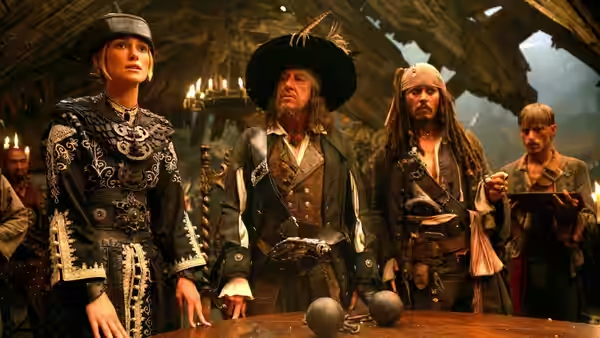
Penny Rose and Liz Dann dress the nine lords as a costume parade, and the film knows it, because it keeps cutting back to them when it has nothing else to show. Hans Zimmer’s score does more lifting than a score should, and the big set piece, two ships fighting inside a whirlpool in a rainstorm, would be a shambles without it. As spectacle it is enormous and you can follow it; Wolski keeps tilting the horizon so we always know which deck we are on. We were glad of it after the hour before, which is not quite the same as enjoying it.
Against The Curse of the Black Pearl (2003), a light, clean adventure, this is a wardrobe that has fallen open. It is a better film than Dead Man’s Chest (2006), because it has an ending and a stranger best sequence, but Verbinski’s gift for the odd image is spent servicing a plot he does not seem to believe in either. Pintel (Lee Arenberg) and Ragetti (Mackenzie Crook) get most of the honest laughs, standing at the edge of scenes and saying what we were thinking.
See it for the Locker, the crabs and Rush, and fetch a drink during the council. It is a 12A that opens with a mass hanging and asks you to laugh at a monkey shortly after, and it never squares those two films. At home the plot gets no clearer, but at least you can ask each other who is on whose side without being shushed.