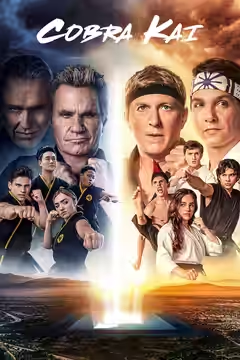
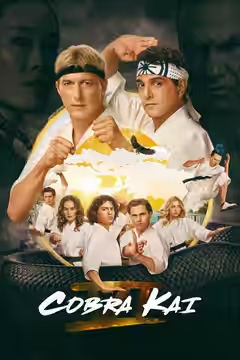
Six seasons of what happened to the bully from The Karate Kid. William Zabka makes Johnny Lawrence funny and then, without warning, sad, and the series is worth two seasons of anyone’s time. After that it repeats itself.
In 1984, in The Karate Kid, a blond boy lost the All Valley tournament to a crane kick and was never heard from again. Josh Heald, Jon Hurwitz and Hayden Schlossberg have spent six seasons and 65 episodes wondering what became of him. Their answer is that Johnny Lawrence has been in the San Fernando Valley the whole time, drinking, getting fired and not getting over it. Cobra Kai is warmer, funnier and better acted than a sequel to a 1984 teen film has any business being, and it goes on for about three seasons longer than it should. We can recommend it, with that caveat written large.
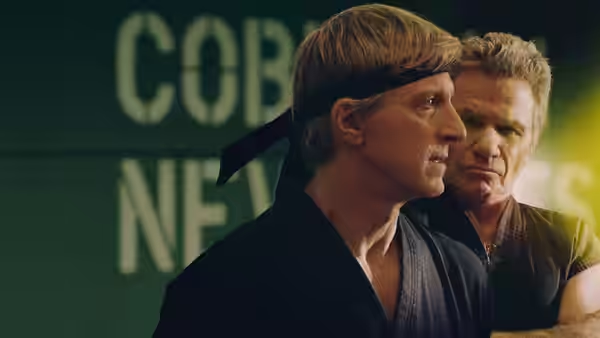
William Zabka carries it. He plays Johnny as a man who stopped taking in new information around 1985: he drives a Pontiac Firebird, does not know what the internet is for and speaks to teenagers the way his own sensei spoke to him, which is the problem in one sentence. Zabka never winks at us. We laughed at Johnny for the first two episodes and then, watching him stand in his empty dojo trying to teach one nervous boy to punch, we found we minded what happened to him, which we had not expected to.
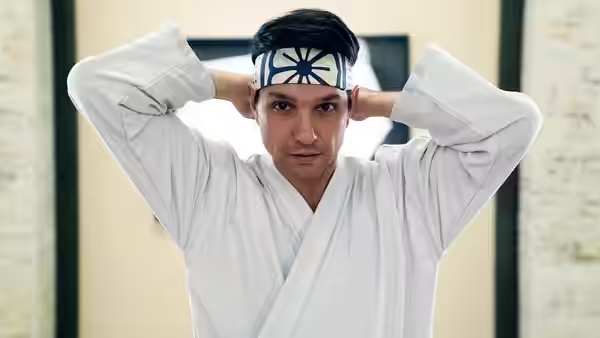
The nervous boy is Miguel Diaz, and Xolo Maridueña plays him with a decency that makes the arrangement work: he wants a father and Johnny has misplaced a son. Ralph Macchio, meanwhile, plays Daniel LaRusso as a car dealer who gives away a bonsai with every purchase. The show’s best joke is that it is no longer sure Daniel is the hero, and neither is Daniel. Courtney Henggeler, as his wife Amanda, is the one adult in the Valley who can see how ridiculous all of this is, and she gets the driest lines and lands them.
The young cast is stronger than the writing gives it room to be. Tanner Buchanan’s Robby Keene, Johnny’s abandoned son, drifts towards Daniel’s dealership for reasons the first season handles with some care. Mary Mouser’s Samantha LaRusso, Peyton List’s Tory Nichols and Jacob Bertrand’s Hawk are all playing teenagers whose lives are decided by which dojo they belong to this week, and they sell it more often than they should be able to.
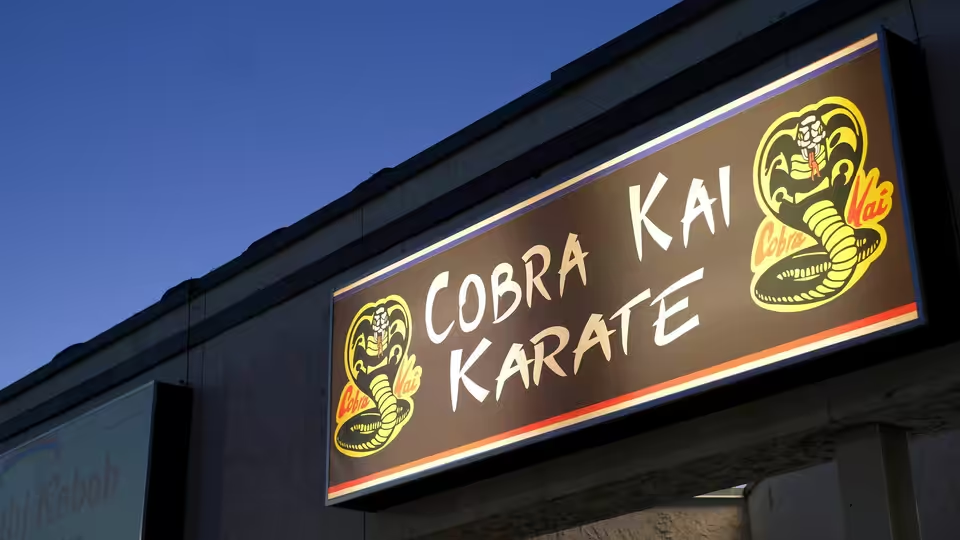
It is made cleanly. Paul Varrieur shoots the Valley in flat, hard sunlight, all tan stucco and car parks, so the dojo looks like what it is, a unit in a strip mall with a cobra painted on the window. Ryan Berg gives Daniel’s showroom glass, chrome and potted trees, and Johnny’s flat the furniture of a man who does not expect visitors. The fights are the series’ strongest craft. The editors, Dexter Adriano, Nicholas Monsour, Zack Arnold and Bartholomew Burcham among them, hold wide and let the choreography play, and the school cafeteria brawl in the first season is staged with more clarity than most cinema action. Leo Birenberg and Zach Robinson score it with 1980s synth and electric guitar, played entirely straight, which suits Johnny and nobody else.
The trouble is plot. Every season ends at a tournament. Teenagers switch dojos and allegiances every few episodes, and the grown men behave like the teenagers. Martin Kove’s John Kreese and Thomas Ian Griffith’s Terry Silver both return, and are enjoyable, and the series has to keep inventing reasons for them to stay. By the fifth season we could not have told you which child was training under whom and why, and we noticed we no longer minded. For a series built on rivalry, that is the wrong thing to notice.
The 1984 film taught one lesson and stopped. Cobra Kai teaches it 65 times and keeps finding new students to teach it to. The sixth season, at fifteen episodes, is the longest and is billed as the last, which is right, and about two seasons overdue.
Watch the first two seasons with someone who remembers the crane kick. If you are still watching in the fifth, you will know why, and his name is William Zabka. It carries a 15, and the violence between children is pitched a good deal harder than the films ever were.