Sam Bain and Jesse Armstrong’s student house comedy is funnier and sadder than its premise suggests, and Jack Whitehall’s JP is a proper creation. Forty minutes an episode is a stretch and the last series thins; the first two are worth your week.
Sam Bain and Jesse Armstrong, who made Peep Show, put six first-years into a shared house because they applied too late for halls, and watch what happens over eight episodes of forty minutes each. The length is the tell. This is not a sitcom that wants to get in and out; it is a comedy-drama, and it wants the drama to hurt. Over the first two series, most of the time, it does. It is good, and it is a good deal sadder than a trailer would have you believe.
The house fills up in the first episode. Kingsley Owen (Joe Thomas) arrives having decided to be cool this time and has not told his face. Josie Jones (Kimberley Nixon) mentions the boyfriend at home slightly too often. JP (Jack Whitehall) has money, says so, and cannot understand why nobody is impressed. Violet Nordstrom (Zawe Ashton), who answers to a shorter name, drinks, reads and is the only one not pretending, which is why everyone else wants her approval. Oregon (Charlotte Ritchie) is pretending hardest: she has renamed herself, hidden her money and follows Nordstrom everywhere. Howard (Greg McHugh) was already there when they arrived and has views about the fridge.
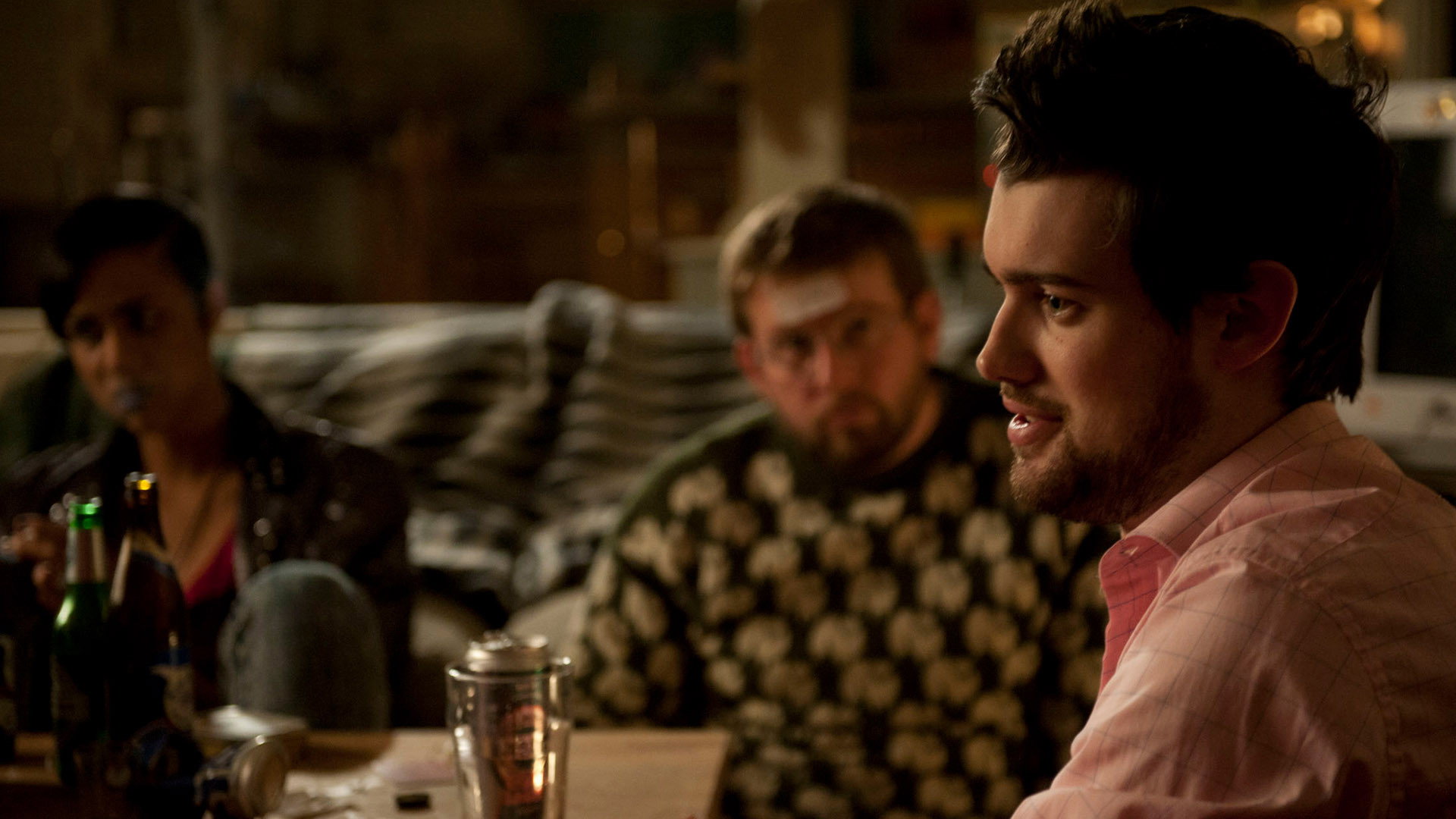
The jokes are about the gap between who they have decided to be and who they are, and there are a lot of them. Whitehall is the find. JP is unbearable, and Whitehall plays him not as a monster but as a boy who has been told that money and confidence would do the work and is now watching them fail. McHugh gives Howard a stillness the others cannot manage, a man who has been on his own long enough to have made peace with it and is now cross to have company. The writing room is wide, with Tom Basden, Penelope Skinner, Jon Brown and Tony Roche among the names alongside Bain and Armstrong, and the voice holds across all of them.
Here is what got at us. We laughed most at JP, and we expected to. What we did not expect was to feel as bad as we did about Oregon and Professor Tony Shales (Tony Gardner), the tutor who notices her in the first episode and lets her mistake his attention for a compliment. Gardner plays him as a coward who has worked out how to look like a mentor, and Ritchie plays Oregon as a girl who is certain she is the one in charge. We watched a nineteen-year-old walk slowly towards a bad decision over several episodes, and the show declined to hurry her. That is the drama it promised, and it is uncomfortable in the right way.
It looks like a drama, too. Tom Sayer’s house is brown and cold and has a kitchen where everything happens, because in every student house everything happens in the kitchen. The cinematographers, five across the run, Sam McCurdy and Maja Zamojda among them, shoot it hand-held in whatever light is there, with no laughter track and no set built to be admired, so a gag lands in the same flat light as a heartbreak. Christian Henson’s music stays out of the way. The editors let scenes run a beat past the joke, so the sadness has room to get in. Sometimes they let them run two, and the episode sags.
Forty minutes is the cost. Every series has episodes in which Kingsley and Josie circle each other for the fourth time and we could feel the writers waiting for the clock. Sabine (Jelka van Houten), who joins in the second series, is used mainly as a joke about being sensible. And the show thins as it goes. Series 3 and 4 bring in Candice (Faye Marsay) and Sam (Hannah Britland) and widen the world, and some of the pressure of six people in one house leaks out with them. Series 4, six episodes in 2016, faces the end of university squarely and is more affecting than funny.
The Young Ones was anarchy and Peep Show was despair; this is embarrassment with a bit of hope left in it, which is a harder tone to hold. Most critics landed in the middle on it, and two of the six we read found it laboured. We think they were watching for a sitcom and missed the drama sitting in the next room. Start at the beginning, watch the first two series, and stop when the house stops feeling crowded.