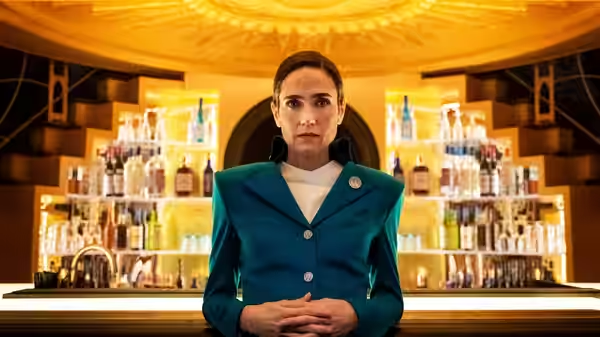
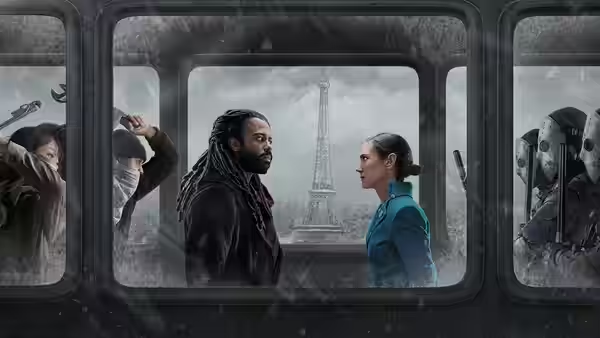
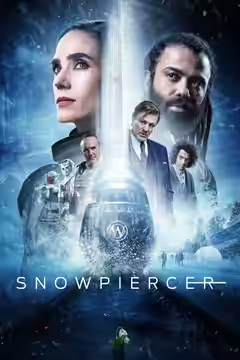
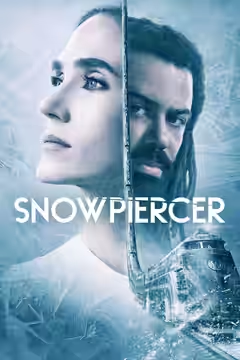
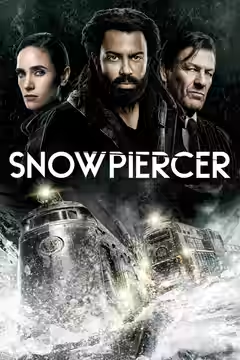
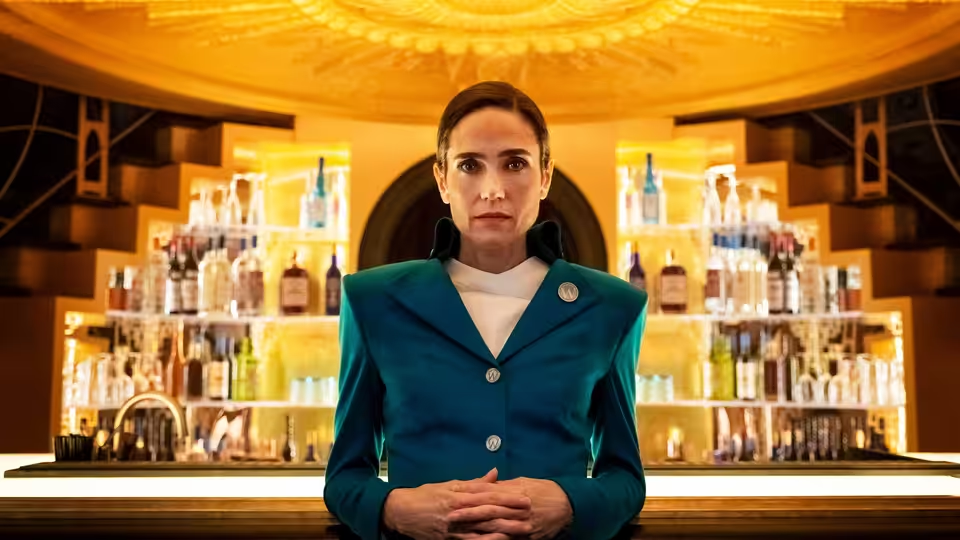
Melanie Cavill (Jennifer Connelly) stands with clasped hands at a bar
Series review

Snowpiercer

2020 · Created by Graeme Manson, Josh Friedman · Series

In a sentenceJennifer Connelly makes a train’s internal politics more interesting than its murder mystery

A murder investigation unfolds aboard Snowpiercer, a giant train whose passengers are divided by class. Andre Layton (Daveed Diggs), Melanie Cavill (Jennifer Connelly) and Bess Till (Mickey Sumner) are among the people caught up in the case and the conflicts surrounding it. The search for answers brings the train’s unequal society into view, with relationships, rival interests and questions of survival complicating the inquiry. Layton has to pursue the mystery within that divided community, where identifying a killer is only one of the problems facing the passengers.

Plays from YouTube when you press play; nothing loads from them until then.

Fi1m review

Snowpiercer makes an uneven detective drama out of its class-divided train, with Jennifer Connelly supplying much of the interest. The first season becomes absorbing, but its solemn dialogue and slow start make that improvement harder work than it should be.

The first season of Snowpiercer is decent science-fiction television with an opening that makes it unnecessarily difficult to settle in. Creators Josh Friedman and Graeme Manson turn a giant train divided by class into the setting for a murder inquiry, introducing its passengers through their competing interests. It is a workable way to introduce a complicated society. Too often, though, the investigation takes precedence over the people whose lives ought to make us care about the answer.

The difficulty is not the mixture of detective fiction and social conflict; those ought to suit each other. A closed community can make every question awkward, particularly when some passengers have more power than others. Here the early episodes spend too much time explaining people through dialogue and backstory, with a solemnity that makes the stranger material feel oddly routine. We grew impatient with the murder inquiry because those explanations kept interrupting the more interesting business of discovering how the train’s society worked.

Jennifer Connelly gives us something worth watching while the plotting finds its pace. As Melanie Cavill, she makes the character’s coldness interesting enough to hold our attention even when the dialogue is doing little to help. Daveed Diggs brings conviction to Andre Layton, and Mickey Sumner makes Bess Till a welcome presence in an ensemble that is not always given enough room to develop. Their acting keeps relationships worth following through stretches when the investigation itself feels less urgent.

The production design team, including Barry Robison, makes the train worth exploring. The sets make the differences between passengers easier to grasp than some of the dialogue does, giving the class conflict a convincing physical setting. The cinematography, with John Grillo among those credited, supports the drama’s serious tone without being especially playful. That restraint helps make the peculiar premise credible. It also becomes a limitation when the writing needs something beyond competent images to distinguish its familiar detective business.

The editing team includes Marta Evry and Jay Prychidny, but the early storytelling has a stop-start rhythm that the cutting cannot disguise. The inquiry repeatedly has to accommodate another explanation before it can move forward. Music credited to The Haxan Cloak and Bear McCreary suits the prevailing seriousness, though the drama hardly needs more encouragement to insist that everything matters. Less emphasis might have made the shifts between crime story, survival drama and social satire feel less laboured, and left more room for the premise’s absurdity.

The first season improves when it gives more attention to its characters and the arrangements keeping this society going. Its longer form begins to feel useful, allowing relationships to complicate the class conflict rather than merely illustrate it. There is more to Melanie Cavill than the initial chill suggests, and the increased attention to her gives the drama a firmer centre. By then, the passengers have become sufficiently interesting that an episode need not depend entirely on the strength of its next investigative development.

The series is most persuasive as science-fiction television when it asks how people with different interests can go on living together. That question gives its enclosed setting a purpose beyond providing a list of suspects, although the stiff conversations remain an obstacle. Try it for the people and their competing claims on the train; expect the detective work to test your patience.

Critical consensus AI synthesised

59
Positive
5
Mixed
6
Negative
3
The Guardian
25 May 2020
77*

The critic finds the series a highly watchable piece of trashy comfort viewing, turning the premise into a steampunk police procedural on a giant train. It is praised for delivering diverting episodic storytelling suited to lockdown viewing despite bypassing the deeper allegory of its sources.

Read the full review →
Empire
25 May 2020 · James Dyer
65*

The TV adaptation lacks the propulsion and punch of the film but delivers an enjoyable, absorbing sci-fi procedural with good supporting characters and expanded mythology. It is recommended as lockdown entertainment despite being po-faced.

Read the full review →
The i Paper
25 May 2020 · ★★★ · Barbara Speed
60

The series is a schlocky, defanged reboot of the source material that turns the class allegory into a murder mystery. Strong set design and Jennifer Connelly's icy performance stand out as highlights.

Read the full review →
Vulture
15 May 2020
60*

The series starts out shaky and only becomes compelling midway through, averaging out to halfway decent rather than great. It fails to fully tap into the zeitgeist despite its themes, though relatable elements and strong performances, particularly Jennifer Connelly's, provide some appeal.

Read the full review →
The Hollywood Reporter
12 May 2020 · Daniel Fienberg
50*

TNT’s adaptation is a tonally uneven, narratively confusing mess with half-developed characters and incomplete satire, though it is not awful. Solid production values, some strong performances, and moments of giddy lunacy help it settle into a watchable rhythm after early episodes.

Read the full review →
The Times
7 June 2020 · Liam Fay
47*

The critic describes the series as a floridly bonkers and clumsily assembled saga that yokes together mismatched genres with erratic tone. It is faulted for a futile attempt to make the cartoonish premise feel gritty, resulting in a long bumpy ride with only modest reward.

Read the full review →

Straight answers AI written, from our review

Is Snowpiercer worth watching?
Snowpiercer is worth trying for patient science-fiction viewers interested in class conflict and character drama; we score it 63/100. Jennifer Connelly supplies much of the interest, and the first season becomes absorbing as the passengers’ relationships develop, but the slow murder inquiry and solemn dialogue make it harder work than it should be.
Where can I watch Snowpiercer in Panama?
Snowpiercer is not on any streaming or rental service in Panama at the moment. Availability is checked daily.
How violent or frightening is Snowpiercer, and is it suitable for children?
Snowpiercer carries a UK 18 certificate and a US TV-MA rating, making it an adult series rather than suitable viewing for children. Its murder investigation and survival conflicts establish a serious premise, but we cannot offer a precise guide to violence or frightening scenes beyond the adult classification.

Cast

If you liked this, try…

  1. The Prisoner (1967) · not on Fi1m yetAnother enclosed society where apparently reasonable rules make individual freedom increasingly difficult.

  2. High-Rise (2015) · not on Fi1m yetClass divisions become architecture, with nastier humour and less interest in detective work.

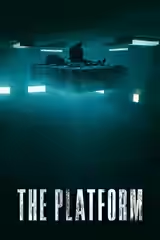
  3. The Platform (2019) · not on Fi1m yetA harsher confined-space allegory about unequal resources and the excuses people make.

  4. 3% (2016) · not on Fi1m yetCompetition for privilege turns survival drama into a sustained examination of inequality.

  5. Silo (2023) · not on Fi1m yetA sealed community, institutional secrets and an investigation that threatens the accepted order.