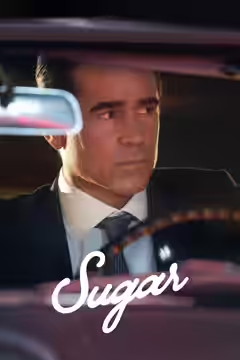
Colin Farrell is as good as he has ever been as a private detective who would rather be in a Bogart picture. For two episodes the series around him is nearly that good. Then the case goes thin, and a turn we will not describe goes worse.
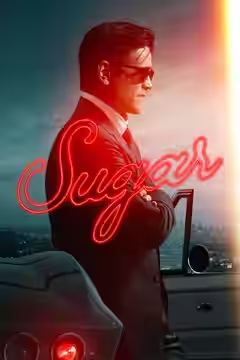
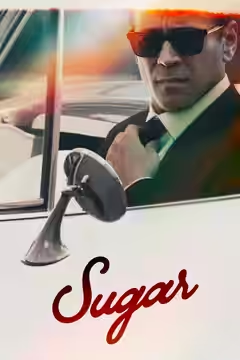
Mark Protosevich’s series puts a private detective in a Los Angeles hotel, gives him a sharp suit, a soft voice and a shelf of old films, and asks the question on the poster: who is Sugar? The first two hours, directed by Fernando Meirelles, answer it the way a good noir should, by watching him work. The remaining six spend most of their time not answering it at all, and then answering it badly.
Farrell is the reason to watch, and he is reason enough for a while. He plays John Sugar as a man who is kind on purpose, who tips well, apologises to the people he has to hit and cannot pass a stray dog. It is a courteous, quiet performance, most of it in the eyes, and it goes against the whole tradition the series is borrowing from, where the detective is a cynic and the city has earned it. Sugar believes people are worth saving. Farrell makes that seem like a choice rather than a script note, and it is the one idea here that holds for all eight episodes.
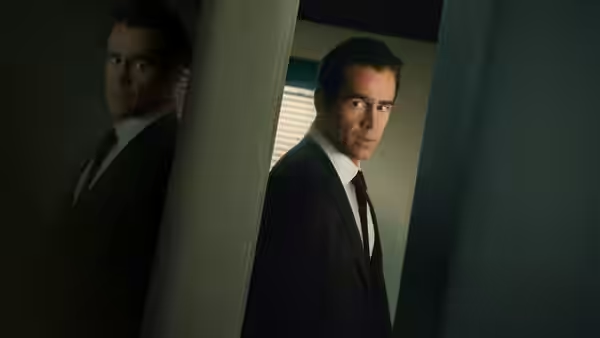
Meirelles and his regular cinematographer César Charlone, who shot City of God (2002) together, give the opening episodes a real look: sodium-orange nights, a hotel bar lit from below, the Siegel house all glass and money. Tom Foden’s production design puts Sugar in a room that could be 1954 if you took the laptop away. The editing team, nine names deep on the credits, has one trick, and for two hours it is a good one: mid-scene, for a second or two, the picture cuts to a black-and-white film from the 1940s or 50s, a detective in a hat doing what Sugar is about to do. We were, for those first two episodes, happier than we expected to be, and it was the ease of it, Farrell walking into a room in a grey suit while a dead man’s face flickered over his, that did it.
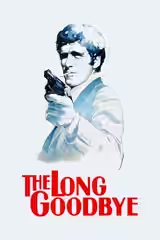
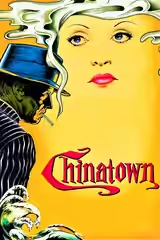
Then the trick wears. By the fourth episode the clips arrive on cue, announcing that a scene is about to be a scene, and the case they are decorating has gone slack. A missing granddaughter, a family with money and a secret, a man who wants the family kept out of the papers: this is the plot of Chinatown (1974) and The Long Goodbye (1973) and a hundred others, and the series knows it, and knowing it is not the same as doing something with it. Ten writers are credited. The dialogue often sounds like it, with lines that explain what the last scene meant and characters who state their motives as if reading them off a card.
The supporting cast is better than what it is given. Amy Ryan plays Melanie with a dry, lived-in warmth and is the only person Sugar has a proper conversation with; the series is at its best when they are in a car together. James Cromwell does a great deal with a wheelchair and a stare. Kirby Howell-Baptiste has to carry the series’ secret in every scene and is asked to do it mostly by looking worried at a screen. Nate Corddry’s Davy is a coward written as a coward, and Corddry finds nothing more in him because there is nothing more there. Adrian Younge and Ali Shaheed Muhammad’s score, all brushed drums and vibraphone, is lovely and does more to make the thing feel like noir than the plotting does.
Midway through the run the series takes a turn we will not describe, and which most of the reviews so far have described in full, so avoid them if you intend to watch. What we can say is that the series has been coy about it for five hours, with cutaways and meaningful pauses, and that the coyness is the problem. When the turn came we laughed, not kindly, and then felt cheated by the wait. The answer is not the disgrace some critics have called it. It is simply a big idea dropped into a small mystery, and the mystery does not grow to fit it.
Against the genre’s own standards, the ones the series keeps cutting away to, it comes up short: those films had thin plots too, but they moved, and they let the detective’s decency cost him something. Sugar’s costs him a sore rib. A second series of eight episodes followed. Watch the first two of this one, decide whether you want to know who Sugar is, and bear in mind that the series is less sure than its tagline sounds.