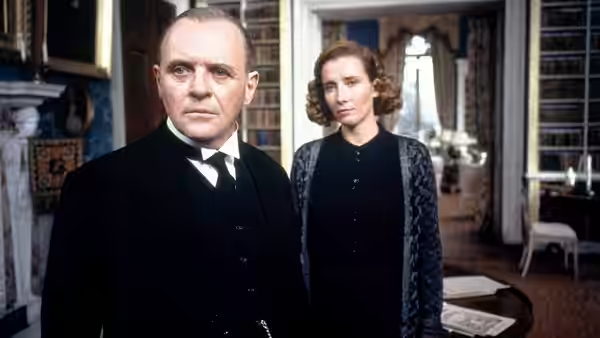
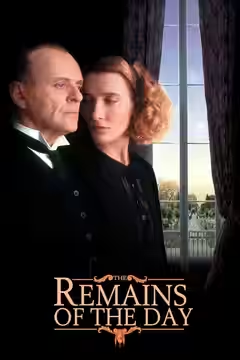
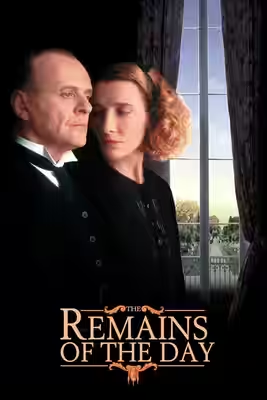
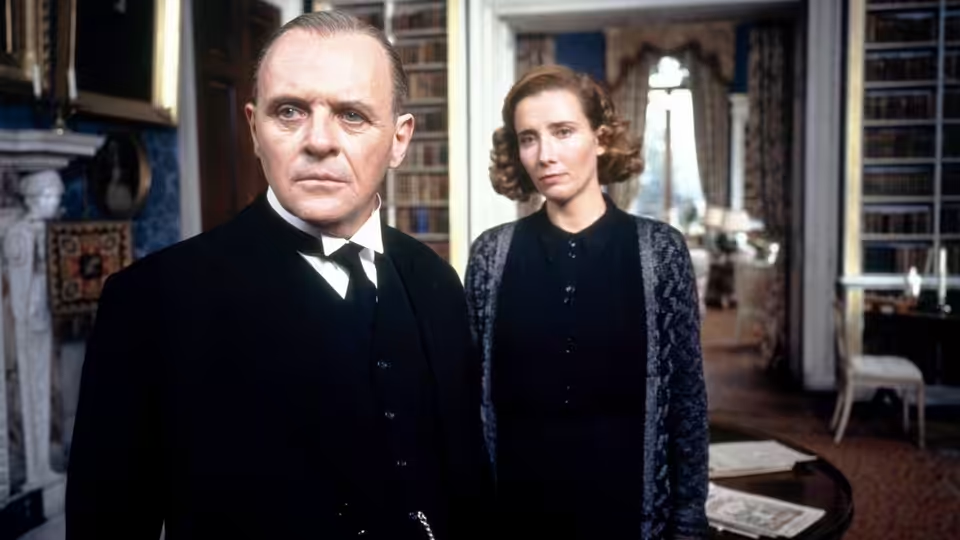
James Stevens (Anthony Hopkins) and Miss Kenton (Emma Thompson) standing in the library
Film review

The Remains of the Day

1993 · Directed by James Ivory · 2h 14m

In a sentenceAnthony Hopkins makes answering a personal question look like a breach of contract

James Stevens (Anthony Hopkins) is a butler whose commitment to his duties leaves little room for a private life. Miss Kenton (Emma Thompson), a housekeeper, works alongside him, and their conversations test the limits of his professional reserve. Adapted from Kazuo Ishiguro’s novel, the drama follows a man whose ideas about service shape both his personal relationships and his understanding of power and politics. James Fox plays Lord Darlington, with Christopher Reeve as Jack Lewis and Hugh Grant as Reginald Cardinal, in a story of work, affection and feelings left unspoken.

Plays from YouTube when you press play; nothing loads from them until then.

Fi1m review

Anthony Hopkins and Emma Thompson make James Ivory’s restrained romance painfully affecting. The music sometimes insists on feelings the performances have already made clear, but their polite conversations are reason enough to give it an evening.

James Ivory’s The Remains of the Day is a deeply affecting drama about a butler who has become dangerously good at his job. We recommend it warmly, with a reservation about music that keeps explaining what the actors have already made clear. Adapted by Ruth Prawer Jhabvala from Kazuo Ishiguro’s novel, it treats professional devotion as something capable of doing lasting damage. Stevens can discuss his duties without difficulty, but speaking about what he wants seems almost beyond him.

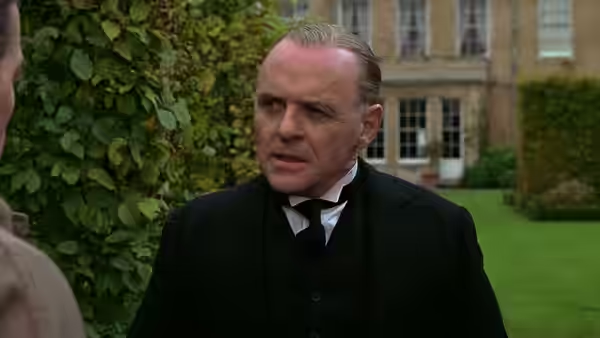
Anthony Hopkins plays James Stevens with a control that can look almost comic until we notice how much effort it costs. His polite replies suggest less manageable answers being suppressed, and Hopkins makes that suppression absorbing to watch. He lets us understand Stevens without making him suddenly confessional for our benefit. Being so relentlessly correct must be exhausting to live beside, and the performance allows us to feel that irritation without losing sympathy for the man.

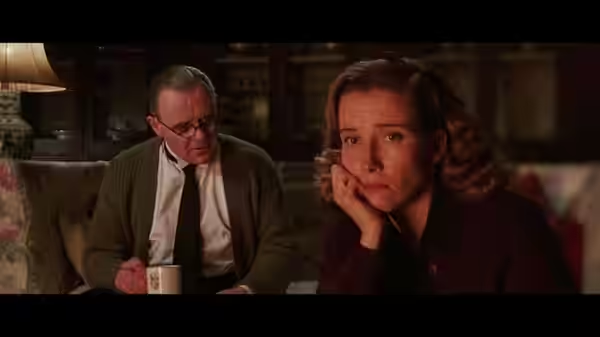
Emma Thompson’s Miss Kenton makes that exhaustion felt without asking us to applaud her patience. Their polite exchanges are the film’s strongest scenes, because she gives ordinary conversation a warmth he cannot comfortably return. We were moved more than we expected by her attempts to reach him through this professional courtesy. Thompson makes the wish for an answer so clear that Stevens’s careful replies begin to hurt, although neither performer needs to make a display of the hurt.

The politics matter here, too: Stevens’s devotion to duty extends beyond the damage it does to his personal life. Ivory asks us to consider what happens when someone takes pride in serving but leaves the thinking to somebody else. James Fox’s Lord Darlington belongs to the same ordered society, and the film gives that order enough appeal for obedience to seem understandable. Jhabvala’s screenplay is particularly good at making us question the rules these people accept, without stopping every conversation to explain why we should.

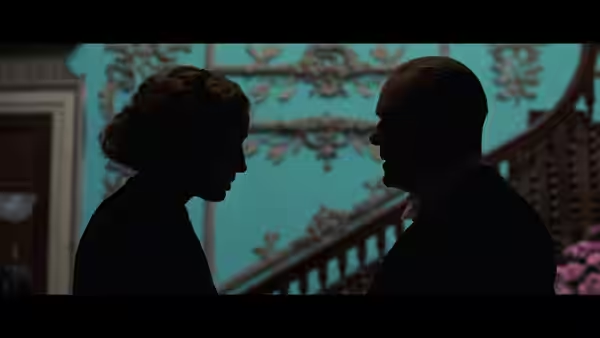
Tony Pierce-Roberts’s cinematography keeps us conscious of the order surrounding Stevens. Luciana Arrighi’s production design makes the carefully arranged period settings feel like places where a lapse would be noticed, which helps explain the vigilance of the people working in them. The rooms can be admired without making the life inside them look enviable. Andrew Marcus’s editing gives the conversations space, allowing us to attend to the performances instead of hurrying towards the next piece of information. Hopkins and Thompson earn that patience.

The score is harder to defend. Richard Robbins’s music can press the sadness on us when the actors have already done the work, and we found ourselves wishing for less of it. In those passages, Ivory’s careful direction begins to feel over-careful, with too little left for us to discover unaided. This is a real limitation in a film whose actors are so good at suggesting feelings their characters cannot name.

A drama about servants and employers could settle for admiring manners, clothes and rooms, and this one occasionally comes close. What keeps it from becoming a comfortable visit is its attention to how people use good behaviour to avoid being honest. We do not need Stevens to become more forthcoming, because Hopkins has given us enough to understand why he finds it so difficult. Watch it for the conversations with Thompson, and allow for music that sometimes fails to notice how quietly they are speaking.

Critical consensus AI synthesised

80
Positive
11
Mixed
0
Negative
1

Most critics rate the film highly, and the praise gathers around Anthony Hopkins, whose butler Stevens is singled out in nearly every review as controlled, thoughtful and the reason the film works. Emma Thompson’s housekeeper is close behind. Beyond the leads, the reviews credit James Ivory’s direction, Ruth Prawer Jhabvala’s script and the period staging, and most read the film as two things at once: an upstairs-downstairs drama with a political edge, and a quiet tragedy of feeling left unspoken.

The reservations are about feeling. Variety finds it absorbing but short of the emotional force that would make it fully satisfying, The New Yorker calls the adaptation clunky, and Time Out thinks it only comes alive in the scenes of polite sparring between the leads. The one outright dissent comes from The Independent, which finds the pacing too deliberate and the music intrusive, spelling out what the characters cannot say. The spread is otherwise narrow.

Radio Times
★★★★★ · Adrian Turner
100

This impeccable adaptation of Kazuo Ishiguro's novel stars Anthony Hopkins as the emotionally repressed butler and Emma Thompson as the housekeeper he possibly loves. It is as much a study in power and politics as it is Hopkins's blinkered view of the world, with immaculately staged 1930s and 40s settings and direction alive to every nuance.

Read the full review →
Empire
13 March 2007 · Angie Errigo
90*

The film is another perfectly crafted Merchant-Ivory production that excels as both an upstairs-downstairs drama with political undertones and a quiet tragedy of repressed emotion. Hopkins gives a remarkable, wonder-evoking performance as the dutiful butler.

Read the full review →
Los Angeles Times
5 November 1993 · Kenneth Turan
90*

The film is a moving, carefully modulated picture that overcomes stodginess with miraculous acting from Hopkins and Thompson. It presents a melancholy romance between characters bound by professional codes, making the tandem performances the highlight.

Read the full review →
RogerEbert.com
5 November 1993 · Roger Ebert
90*

The critic praises the subtle, thoughtful adaptation that explores a butler's repressed emotions and blindness to political realities in pre-WWII Britain, highlighting the performances and the theme of duty over personal happiness.

Read the full review →
The Hollywood Reporter
5 November 1993 · David Hunter
90*

The critic praises the film as bound for box-office glory and Oscar honors, highlighting Anthony Hopkins' colossal performance as the duty-bound butler Stevens. The uniformly excellent cast and James Ivory's direction of the technical team are singled out for praise.

Read the full review →
The New York Times
5 November 1993 · Vincent Canby
90*

The critic praises the film as a spellbinding tragi-comedy with psychological and political scope, an exquisite work that stands out among Merchant-Ivory productions. The adaptation captures the novel's metaphoric depth through the butler's story of honor and duty.

Read the full review →

Straight answers AI written, from our review

Is The Remains of the Day worth watching?
The Remains of the Day is worth watching for anyone with patience for a romance conducted almost entirely through polite conversation, and we scored it 88. Anthony Hopkins and Emma Thompson make a butler's refusal to speak his mind painfully affecting. Our one reservation is Richard Robbins's score, which keeps pressing sadness the actors have already made plain.
How long is The Remains of the Day, and what is it rated?
The Remains of the Day runs 2h 14m. It is a drama and romance film.
Where can I watch The Remains of the Day in Estonia?
The Remains of the Day is not on any streaming or rental service in Estonia at the moment. It is available in 33 other countries; change your country at the top of the page to see where. Availability is checked daily.
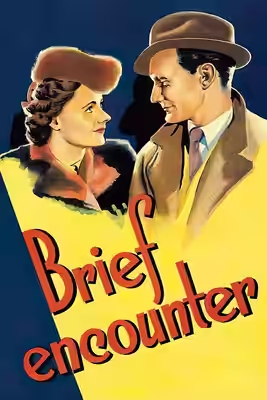
How does The Remains of the Day compare to Brief Encounter?
The Remains of the Day and Brief Encounter are both English romances in which good manners make everything worse, but they differ in scale and in what is at stake. James Ivory's film is longer and quieter, and it ties its butler's reserve to questions of duty and politics. David Lean's is the tighter and the more urgent of the two, and the one we would press on a stranger first.
Is The Remains of the Day based on a true story or a book?
The Remains of the Day is based on Kazuo Ishiguro's novel of the same name, adapted for the screen by Ruth Prawer Jhabvala, and is not a true story. The film keeps the novel's concern with a butler whose devotion to service damages both his private life and his judgement. Knowing the book is not necessary, since Hopkins makes Stevens's reticence clear without a narrator.
What should I watch after The Remains of the Day?
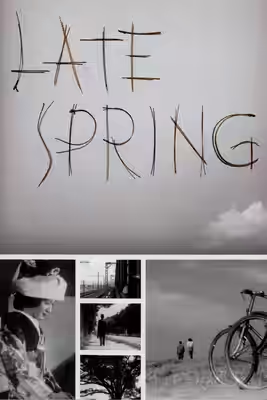
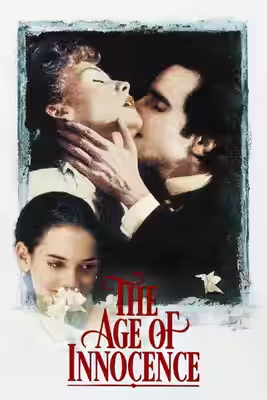
After The Remains of the Day, try Brief Encounter (1945, Fi1m 90): For another English romance in which good manners make everything worse. Then Late Spring (1949, Fi1m 92): For family duty, withheld feelings and patient attention to ordinary conversation; and The Age of Innocence (1993, Fi1m 86): For another society that makes speaking plainly about love nearly impossible.

Cast

Awards

Academy Awards, 1994

Nominated
Best Actor
Nominated
Best Actress
Nominated
Best Costume Design
Nominated
Best Director
Nominated
Best Original Score
Nominated
Best Picture
Nominated
Best Production Design
Nominated
Best Writing, Adapted Screenplay

Silver nugget for the best foreign film, 1994

Won
Silver nugget for the best foreign film

If you liked this, try…

  1. Brief Encounter (1945, Fi1m 90)For another English romance in which good manners make everything worse.

  2. Late Spring (1949, Fi1m 92)For family duty, withheld feelings and patient attention to ordinary conversation.

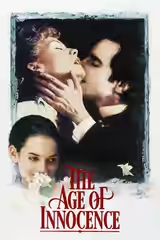
  3. The Age of Innocence (1993, Fi1m 86)For another society that makes speaking plainly about love nearly impossible.

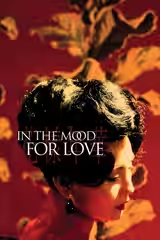
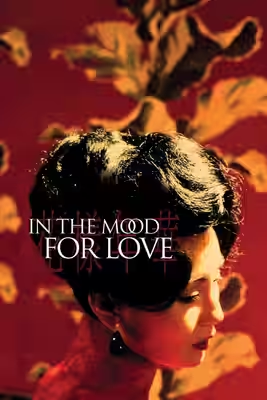
  4. In the Mood for Love (2000, Fi1m 91)For a romance whose restraint makes every small exchange matter.

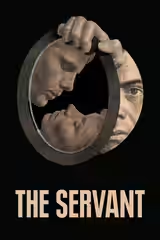
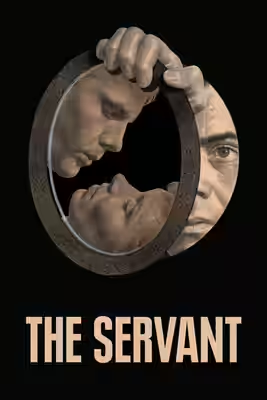
  5. The Servant (1963, Fi1m 89)For a less reassuring look at service, dependence and the English household.

Free account

Know what to watch tonight

Two lists that know where things are streaming, collections you can share, your own score beside ours, and Discover that remembers what you have seen.

  • Want to see, sorted by what is streaming now
  • Seen, with your score out of ten
  • No adverts, ever