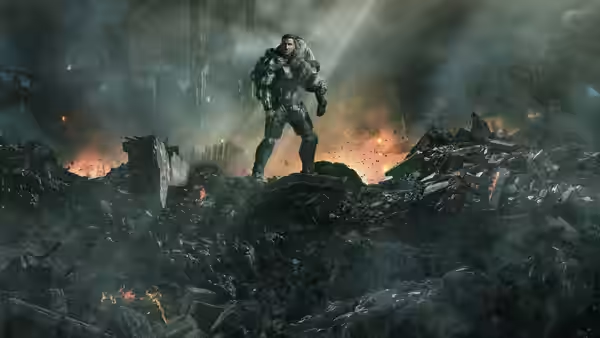
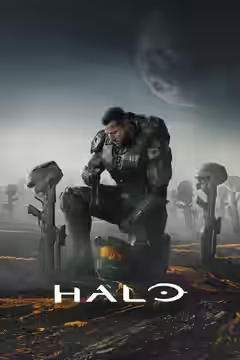
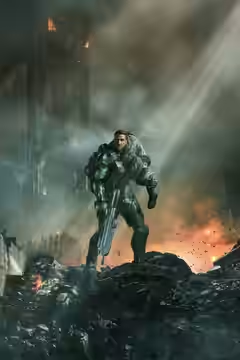
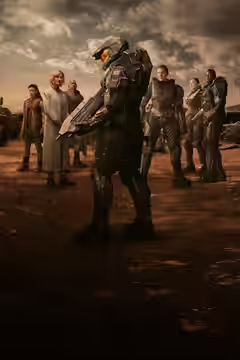
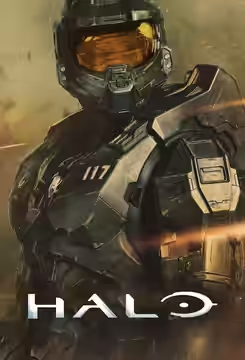
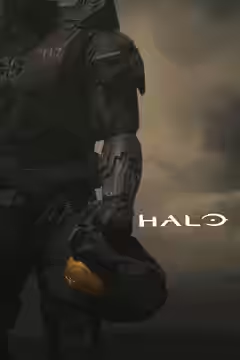
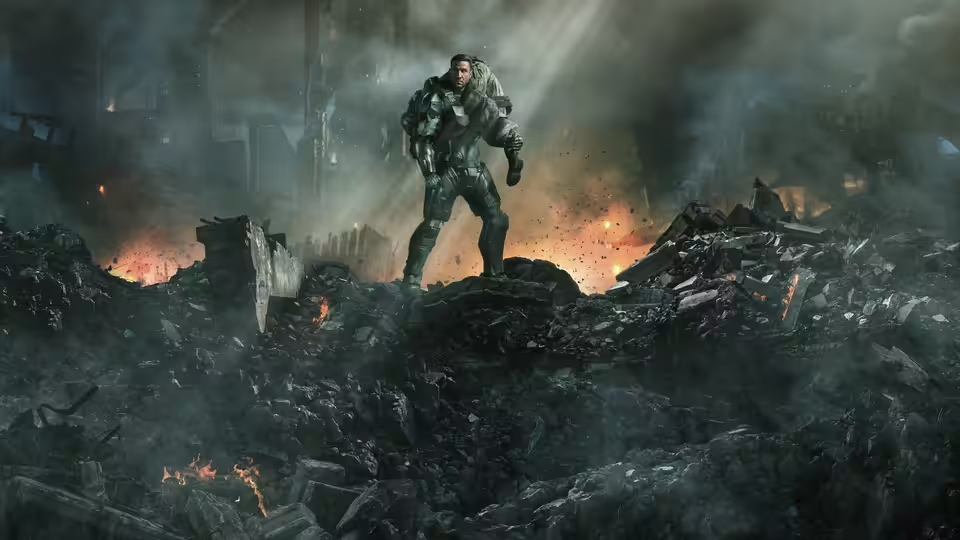
Master Chief (Pablo Schreiber) stands on a mound of rubble amid a burning battlefield
Series review

Halo

2022 · Created by Kyle Killen, Steven Kane · Series

In a sentenceThe armour looks ready for a war that the script would rather explain

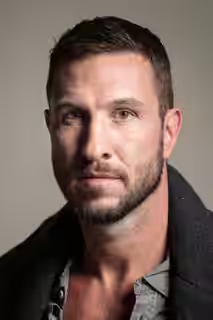
Master Chief, Spartan-117 / John-117 (Pablo Schreiber), follows orders in a military conflict with alien opponents. His developing relationship with Kwan Ha (Yerin Ha) brings questions about his humanity into sharper focus, along with doubts about the authority he serves. Dr. Catherine Halsey (Natascha McElhone) has a close, complicated connection with Chief, making his struggle for independence personal. As he begins to question what is expected of him, military duty competes with his need to understand himself. The fighting continues around a soldier whose obedience can no longer be taken for granted.

Plays from YouTube when you press play; nothing loads from them until then.

Fi1m review

Pablo Schreiber and Yerin Ha give Halo enough human interest to make its sluggishness frustrating. The military science fiction has promise, but weak action and overexplained plotting make this a difficult series to recommend.

Created by Steven Kane and Kyle Killen, Halo is most promising when it lets its central soldier question the people giving him orders. Pablo Schreiber gives Master Chief enough uncertainty to make that question worth following. The series around him is harder to commit to: familiar science fiction, slowed by explanation and only intermittently rescued by its actors. There is enough here to make the wasted opportunities frustrating, but not enough to recommend the whole programme.

Schreiber’s voice does useful work, suggesting thought behind a character who could easily be reduced to a suit of armour. He gives Chief an intensity that does not depend on the action convincing us, which is fortunate. Yerin Ha’s Kwan Ha provides an expressive partner, and their developing relationship gives the programme something to attend to beyond its own terminology. The chemistry works because both performers make their encounters feel important before the script has finished telling us why they matter.

Natascha McElhone’s Dr. Catherine Halsey brings a more troubling relationship into view. The closeness between her and Chief makes the question of who controls him more interesting, because it cannot be kept at the level of military procedure. We were uneasy watching that closeness, because it complicates the question of how freely he can act. These scenes give the questions about Chief’s humanity a personal urgency that the military plotting often lacks.

Visually, the programme is not without care. Karl Walter Lindenlaub and Carl Sundberg are among the cinematographers, and the sense of scale helps these worlds feel substantial, even when their science-fiction imagery seems familiar. The production design, credited to James Foster and Sophie Becher, gives the settings different degrees of wear and habitation; they do not all appear to have been built that morning. Those distinctions help us understand the places without needing another briefing.

The action is much less persuasive. The Spartans have a convincing look and sound, but the alien effects often seem insubstantial, leaving fights without the physical force they need. Sean Callery’s score cannot give those digital opponents the weight they lack, and the music is left with too much responsibility for making the conflict feel urgent. For a programme that offers armed confrontation as a major attraction, this is a serious weakness rather than a defect we can politely overlook.

The longer problem is the pacing. Nicholas Wong and Maxime Lahaie are among the editors, but there is only so much cutting can do when the writing keeps interrupting its strongest relationships with detours and information. We were bored by the exposition, particularly when it displaced the developing rapport between Schreiber and Ha. The programme repeatedly asks us to absorb information before giving us a reason to care about it, and the actors cannot keep supplying that reason unaided.

Military science fiction can make the consequences of obedience immediate and personal. Halo has the cast and the uneasy relationships to do that, which makes its reliance on familiar plotting more disappointing. Fidelity to a game does little to help an episode that cannot sustain interest between confrontations. Anyone coming principally for convincing combat should look elsewhere.
Critical consensus AI synthesised

49
Positive
2
Mixed
7
Negative
6

The consensus on Halo is mixed to negative, with praise clustering around the cast rather than the storytelling. Critics repeatedly credit Pablo Schreiber with giving Master Chief humanity, while Yerin Ha’s performance and her chemistry with Schreiber provide another point of interest. Several reviews also welcome the attempt to explore the people beneath the armour, even when the surrounding science-fiction plotting feels familiar.

The reservations centre on slow pacing, heavy exposition and a shortage of distinctive ideas, though the spread runs from qualified enthusiasm to firm dismissal. Visual scale and design divide critics: Paste praises the lived-in contrasts between worlds and faithful game details, while other reviews find the action weak and the effects unconvincing. The reviews also cover different stretches of the programme, from opening episodes to the second season, which Radio Times finds disjointed and lacking what made the first season special.

Empire
22 June 2022 · James Dyer
65*

Dyer finds the series an uneven but worthwhile adaptation, with a grim, involving take on the Halo universe. He praises Pablo Schreiber’s performance for giving the Master Chief humanity and intensity, while noting that slow pacing and detours often drag.

Read the full review →
IndieWire
14 March 2022 · C+ · Ben Travers
63

Travers finds the series a predictable but promising mix of familiar sci-fi and fantasy formulas. He praises Pablo Schreiber’s voice work and the production’s visual scale, while criticizing the action as toy-like.

Read the full review →
The AV Club
14 March 2022 · C+ · William Hughes
63

Hughes finds the adaptation tepid and cheap, with writing that rarely improves on its first draft. He praises Pablo Schreiber and Yerin Ha’s chemistry and the show’s sci-fi weirdness.

Read the full review →
Variety
14 March 2022 · Caroline Framke
60*

Framke finds the series an ambitious but overly familiar adaptation that has not yet developed a distinct point of view. She praises Yerin Ha’s compelling performance as Kwan, while noting that the aliens are among the show’s least convincing effects.

Read the full review →
Vulture
24 March 2022 · Roxana Hadadi
35*

Hadadi finds the first two episodes weighed down by exposition and lacking a distinctive identity, though she sees potential in the series. She praises Yerin Ha’s expressive performance and the developing dynamic between Quan and Master Chief.

Read the full review →
Radio Times
5 February 2024 · Louise Griffin
30*

The review says the second season misses the mark and loses what made the first season special. It singles out the run’s disjointedness as its main complaint.

Read the full review →

Straight answers AI written, from our review

Is Halo worth watching?
Halo is difficult to recommend despite its promising central performances; we score it 52 out of 100. Pablo Schreiber and Yerin Ha give its questions about humanity and obedience some feeling, but slow exposition and unconvincing alien combat make it a frustrating choice even for military science-fiction enthusiasts.
Where can I watch Halo in Indonesia?
Halo is not on any streaming or rental service in Indonesia at the moment. It is available in 38 other countries; change your country at the top of the page to see where. Availability is checked daily.
How violent or frightening is Halo, and is it suitable for children?
Halo carries a UK 15 certificate, so it is not suitable for children under 15. The series includes armed conflict with alien opponents, though we find the digital effects make the fights feel insubstantial; that criticism should not be mistaken for reassurance about their suitability for younger viewers.
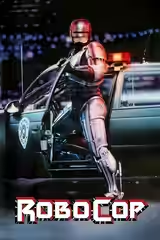
How does Halo compare to RoboCop?
Halo is the weaker choice beside RoboCop: both explore an armed servant questioning those who control him, but we recommend the film for its sharper action and more affecting treatment of humanity. The series finds interest in Chief’s uneasy relationships, then slows them with explanation; RoboCop also offers pointed criticism of corporate power, though its violence warrants a serious warning.
What should I watch after Halo?
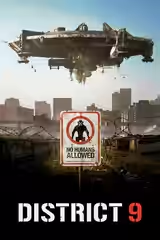
After Halo, try RoboCop (1987, Fi1m 91): A manufactured law enforcer discovers the human life his employers would prefer forgotten. Then Ghost in the Shell (1995, Fi1m 83): Military hardware and uncertain personhood, explored with greater patience and visual imagination; and District 9 (2009, Fi1m 81): Alien conflict and institutional cruelty made grubby, immediate and uncomfortable.

Cast

If you liked this, try…

  1. RoboCop (1987, Fi1m 91)A manufactured law enforcer discovers the human life his employers would prefer forgotten.

  2. Ghost in the Shell (1995, Fi1m 83)Military hardware and uncertain personhood, explored with greater patience and visual imagination.

  3. Battlestar Galactica (2004) · not on Fi1m yetSoldiers, civilians and compromised leaders make survival a matter of difficult choices.

  4. District 9 (2009, Fi1m 81)Alien conflict and institutional cruelty made grubby, immediate and uncomfortable.

  5. Mars Express (2023) · not on Fi1m yetArtificial people and corporate power meet in a brisk, carefully plotted investigation.