Film review

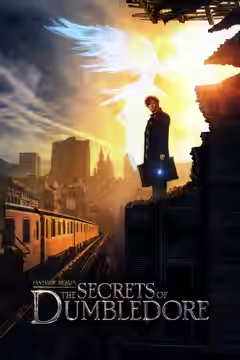
Fantastic Beasts: The Secrets of Dumbledore

2022 · Directed by David Yates · 2h 22m · MPA PG-13

In a sentenceDumbledore assembles a team, gives them a plan, and declines to tell anyone what it is, including us

FantasyAdventure

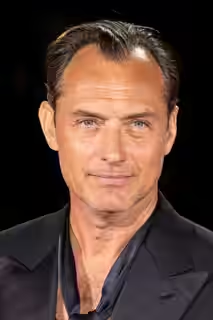
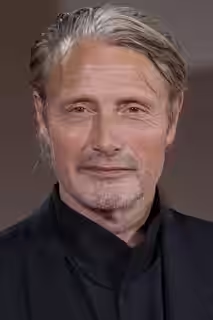
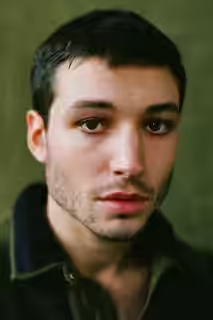
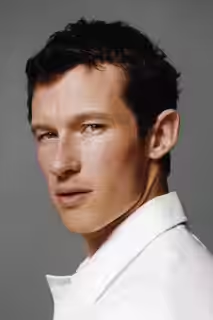
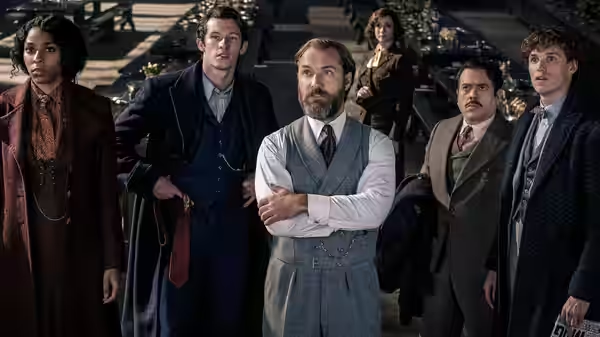
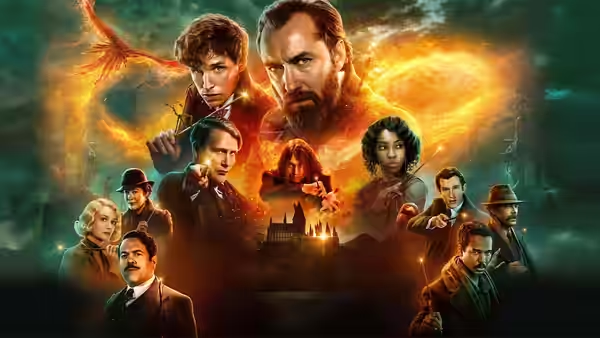
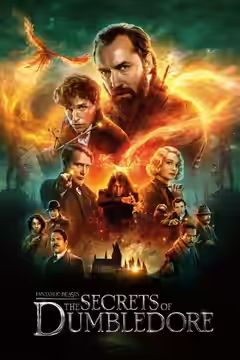
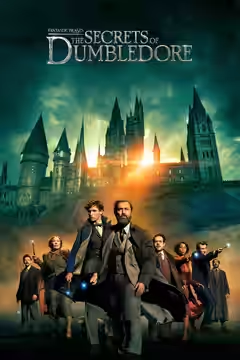
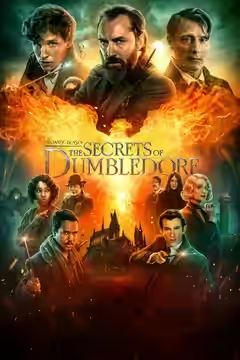
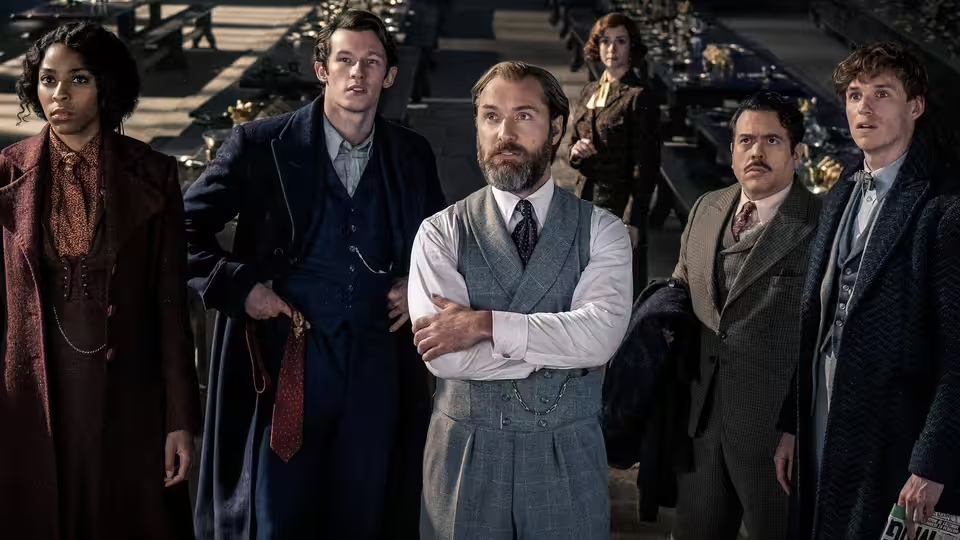
The early 1930s. Albus Dumbledore (Jude Law) meets Gellert Grindelwald (Mads Mikkelsen) in a London tearoom and learns that his old friend means to take control of the wizarding world and make war on Muggles. A blood pact from their youth means Dumbledore cannot fight him himself, so he assembles a team: Newt Scamander (Eddie Redmayne), his brother Theseus (Callum Turner), the Muggle baker Jacob Kowalski (Dan Fogler), the American professor Lally Hicks (Jessica Williams) and Yusuf Kama (William Nadylam). Grindelwald wants a qilin, a deer-like creature that can see into hearts and will decide the election for the wizarding world’s most senior office, and sends Credence Barebone (Ezra Miller) to steal one. The team heads for Berlin, where Anton Vogel (Oliver Masucci) is about to clear Grindelwald of his crimes.

Plays from YouTube when you press play; nothing loads from them until then.

Fi1m review

Jude Law and Mads Mikkelsen give the series two grown-ups worth watching, and David Yates surrounds them with a plot that even Dumbledore admits is meant to confuse. Handsome, grey and long, it is a franchise that has misplaced its own beasts.

The third Fantastic Beasts film is 142 minutes long and about an election. Gellert Grindelwald (Mads Mikkelsen) wants to lead the wizarding world and rid it of Muggles, and Albus Dumbledore (Jude Law) cannot stop him himself, because a pact made when they were young means neither can raise a wand against the other. So Dumbledore sends other people. David Yates, who has directed every film in this series and the last four Harry Potter pictures, stages it with care and without much joy. It is tidier than the last one, and we still spent long stretches waiting to be told why any of it mattered.

The two men at the centre are the reason it works when it does. The film opens with Dumbledore and Grindelwald across a table in a London tearoom, talking quietly about the life they once meant to share, and Law and Mikkelsen play it as two old lovers who know exactly how to wound each other. We were moved by it, more than the rest of the film had any right to expect, because for four minutes nobody explains a rule or a prophecy; two people look at each other and regret. Mikkelsen, taking over the part, makes Grindelwald calm and reasonable, a man who never raises his voice because he has never needed to, and the film is better every time he is in it.

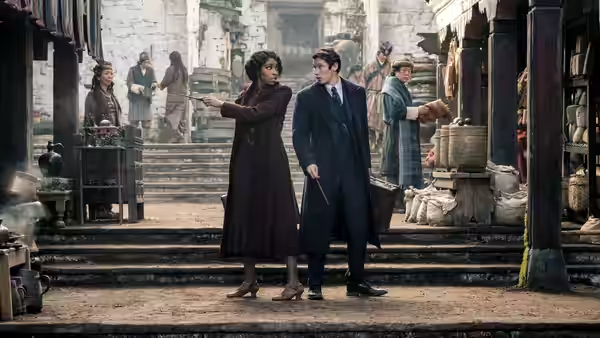
The comedy is Dan Fogler’s. Jacob Kowalski is a Muggle baker handed a wand he cannot use and dragged into a war he barely understands, and Fogler plays him with a decency that keeps the film human. His scenes with Alison Sudol’s Queenie, now standing at Grindelwald’s shoulder, are the only strand with a shape you can feel: Jacob still wants her back and Queenie is not sure she has left. Jessica Williams is brisk and funny as Lally Hicks and deserved more of the film than she gets.

Eddie Redmayne, top of the bill, spends much of the running time as a courier for other people’s plot. Newt Scamander gets one good set piece, a rescue from a prison guarded by scorpion-like creatures that must be walked past with a swaying, knock-kneed dance, and Redmayne and Callum Turner, as his brother Theseus, make it the one sequence where the film is properly silly and properly alive. Otherwise the beasts of the title are a side attraction. Katherine Waterston’s Tina appears for what feels like two scenes. Ezra Miller’s Credence, William Nadylam’s Yusuf Kama and Richard Coyle’s Aberforth are each given something to carry and nowhere much to take it.

The script, by Steve Kloves and J.K. Rowling, has an alibi built in. Dumbledore’s plan is meant to confuse Grindelwald, so the audience must be confused too, and the film says as much out loud. That is a licence to leave scenes unexplained, and the film uses it. Mark Day cuts each sequence to end the moment its information has been delivered, so people arrive in Berlin, or at Hogwarts, or on a mountainside, say what they need to, and are gone. We were not bored, exactly. We were unengaged, which is worse, because being bored at least means you wanted something.

It looks expensive and it looks grey. George Richmond shoots Berlin in slate and brown, and even the qilin, whose birth in the rain is the film’s most tender image, comes out silver. Stuart Craig and Neil Lamont build a 1930s Germany of marble halls, torchlit rallies and a wizarding ministry that looks like a railway station, and Colleen Atwood puts everyone in long coats, so the whole film seems to be waiting on a platform. James Newton Howard’s score does the honest work of a sequel, bringing back the old Hogwarts theme when the school appears, and we felt it land and felt slightly managed.

Against the series’ own standard this is an improvement. Against the eight films that came before the series, it is a handsome afterthought. If you watch it, watch it at home, where you can pause and work out who is on whose side; the 12A is right, though the youngest may drift off during the election and not much miss it.

Critical consensus AI synthesised

53
Positive
7
Mixed
10
Negative
11

Most critics agree this is an improvement on The Crimes of Grindelwald, though that is faint praise for many of them. The praise clusters around the cast: Mads Mikkelsen’s recast Grindelwald is widely called an upgrade, and his scenes with Jude Law’s Dumbledore are the part most reviews find something in. Newt’s creatures get fond mentions, and the production design is admired even by those who dislike the film.

The reservations are the familiar ones: convoluted, overstuffed plotting, a long runtime, too many characters and too little wonder. Several reviews say the film sits awkwardly between a children’s story and the adult political thriller it wants to be, and a few note that the controversies around its author colour the experience. The spread is wide. The Evening Standard finds it close to fantastic, while the Los Angeles Times calls it drab, grey anti-cinema with no stakes, and more critics write it off than recommend it.

Evening Standard
5 April 2022 · Charlotte O'Sullivan
80*

Rowling experiments boldly with queer themes and a Cabaret-like political edge in 1930s Berlin, making for a risky but rousing hybrid that is a work in progress but within a whisker of being fantastic.

Read the full review →
The i Paper
7 April 2022 · Helen O'Hara
75*

This is the best entry in the franchise yet as it leans into Harry Potter mythology with Jude Law's Dumbledore front and centre and effective human drama, though it lacks real peril and visual distinction.

Read the full review →
Empire
5 April 2022 · Ben Travis
70*

The film is an improvement on the previous entry with more fun, solid action and moments of genuine heart, though it falls short of the original Potter heights due to muddled plotting and flat direction.

Read the full review →
The New York Times
14 April 2022 · Amy Nicholson
70*

The film is a pointed political primer on totalitarianism and an election in the wizarding world, making it the most absorbing and well-paced entry in the trilogy despite its length. It centers Grindelwald's campaign against Muggles rather than a tedious monster chase.

Read the full review →
The Times
5 April 2022 · ★★★★☆ · Kevin Maher
70*

The film is a muscular story with unexpected soul, slickly directed and improved over the previous entry by trimming excess. It makes for a fitting potential end to the series.

Read the full review →
Variety
5 April 2022 · Peter Debruge
70*

This vastly improved sequel fleshes out the anti-fascist message with Mads Mikkelsen as Grindelwald and a more focused screenplay. It reveals emotional depths in the Dumbledore-Grindelwald relationship and feels like a prestige serialized story.

Read the full review →

Cast

If you liked this, try…

Harry Potter and the Prisoner of Azkaban poster

Harry Potter and the Prisoner of Azkaban

2004 · The series at its best: one school year, one secret, a hippogriff that weighs something.

Cabaret poster

Cabaret

1972 · Berlin sliding towards fascism, done with songs, sequins and far more nerve.

Pan's Labyrinth poster87

Pan's Labyrinth

2006 · Creatures and a dictatorship in the same story, and the creatures mean something.

Spirited Away poster92

Spirited Away

2001 · A bestiary with a heart, where every strange animal earns its place on screen.

Hannibal poster

Hannibal

2013 · Mikkelsen doing the quiet, courteous menace this film only occasionally lets him do.