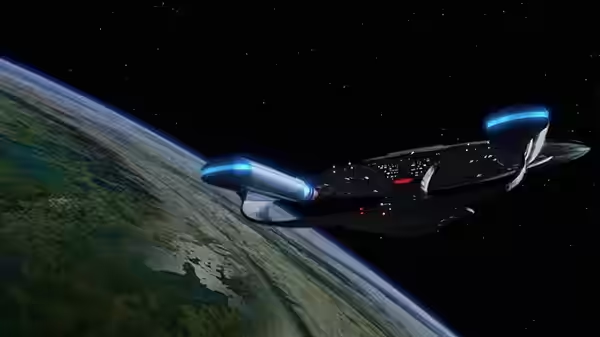
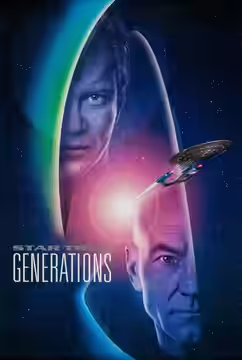
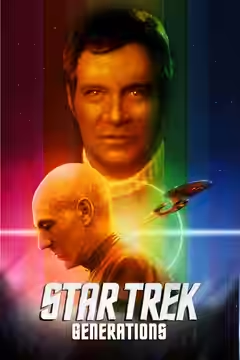
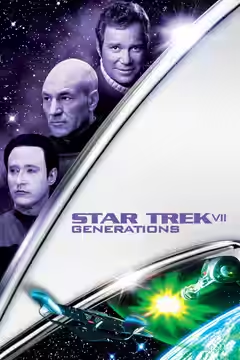
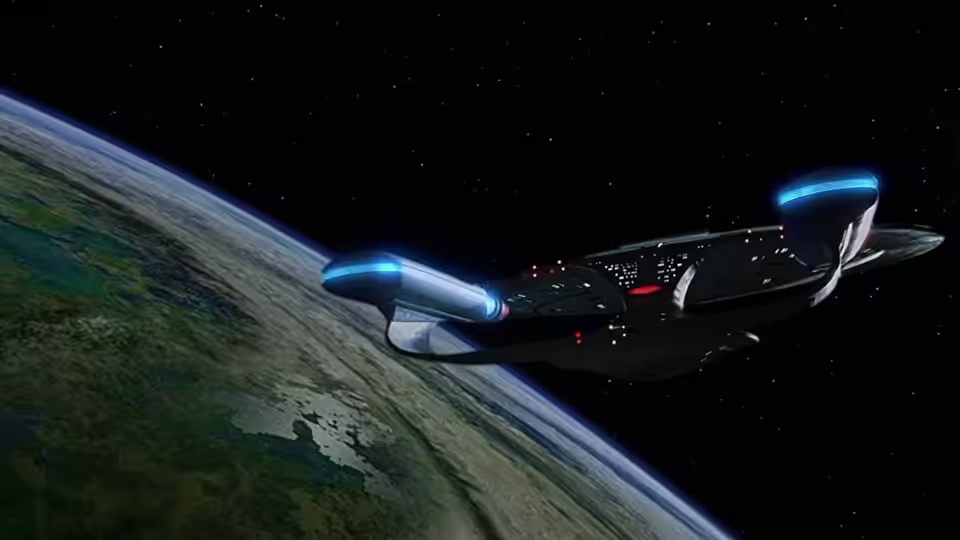
a starship with glowing blue engines flying above a green planet
Film review

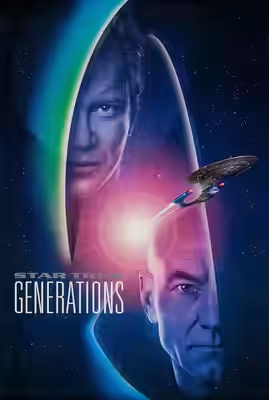
Star Trek: Generations

1994 · Directed by David Carson · 1h 58m

In a sentenceMalcolm McDowell blows up suns to get back to a place he liked, and we understood the impulse by the second hour

Captain James T. Kirk (William Shatner), Montgomery Scott (James Doohan) and Pavel Chekov (Walter Koenig) are guests at the launch of a new Enterprise under Captain John Harriman (Alan Ruck), and the maiden voyage turns into a rescue at the Nexus. Decades later, Captain Jean-Luc Picard (Patrick Stewart) commands another Enterprise, on which Data (Brent Spiner) has just had an emotion chip fitted. The crew are led to Dr. Tolian Soran (Malcolm McDowell), a scientist who means to get into the Nexus, whatever it costs the stars in his way. Picard, grieving news from home, has to work out what Soran wants before he takes it.

Plays from YouTube when you press play; nothing loads from them until then.

Fi1m review

Patrick Stewart’s crew take over the cinema series with a good villain, a fine first ten minutes and a script that cannot decide whether it is a thriller, a wake or a party for the fans. Watchable, handsome in a murky way, and never once urgent.

The job of Star Trek: Generations is to hand the cinema series from William Shatner’s crew to Patrick Stewart’s, and the film knows it. Rick Berman’s story, written up by Ronald D. Moore and Brannon Braga, opens with Captain James T. Kirk (Shatner) at the launch of a new Enterprise, passes the ship’s name to Captain Jean-Luc Picard (Stewart), and spends its 118 minutes trying to make a plot out of the handover. There is a villain, a threat and a ship in trouble, and none of it feels pressing. It is a decent television two-parter with bigger effects and dimmer lighting.

The opening is the best stretch. Kirk, Montgomery Scott (James Doohan) and Pavel Chekov (Walter Koenig) watch from the bridge while its new captain, John Harriman (Alan Ruck), tries to look as if he is in charge, and Ruck plays the humiliation well. The maiden voyage runs into the Nexus, and the rescue that follows is tense in a way the film never manages again. Peter E. Berger cuts it fast, Dennis McCarthy’s score keeps to the brass, and Shatner, given a last chance to be the man who fixes things, takes it without fuss.

Then the film leaps forward and settles in with the television crew, rather too comfortably. Data (Brent Spiner) has an emotion chip fitted and spends the middle hour laughing at nothing, trying drinks he dislikes and hiding under a console. Some of it is funny; most of it is Spiner doing a sketch. Worf (Michael Dorn) is promoted on a holodeck sailing ship and walked off a plank, and the joke is that people get wet. Riker (Jonathan Frakes), La Forge (LeVar Burton), Crusher (Gates McFadden) and Troi (Marina Sirtis) get a scene or two apiece.

Stewart is the reason the middle holds at all. Picard receives news of a death in his family early on and the film gives him one long scene in his quarters with Troi. He plays it small, never raising his voice, and we were moved more than we expected to be by a man in a starship uniform looking through a box of photographs. Then the film cuts to Data and a cocktail, and the feeling goes.

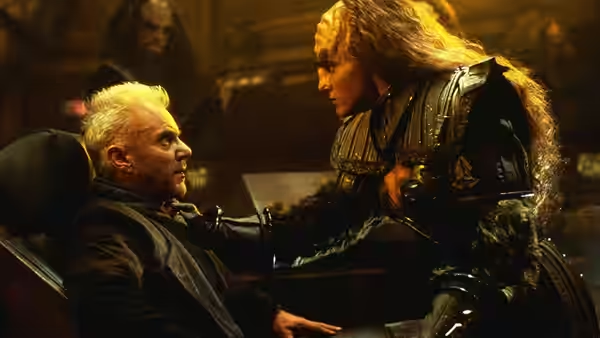
McDowell’s Soran is the other reason. He wants to get into the Nexus, and is prepared to knock stars out of the sky to do it, and McDowell plays him tired rather than mad, a man who has done the sums and finds them regrettable. His two scenes with Stewart, arguing about what time does to a person, are the only ones in the film where two people want something from each other. He is not on screen enough, and when he is the film keeps cutting away to check on the Klingons.

John A. Alonzo, who shot Chinatown, lights the Enterprise like a house at night: slats of light through blinds, deep shadow across the bridge, faces half lit. A bridge that looked like an open-plan office on television now looks like a submarine, and we kept wanting somebody to switch on a lamp. Herman F. Zimmerman’s sets and Robert Blackman’s uniforms are the television ones, better made, and the film’s biggest effect, the saucer coming down through an atmosphere, is a fine piece of model work that arrives after the story has run out of things to say.

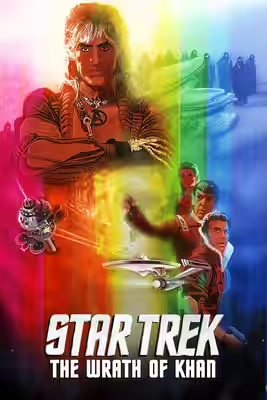
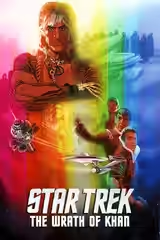
The second half takes a turn we will not describe, except that it brings the two captains together and gives them little to do. Star Trek II: The Wrath of Khan was about growing old and had one villain who hated one man. This one is about growing old too, says so several times, and never finds a story to carry the idea.

Most critics were harder on it than we are, and their complaint, that it is a film for people who already know these characters, is fair. If you do, there is a decent evening here: Ruck’s ten minutes, McDowell’s weary menace, Stewart with the photographs. For anyone else it is 118 minutes of pleasant people in a dark room talking about the Nexus, and the PG certificate is exact.
Critical consensus AI synthesised

41
Positive
2
Mixed
2
Negative
7

Most critics find Star Trek: Generations a disappointment: a handover from the original crew to the Next Generation that serves neither cast well. What praise there is gathers around the look of the film. The cinematography, the saucer crash sequence and the effects work are singled out even by reviewers who dislike everything else, Malcolm McDowell’s villain gets a good word, and Data’s emotion chip subplot is mentioned kindly more than once.

The reservations are about story. The Nexus plot is called confusing or impenetrable, the pacing uneven, the humour low, and several critics object to in-jokes and fan service standing where a narrative should be. The spread is fairly wide. Variety and The New York Times, writing on release, think it has enough spectacle to satisfy the faithful, and Den of Geek argues it is better than its reputation. Later reassessments are harsher, with /Film the lowest, and few think the meeting of Kirk and Picard justifies the film built around it.

The New York Times
18 November 1994 · Janet Maslin
70*

The most ambitious Star Trek film yet for mixing original and Next Generation casts via temporal flux, though it is flabby and impenetrable in places. It offers enough pomp, spectacle and high-tech dialogue to sustain the franchise, with Shatner's Kirk providing star appeal alongside Stewart's Picard.

Read the full review →
Variety
14 November 1994
70*

It may not boldly go where no man has gone before but has enough verve, imagination and familiarity to satisfy Trekkers. The first bigscreen outing for the Next Generation crew should succeed at the box office, with director David Carson capturing the Trek look effectively despite some fractures in execution.

Read the full review →
Empire
27 April 2006 · Angie Errigo
30*

The critic finds the film a disappointment as the handover from the original crew to the Next Generation, criticizing the incomprehensible plot, poor pacing, uneven character use and lowbrow humor, while noting occasional strong special effects.

Read the full review →
Los Angeles Times
17 November 1994 · Kenneth Turan
30*

The film feels like a religious ritual for fans rather than a conventional movie, retracing footsteps and relying heavily on audience knowledge of the two TV series. It offers familiar Enterprise adventures with Kirk and Picard meeting, plus Data's emotion chip subplot, but lacks bold new territory.

Read the full review →
RogerEbert.com
18 November 1994 · Roger Ebert
30*

The film is undone by its self-referential narcissism and in-jokes aimed at fans, preventing it from telling a strong story. It features a temporal nexus plot involving Kirk and Picard but prioritizes franchise callbacks over coherent narrative.

Read the full review →
The Hollywood Reporter
18 November 2019 · Phil Pirrello
30*

The critic describes the film as a noble misfire that nearly stalled the franchise, hampered by studio mandates and underwhelming story choices such as an eggs scene. The saucer crash sequence and Data's emotion chip subplot receive praise amid the overall disappointment.

Read the full review →

Straight answers AI written, from our review

Is Star Trek: Generations worth watching?
Star Trek: Generations is worth watching only if you already know Patrick Stewart's television crew, and we scored it 48. Alan Ruck's ten minutes at the start, Malcolm McDowell's tired villain and Stewart with a box of photographs are the good stretches. For anyone else it is 118 minutes of pleasant people in a dark room, and never once urgent.
How long is Star Trek: Generations, and what is it rated?
Star Trek: Generations runs 1h 58m. It is a science fiction and action film.
Where can I watch Star Trek: Generations in Serbia?
Star Trek: Generations is streaming on SkyShowtime and Netflix in Serbia, and it is also available to rent from Amazon Prime Video from din 2.99. Availability is checked daily; the links above go straight to each service.
How violent or frightening is Star Trek: Generations, and is it suitable for children?
Star Trek: Generations is a PG and the certificate is exact: there is a ship in trouble, a villain who knocks stars out of the sky, and a death in the family felt off screen, but nothing to frighten a child of ten. The bridge is lit like a submarine, which is murky rather than menacing. Younger children may be bored before they are scared.
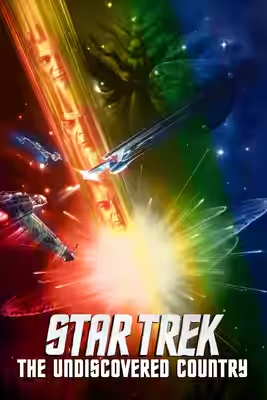
How does Star Trek: Generations compare to Star Trek VI: The Undiscovered Country?
Star Trek: Generations is the weaker of the two, and Star Trek VI: The Undiscovered Country is the one to choose if you want a story with any pressure behind it. The earlier film gives the original crew a Cold War thriller and is, for an hour, the smartest the series was. Generations has a better villain in McDowell and a fine opening, then settles into a comfortable middle hour with the television crew.
Do you need to have seen the other Star Trek films before Star Trek: Generations?
Star Trek: Generations is written for people who already know the cast of the television series, and a newcomer will feel the lack. The plot stands alone, and the opening with Kirk, Scott and Chekov explains itself, but the middle hour assumes you care about Data's emotion chip and Worf's promotion. Start with The Wrath of Khan or The Undiscovered Country instead.
What should I watch after Star Trek: Generations?
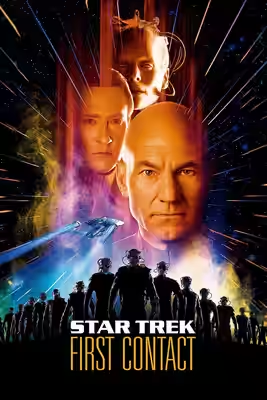
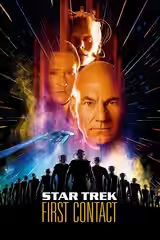
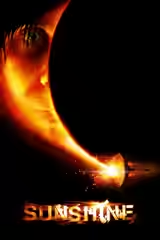
After Star Trek: Generations, try Star Trek II: The Wrath of Khan (1982, Fi1m 85): The series film about ageing that finds a story to carry it. Then Star Trek: First Contact (1996, Fi1m 82): The same crew, the next film, and this time with somewhere to go; and Sunshine (2007, Fi1m 74): A crew, a dying star and a plan; tense where this one drifts.
What order should I watch the Star Trek films in?
Release order is the safe choice for Star Trek, and it is the order our collection page lists them in. Star Trek: Generations is number 7 of the 13 Star Trek titles on Fi1m; before it comes Star Trek VI: The Undiscovered Country and after it Star Trek: First Contact. The full order.
Members

1 review · Fi1m gave it 48
@joe826 September 2026 · edited

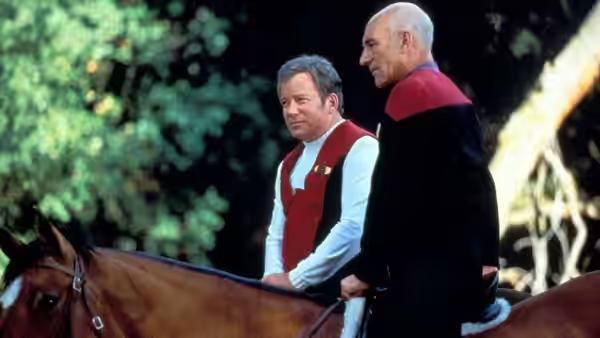
Saw this with my dad, having spent years watching TNG together, so it has a special place in my heart. Also Picard on a horse is badass.

Members' reviews are checked before they appear and are signed with a handle. Ours is above; theirs are theirs. Seen it? Add yours.

Part of · 7 of 13

Star Trek

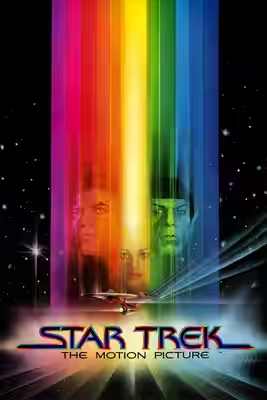
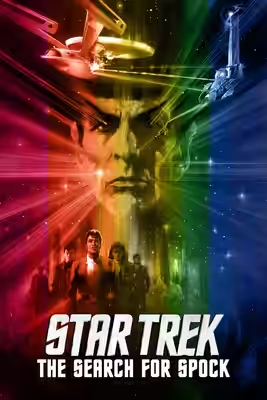
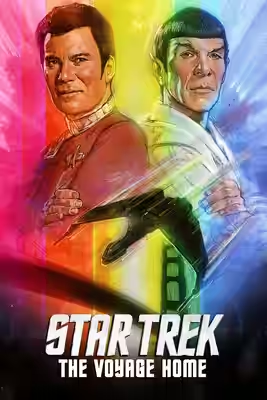
13 films on Fi1m · 1979–2016 · average 66 · best Star Trek II: The Wrath of Khan 85

All 13 in order

Cast

If you liked this, try…

  1. Star Trek II: The Wrath of Khan (1982, Fi1m 85)The series film about ageing that finds a story to carry it.

  2. Star Trek: First Contact (1996, Fi1m 82)The same crew, the next film, and this time with somewhere to go.

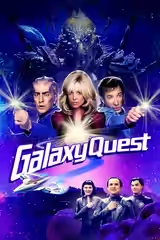
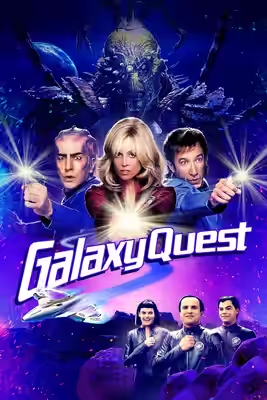
  3. Galaxy Quest (1999) · not reviewed yetA comedy about a cast who cannot escape their starship, made with real affection.

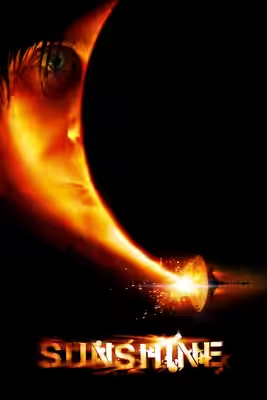
  4. Sunshine (2007, Fi1m 74)A crew, a dying star and a plan; tense where this one drifts.

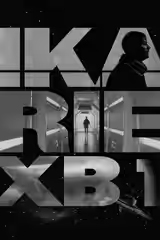
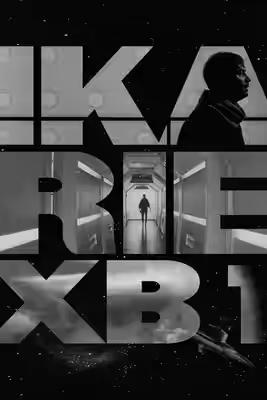
  5. Ikarie XB-1 (1963) · not reviewed yetCzech deep-space voyage, patient and strange, that the television series clearly watched.

Free account

Know what to watch tonight

Two lists that know where things are streaming, collections you can share, your own score beside ours, and Discover that remembers what you have seen.

  • Want to see, sorted by what is streaming now
  • Seen, with your score out of ten
  • No adverts, ever