David S. Goyer and Josh Friedman’s adaptation of Asimov is built on a scale television rarely attempts and lit like a cathedral. It is also slow, solemn and short of people to care about, though Lee Pace’s cloned emperor is worth the wait.
Isaac Asimov’s Foundation novels are about a mathematician who works out that the Galactic Empire will fall and sets up a colony to shorten the dark age that follows. They are almost entirely conversation, and nobody in them lasts more than a story or two. David S. Goyer and Josh Friedman have turned that into a serial drama with a cast that can come back each week, which means inventing a great deal. Their biggest invention is the Empire itself, three clones of the same man ruling at once at different ages, and it is the best thing in the series.
Lee Pace plays Brother Day, the clone in his prime, as a man who has never once been contradicted and has read about it in books. He speaks softly and takes any surprise as an insult, and Pace lets doubt in just often enough to keep him human. Cassian Bilton’s Brother Dawn is the boy learning to be him and Terrence Mann’s Brother Dusk the old man who was him, and the three of them at one table are the series at its most alive. Laura Birn’s Demerzel, the adviser who has served every one of them, does almost nothing with her face and holds the eye anyway.
Jared Harris gives Hari Seldon the dry pleasure of a man who finds his own equations funny, and his trial before the emperors, in which he defends a prediction nobody wants to be true, is the best written stretch of the first episode. Lou Llobell’s Gaal Dornick, the prodigy from Synnax who has crossed the galaxy to work with him, is our way in, and Llobell is watchful and likeable. The scripts, though, use her mainly to ask the questions other people get to answer, and for long stretches she is the person the ideas happen near.
Then there is Terminus. Leah Harvey’s Salvor Hardin is a warden on a cold frontier world, guarding a colony and an object the colonists cannot go near, and the series keeps cutting away from Trantor to her. Harvey is capable and unfussy; the material is standard frontier siege stuff, and the show’s largest ideas shrink to people crouching behind rocks with rifles. The jumps between the strands are not always marked, and there were evenings when we could not have said how many years lay between two adjacent scenes. Eight editors are credited across the run, Skip Macdonald and Sidney Wolinsky among them, and it shows.
We will be honest about the first hour. When Gaal’s ship drops through the cloud over Trantor and the city goes on beneath it with no horizon, we sat forward, and for a while we were as impressed as the series wanted us to be. Somewhere around the fifth episode we noticed we had been admiring for weeks and had not felt anything since, and we were cross with the show for spending so much on rooms and so little on the people standing in them.
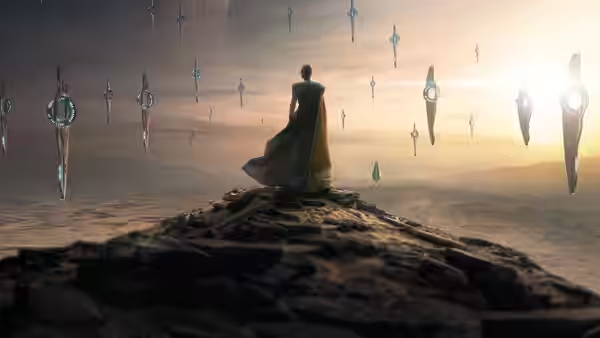
The rooms are superb, to be fair to them. Rory Cheyne builds Trantor’s palace as a vast pale hall in which three men are made to look small on purpose, and Terminus as prefabricated huts on grey scrub. Shauna Callanan puts all three emperors in the same imperial blue, so that three ages of one man read as one body. Eight cinematographers are credited, Owen McPolin and Danny Ruhlmann among them, and the palette holds steady from episode to episode. The score is choral and constant, and it tells us the stakes are galactic in scenes where two people are reading a screen.
Asimov’s argument was that individuals do not matter and history moves regardless, which is a poor engine for a drama built around individuals. Goyer and Friedman know this and spend the season arguing with the book, and now and then they win. Watch the first two episodes and see whether Trantor holds you. If it does not, nothing later will; if it does, you will forgive a good deal, and there is a good deal to forgive. The first season runs ten episodes, arrived on 23 September 2021, and carries a 15.