The Enterprise is back to one adventure a week, with a captain who listens and a bridge you would want to work on. Warm, handsome and good company; a little too fond of the old tunes to find many new ones.
Alex Kurtzman, Akiva Goldsman and Jenny Lumet have gone back to the beginning. Christopher Pike was the captain of the Enterprise in the first, rejected pilot of Star Trek, before William Shatner was hired, and this series gives him the ship for the years before Kirk. More to the point, it gives him one story a week. After the long, gloomy arcs of Star Trek: Discovery, where Anson Mount’s Pike first turned up, here a planet is found, a problem is met and the credits roll on a ship at peace. It is the most straightforwardly enjoyable Star Trek in a long while, and it plays safe.
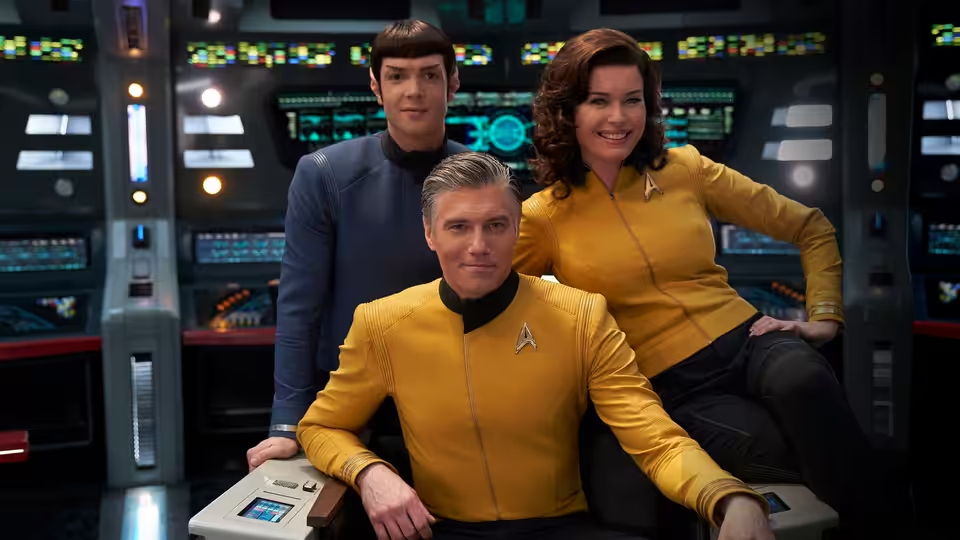
Mount is the reason it works. His Pike listens, and when he lectures, and the writers are fond of having him lecture, he does it as a man who would rather be doing almost anything else. Rebecca Romijn’s Una Chin-Riley is his first officer and his equal, and the two of them talk like colleagues of twenty years. That ease spreads across the bridge, and it is the thing the series gets most right.
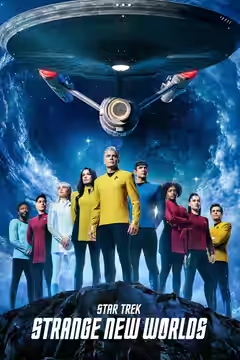
Jonathan Lee’s Enterprise is the handsomest version of the ship anyone has built. The bridge is white and pale blue with rounded edges and no hard shadows, and the turbolift doors still make a noise you can hum. Gersha Phillips and Bernadette Croft have put the crew back into gold, blue and red tunics, properly cut this time, so the old colour code reads at a glance. Glen Keenan and Magdalena Górka, two of five credited cinematographers, keep the light warm and the lens flares to a level a viewer can forgive. Nami Melumad’s score does the climbing-strings work every space adventure needs, and the title music quotes Alexander Courage’s 1966 fanfare, which made us sit up a little each week.
We did not expect to be got at by a show this comfortable, and we were. Celia Rose Gooding’s Nyota Uhura is a young officer who is not sure she belongs on the ship, and Gooding plays her plainly, without the wink a role this famous invites. Mount watches her as if he has already decided she will do, and more than once we found a lump in the throat that knowing exactly how the scene had been built could not shift. Bruce Horak’s Hemmer, sardonic and short with everyone, is the best of the new faces. That is the series at its best: an old, slightly silly Star Trek idea played completely straight.
The weaknesses are the ones the format invites. Some of the crew stay a line of dialogue rather than a person: Melissa Navia’s Erica Ortegas gets one quip per scene and little else, episode after episode, which is a waste of a likeable actor. Ethan Peck’s Spock is good when the show lets him be still, and the show keeps refusing, pushing him into comic set-ups until his dignity starts to look like a running gag. The morals are laid on with a trowel, and by the third speech the trick has stopped landing. And the series is fond of its back catalogue. A young Montgomery Scott (Martin Quinn) walks aboard, and Christine Chapel (Jess Bush) and Joseph M’Benga (Babs Olusanmokun) are names from the original series. For a show with this title, it spends a good deal of time on old worlds.
Set against the rest of Star Trek it sits in the upper middle. It has the friendliness of The Next Generation without that show’s patience, and the brightness of the 1966 original without its willingness to unsettle. Jonathan Frakes, who played Riker on The Next Generation, is among the directors, and the show is happiest in his key: light, quick and unembarrassed by itself.
It is a 15 certificate, and now and then it earns one. Watch it an episode at a time, with someone who remembers the tunics; it holds up less well in a binge, where the shape of every hour starts to show. We kept coming back. We were seldom surprised, and we were never bored.