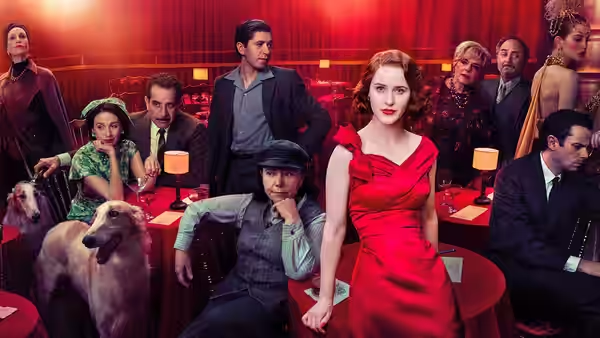
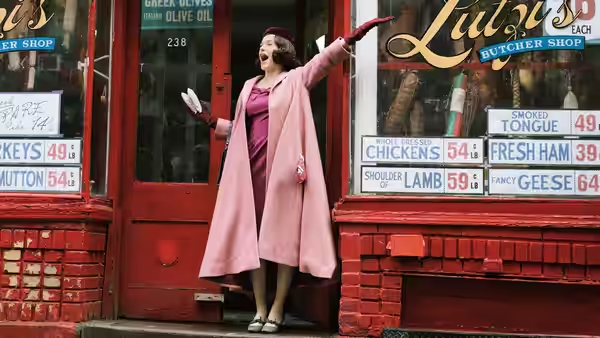
Midge Maisel (Rachel Brosnahan) walking through a crowd of suited men
Series review

The Marvelous Mrs. Maisel

2017 · Created by Amy Sherman-Palladino · Series

In a sentenceA divorce, a microphone and forty-three episodes of people who have never once in their lives paused for breath

New York in the 1950s. Miriam ‘Midge’ Maisel (Rachel Brosnahan) has a good flat, children, and a husband, Joel (Michael Zegen), who does stand-up at night at a club downtown using jokes borrowed from other comics. She goes along to watch and tells him what worked. Then Joel tells her he is leaving, and Midge, drunk, goes downtown and gets on the stage herself, where she is sharper than he ever was. Susie Myerson (Alex Borstein), who works the club, sees the set and decides Midge should be doing this for money. Midge’s parents, Abe (Tony Shalhoub) and Rose Weissman (Marin Hinkle), have views.

Plays from YouTube when you press play; nothing loads from them until then.

Fi1m review

Amy Sherman-Palladino’s comedy about a 1950s housewife who takes up stand-up is quick, handsome and built around a lead performance of real nerve. It talks too fast to notice that everyone in it sounds the same, and it runs longer than it should.

Amy Sherman-Palladino made her name with Gilmore Girls, in which everyone talked faster than anyone else on television. The Marvelous Mrs. Maisel moves the talking to New York in the 1950s and gives it a reason. Miriam Maisel (Rachel Brosnahan) is a housewife with children and a husband, Joel (Michael Zegen), whose hobby is performing other people’s stand-up material at a club downtown. When he leaves her, she goes to the club drunk, takes the stage, and is better at it than he ever was. The show is good: quick, handsome and carried by a lead who never asks to be liked. It is also five seasons built on one voice, and by the end we knew the rhythm of every line before it arrived.

Brosnahan is the reason it works. Midge is vain, tactless, rich and certain, and Brosnahan plays all of that straight rather than winking past it. She lets you see what the tidy life has cost before Midge has worked it out herself. When she finally stands at a microphone the relief on her face is real, and we were surprised by how much we wanted her to be good.

Alex Borstein’s Susie Myerson, who works the door at the club and decides to manage her, is the best thing in it. Susie is short, broke, dressed like a stagehand and permanently furious, and Borstein gives her something Midge never has, which is the ability to listen. Tony Shalhoub and Marin Hinkle, as Midge’s parents Abe and Rose Weissman, begin as types and become the people we most wanted to spend time with; Shalhoub’s Abe treats every family crisis as a problem set by an idiot. Kevin Pollak and Caroline Aaron, as Joel’s parents Moishe and Shirley, are louder and thinner. Luke Kirby drifts through as Lenny Bruce, the one comic in the series who sounds as though he is thinking.

It looks lovely, and it knows it. Bill Groom’s production design gives us a flat of moulded ceilings and pink bathrooms, a department store counter, and a basement club with a floor you would not want to touch. The camera, with M. David Mullen one of four cinematographers, glides through all of it in long unbroken takes. The clothes are coats and hats in the colours of boiled sweets. Kate Sanford, Tim Streeto and the other editors cut to the dialogue, so the cutting is fast whenever the talking is fast, which is always. Eric Gorfain’s music is brassy and brisk and sits under the lines rather than against them.

The trouble is the voice. Sherman-Palladino and Daniel Palladino, who share writing and directing credits across the run, have one way of writing a scene: two people, a torrent of words, a joke in every line, no pauses. Midge talks this way, and so do Susie, Abe, Rose, the shop girl and the policeman. Everyone is a comic. That makes Midge’s act harder to judge, because it sounds like the rest of the dialogue delivered standing up, and it flattens a world that was meant to be resisting her. Somewhere in the third season we noticed we had stopped laughing at the jokes and started admiring the speed. The show also cannot bear to let her lose for long. She stumbles, and then someone important happens to be watching. One dissenting critic found her impossible to like; we would not go that far, but we understood.

Set against Gilmore Girls, this is the more ambitious programme and the less relaxed one. Forty-three episodes across five seasons, from 2017 to 2023, is a long time to spend with people who never breathe, and the later runs send Midge further from the club and the flat, where the show is at its best, and grow baggier as they go. The first season, at eight episodes, is the tightest.

Watch it one episode at a time. Taken in a run it turns into a wall of sound and the clothes stop registering. Taken slowly it is a smart, fond, expensive comedy about a woman who was only ever going to be interesting once her life fell apart, and Brosnahan makes you glad it did.


Critical consensus AI synthesised

78
Positive
9
Mixed
0
Negative
1
IndieWire
20 November 2017 · Ben Travers
90*

The critic praises the series as a sharp, feminist period piece about a housewife turning to stand-up comedy as rebellion. Rachel Brosnahan's performance is highlighted as a standout in Amy Sherman-Palladino's rapid-fire, witty world.

Read the full review →
Radio Times
8.6/10 · Hannah Shaddock
86

This 1950s-set comedy drama is warming and watchable like Gilmore Girls. Rachel Brosnahan brings steel to the role of a housewife-turned-stand-up comedian.

Read the full review →
The AV Club
28 November 2017 · B+ · Gwen Ihnat
83

The review calls it an ambitious, visually dazzling expansion of Sherman-Palladino's style into 1950s New York, with a compelling heroine and strong ensemble. It notes some pacing issues but highlights the period detail and Midge's liberating journey.

Read the full review →
The Hollywood Reporter
26 November 2017 · Tim Goodman
80*

There is a lot to love, with rapid-fire jokes and a magnetic lead actress. The show stands out when Brosnahan stands up as the upbeat optimism and forward-looking aspects prove addictive.

Read the full review →
The i Paper
29 November 2017 · Bernadette McNulty
80*

The critic praises the spirited tempo and genuinely funny jokes that make the show zip along as both a loving historical homage and effortlessly funny. Rachel Brosnahan's charming and sharp performance stands out.

Read the full review →
Vulture
28 November 2017
80*

The critic finds the show charming and lively, especially when Midge performs stand-up, crediting Brosnahan's energy and the sharp, period-authentic production design. It notes the familiar Sherman-Palladino rhythms but praises the heightened Manhattan moxie and costumes.

Read the full review →

Straight answers AI written, from our review

Is The Marvelous Mrs. Maisel worth watching?
The Marvelous Mrs. Maisel is worth watching, and we scored it 76. Rachel Brosnahan's performance as a 1950s housewife who takes up stand-up is the reason, with Alex Borstein's Susie close behind. The catch is that every character talks in the same quick, joke-a-line voice, and the five seasons grow baggy; watch one episode at a time and start with the tighter first run.
Where can I watch The Marvelous Mrs. Maisel in Portugal?
The Marvelous Mrs. Maisel is streaming on Amazon Prime Video in Portugal. Availability is checked daily; the links above go straight to each service.
How violent or frightening is The Marvelous Mrs. Maisel, and is it suitable for children?
The Marvelous Mrs. Maisel is a comedy-drama, not a violent or frightening programme, but its UK 15 certificate reflects adult language and a stand-up act built on frank sexual material. There is nothing in it to scare the squeamish. It is not for children, and younger teenagers will find the humour and the setting aimed well over their heads.
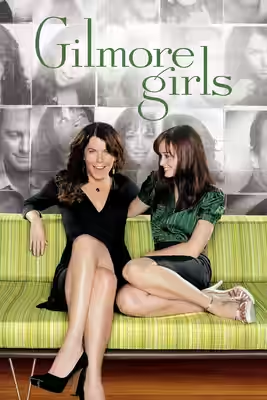
How does The Marvelous Mrs. Maisel compare to Gilmore Girls?
The Marvelous Mrs. Maisel is the more ambitious of Amy Sherman-Palladino's two fast-talking programmes and the less relaxed one; Gilmore Girls is the warmer, with lower stakes and a small-town setting. Both run out of steam in their later seasons. Choose Maisel for the period look and a lead of real nerve, Gilmore Girls for company you can sit with for longer.
What should I watch after The Marvelous Mrs. Maisel?
After The Marvelous Mrs. Maisel, try Gilmore Girls (2000, Fi1m 81): Sherman-Palladino’s earlier fast talkers, in a small town with lower stakes and warmer coffee. Then Hacks (2021, Fi1m 77): A veteran comic and a young writer despise each other into something like a partnership; and Lenny (1974, Fi1m 67): Bob Fosse’s black-and-white Lenny Bruce, the real thing behind Kirby’s version.

Cast

If you liked this, try…

  1. Gilmore Girls (2000, Fi1m 81)Sherman-Palladino’s earlier fast talkers, in a small town with lower stakes and warmer coffee.

  2. Hacks (2021, Fi1m 77)A veteran comic and a young writer despise each other into something like a partnership.

  3. Lenny (1974, Fi1m 67)Bob Fosse’s black-and-white Lenny Bruce, the real thing behind Kirby’s version.

  4. Mad Men (2007) · not reviewed yetThe same decade and city, seen from the offices the Maisel men aspire to.

  5. Funny Girl (1968, Fi1m 70)Streisand as a comic who will not be told she is not beautiful.

Free account

Know what to watch tonight

Two lists that know where things are streaming, collections you can share, your own score beside ours, and Discover that remembers what you have seen.

  • Want to see, sorted by what is streaming now
  • Seen, with your score out of ten
  • No adverts, ever