Tony Warren’s street of Salford terraces has run since December 1960 and, on its good nights, is still funny, humane and sharply observed. On its bad nights it mistakes catastrophe for drama. The good nights are still worth finding.
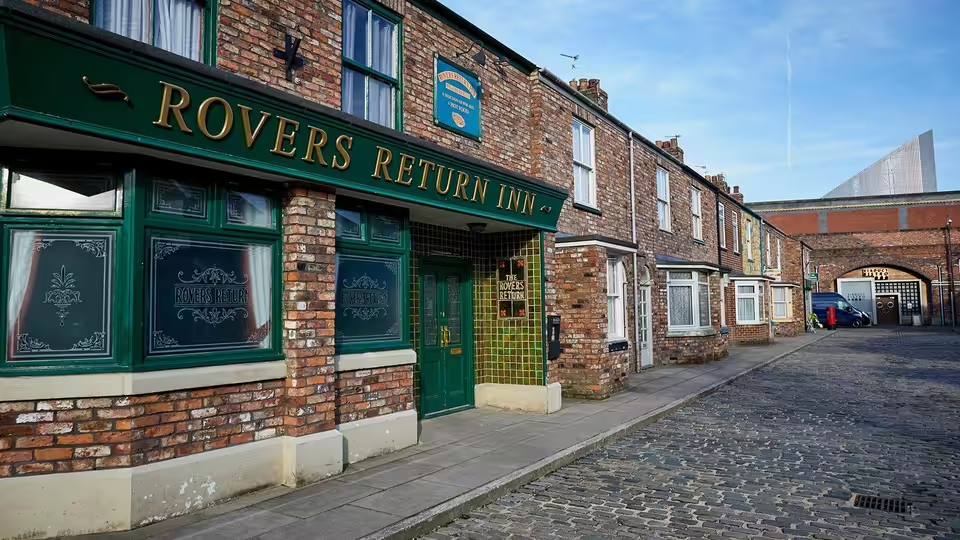
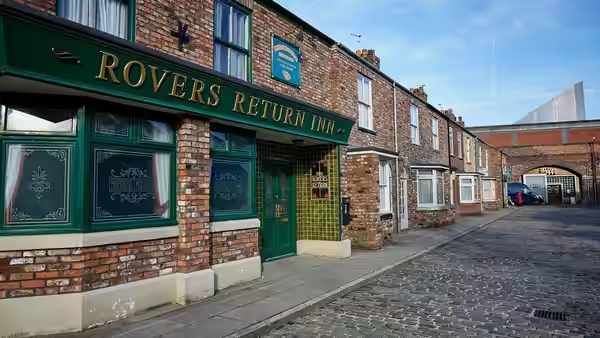
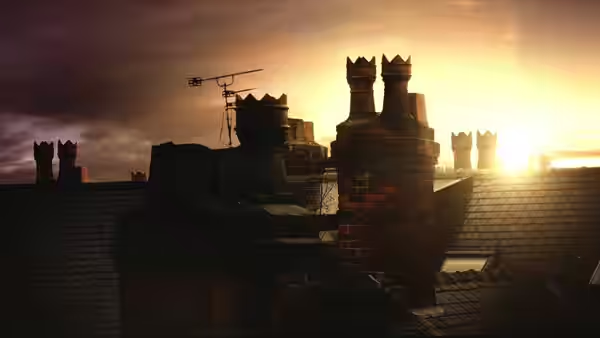
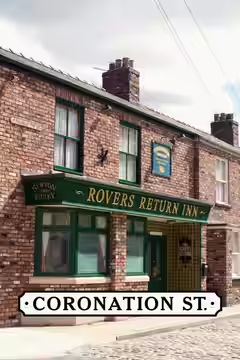
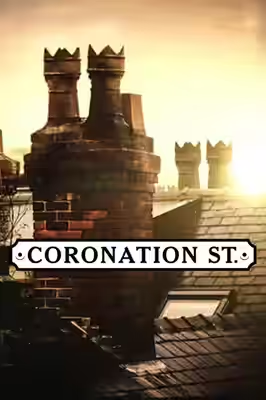
Tony Warren’s Coronation Street was first broadcast in December 1960. It is a terrace of brick two-up two-downs in Weatherfield, a made-up corner of Salford, with a pub called the Rovers Return at one end, and for more than sixty years it has asked one question: what did she say to him, and who heard. On a good night it is as funny and humane as anything on British television. On a bad night it is a disaster film that has wandered on to the wrong set. We recommend the good nights, and there are still plenty of them.
The first run was seven episodes. By the 2010s the programme was turning out more than 250 a year, each 22 minutes long, which is a schedule that would kill a feature film in a week. It has survived because the form is modest. An episode does not have a plot so much as a dozen conversations, most of them in the Rovers or somebody’s back kitchen, and the drama is in who is lying and who has noticed.
Doris Speed played Annie Walker, the landlady of the Rovers, through the early decades, with her chin held a precise inch higher than her customers’. William Roache was in the first episode as Ken Barlow, the clever boy home from university and ashamed of his father’s table manners, and he is still there. Ken has now been embarrassed by every generation on the street in turn, and Roache plays each fresh embarrassment as if it were the first.
The writers’ credits over the years include Jimmy McGovern, Sally Wainwright, Jonathan Harvey, Peter Whalley, John Stevenson and Daran Little, and what the best of them share is an ear for how people in a pub talk: round the subject, in insults, with the real matter saved for the door. The jokes are not written as jokes. A woman at the bar says something about a neighbour’s new coat, and three lines later the neighbour’s marriage is on the table. We laughed out loud more than once at Simon Gregson’s Steve McDonald, a man who begins every explanation already defeated, and it was the particular laugh of recognition. We have stood where he stands. Alan Halsall’s Tyrone Dobbs and Jane Danson’s Leanne Battersby have the same gift for being ordinary without being dull.
What goes wrong is the big week. The anniversary episodes, staged live in 2010 and marked again in 2020, were liked by most critics, and we see why: the live scenes ran without a stumble and the cast rose to the occasion. But both weeks were built around catastrophe, the first turning the programme towards disaster plotting and the second resting its climax on the Geoff and Yasmeen story, and a show that was made out of a coat and a remark became one about sirens. We were cross, and the crossness was specific. The people we had come to watch were being moved out of the way for an event.
The direction is plain by design, and the credits are a surprise. Mike Newell, Roland Joffé, Charles Sturridge and Julian Jarrold have all directed episodes, and none of them left fingerprints, which is to their credit. The camera’s one job is to get to the face that has just heard the thing, and the good directors get there a beat early so we watch the news land. When an episode cuts to a car on a wet road and the music swells, something expensive is about to happen and the writing has clocked off for the night.
Against its own standard, the quiet comic decades, the modern programme is louder and faster, and at more than 250 episodes a year it would be a miracle if it were not. Against everything else on the schedule it is still the place where ordinary working lives get half an hour of attention a night, and nobody else has kept that up since 1960. Watch an ordinary week rather than an anniversary. The programme is at its best when nothing is at stake except who gets to tell the story first.