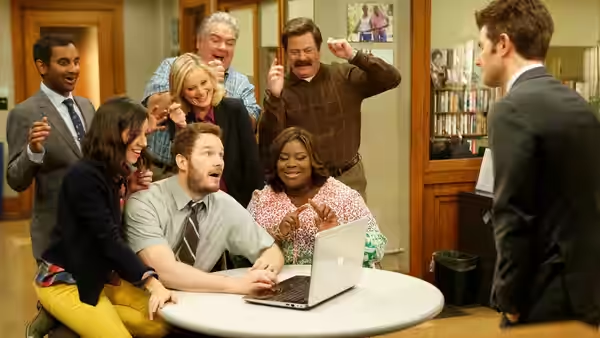
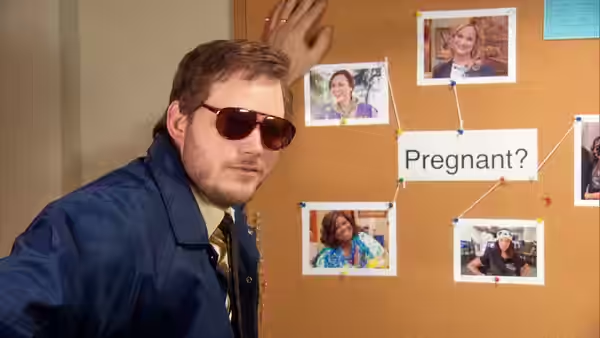
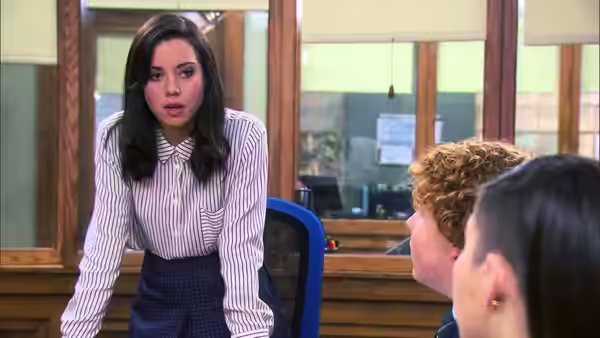
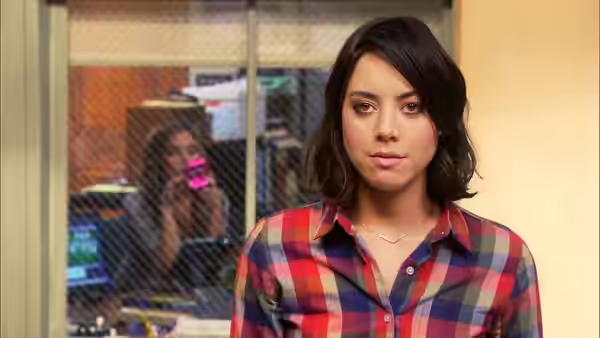
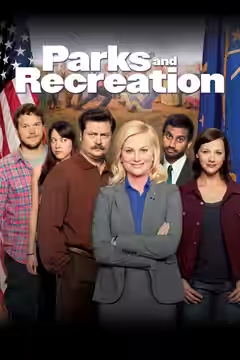
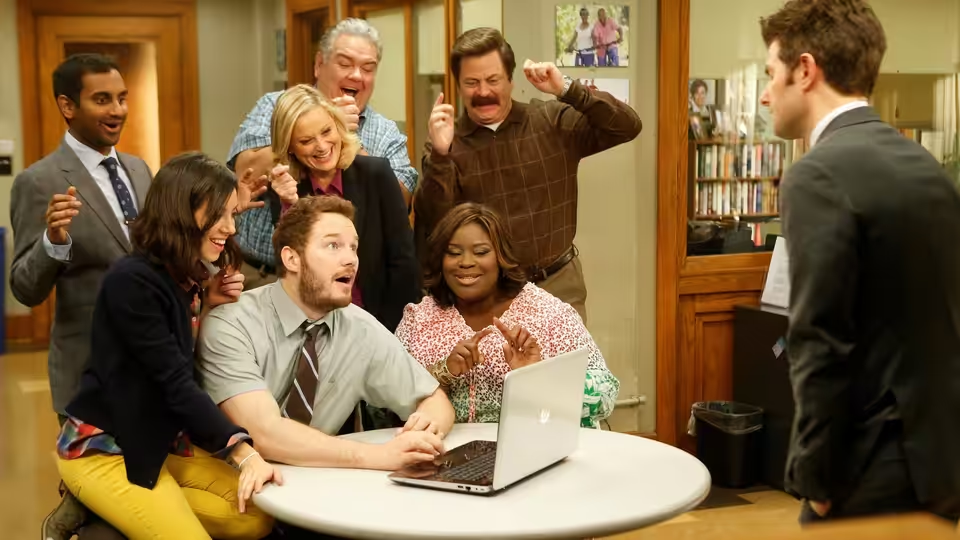
A scene from Parks and Recreation
Series review

Parks and Recreation

2009 · Created by Michael Schur, Greg Daniels · Series · 22m · NMHH 16

In a sentenceA libertarian runs the parks department and the woman who actually loves parks works for him; the joke lasts seven seasons

Pawnee, Indiana. Leslie Knope (Amy Poehler) works in the town’s parks department, believes in local government and says so often. At a public forum Ann Perkins (Rashida Jones) complains about a pit behind her house, where her boyfriend Andy Dwyer (Chris Pratt) has fallen in. Leslie promises to fill it in and build a park. Her boss Ron Swanson (Nick Offerman) would prefer the department did nothing at all. April Ludgate (Aubrey Plaza) sits at a desk and cannot be bothered, and Mark Brendanawicz (Paul Schneider) is the colleague Leslie keeps asking for help. A documentary crew follows them all.

Plays from YouTube when you press play; nothing loads from them until then.

Fi1m review

It begins as a photocopy of The Office and becomes, somewhere in its second year, a warmer and more generous programme than its model ever was. Skip the first six episodes if you must; the other 116 are worth your evenings.

Michael Schur and Greg Daniels made a workplace comedy in a familiar shape: a documentary crew, a dull office, people talking to camera. Almost every critic who saw it in 2009 said it looked like The Office, and it did. This time the office is the Parks and Recreation Department of Pawnee, Indiana, and the woman at its centre, Leslie Knope (Amy Poehler), wants to turn a pit into a park. The programme ran for seven seasons and 122 episodes, and the first season, six episodes long, is the patchy one. After that it becomes warmer and funnier than the show it resembled, and we recommend it with one caveat: start with season two.

The first season’s problem is Leslie. Poehler plays her as a fool who does not know it, chirping about her ambitions while the town ignores her, and Paul Schneider’s Mark Brendanawicz stands beside her as the sane man we are meant to agree with. That is the shape of The Office with the names changed. We were bored, and then irritated, because everyone involved was plainly capable of better.

The fix is simple. Leslie is made good at her job. The writers stop laughing at her and start laughing with her, and the programme becomes about a competent woman surrounded by people who cannot be bothered. Chief among them is Ron Swanson (Nick Offerman), her boss, a libertarian who runs a government department and would like it to do nothing. Offerman plays him with a moustache and a face that moves perhaps twice a season, and the joke never wears out because Ron turns out to be fond of the woman whose every project he opposes. Their friendship is what the whole programme is built on.

Around them the writers, Schur and Daniels at the top of a room that included Harris Wittels, Megan Amram, Alan Yang and Aisha Muharrar, assemble a cast that takes years to wear out. Aziz Ansari’s Tom Haverford has small ambitions and enormous self-regard. Aubrey Plaza’s April Ludgate is contempt in a cardigan, and Chris Pratt’s Andy Dwyer, the boyfriend who fell in the pit, is a large happy dog. Jim O’Heir’s Jerry Gergich exists to be blamed; Retta’s Donna Meagle is above it all. Adam Scott and Rob Lowe arrive later, as Ben Wyatt and Chris Traeger, and stay; Scott gives the show a straight man who is funny in his own right.

Peter Smokler shoots it in the documentary manner, handheld, with a zoom into a face at the moment it registers something it would rather not. Directors including Dean Holland, Morgan Sackett and Schur himself use the format lightly: the camera is a witness the characters have stopped noticing, and the interviews are used for jokes rather than sighing. It looks like a town hall in Indiana, lit like a town hall in Indiana.

It moved us more than we expected. Somewhere in the third season we found we cared whether a small town in Indiana got its park. What did it was Poehler’s refusal to let Leslie’s effort be embarrassing; she plays trying hard as funny without ever playing it as pathetic, and the show holds to that for years without once becoming a lecture.

The flaws are the flaws of niceness. As the seasons go on the writers grow reluctant to let anyone be wrong for long, and quarrels that would once have run for a year are settled in an episode with a hug and a speech. The people of Pawnee, seen mostly at public forums, are written as a mob of idiots, which sits oddly with a programme that loves the idea of serving them. The seventh season, at 12 episodes, is tidy to the point of being a list.

Set against the American The Office, this is the kinder and less original programme. Set against most sitcoms of any country it is an odd thing: a comedy whose central figure is not a monster, an idiot or a sad man, but a woman who is good at her job. Start at season two, watch it at home in twos and threes, and forgive it the hugs.

Critical consensus AI synthesised

74
Positive
9
Mixed
0
Negative
1

Most critics warm to it. The praise clusters on Amy Poehler’s Leslie Knope, an optimistic, hard-working local government official whom several reviewers describe as the sort of comic lead you want to befriend, and on an ensemble cast that keeps the satire of small-town bureaucracy light on cynicism and cruelty. Reviewers writing after the series has finished are the most enthusiastic, and one finds its finale an effective, if formulaic, send-off for every character.

The reservations sit almost entirely on the first season and its debt to The Office. Variety, reviewing in 2009, is the lone negative, finding the show too close to its template and short on imagination. Radio Times and The Independent agree the early episodes are patchy and advise persevering into season two, while IndieWire argues the opening run deserves a second look. The spread is wide: those who saw the whole thing rate it far higher than those who saw only the start.

The Guardian
1 August 2013
90*

The critic praises the show's warm, satirical take on small-town bureaucracy and its ensemble cast, highlighting the evolution of Leslie Knope from buffoon to competent optimist. It is a strong ensemble piece, refreshingly light on cynicism and cruelty, with contagious warmth.

Read the full review →
The Hollywood Reporter
7 April 2009 · Daniel Carlson
90*

The review finds the series genuinely funny and engaging with its own heart and mind, despite stylistic similarities to The Office. It singles out Leslie Knope's genuine heart and eagerness for praise, noting how these qualities balance the comedy without cruelty.

Read the full review →
The Times
9 March 2013 · Caitlin Moran
90*

The critic celebrates Leslie Knope as a boundlessly optimistic, enthusiastic and hard-working female comedy character impossible not to befriend, comparing her positively to classic sitcom leads. The show is described as one that is impossible not to befriend overall.

Read the full review →
Empire
26 April 2013 · Joe Cunningham
70*

Despite fears it would be little more than an Office clone, the first season has a wholesome charm of its own. Poehler’s energetic performance drives a decent enough but not hugely original debut season.

Read the full review →
IndieWire
9 April 2024 · Jon O'Brien
70*

The first season, often dismissed as a flop, still has plenty to admire about the Pawnee gang’s opening six episodes and deserves reevaluation on its 15th anniversary.

Read the full review →
Radio Times
· Jack Seale
70*

The first season is patchy, but persevere (or skip it) and the show becomes as rewarding as other mockumentary sitcoms of the era. It features a host of performers who have since gone on to greater things.

Read the full review →

Straight answers AI written, from our review

Is Parks and Recreation worth watching?
Parks and Recreation is worth watching for anyone who wants a warm workplace comedy about a competent woman surrounded by people who cannot be bothered, and we scored it 83. The six-episode first season is the patchy one, a photocopy of The Office, so we recommend starting at season two. Watch it at home in twos and threes and forgive it the hugs.
How long is Parks and Recreation, and what is it rated?
Parks and Recreation has episodes of about 22m and is rated 16 by the NMHH in Hungary. It is a comedy series.
Where can I watch Parks and Recreation in Hungary?
Parks and Recreation is not on any streaming or rental service in Hungary at the moment. It is available in 27 other countries; change your country at the top of the page to see where. Availability is checked daily.
How violent or frightening is Parks and Recreation, and is it suitable for children?
Parks and Recreation is not violent or frightening; it is a gentle sitcom about a small-town parks department, and its UK 15 certificate reflects adult humour and language rather than anything alarming on screen. Younger children will find little to be scared of and little to laugh at. Teenagers who can take the jokes will be fine.
How does Parks and Recreation compare to The Thick of It?
Parks and Recreation is the kinder of the two, a comedy of local government whose central figure is good at her job and fond of the people who obstruct her, while The Thick of It is Whitehall as a shouting match, with the kindness removed. The British programme is the sharper and more unpleasant; the American one is warmer and lasts longer. Choose by whether you want to wince or to be cheered.
What should I watch after Parks and Recreation?
After Parks and Recreation, try The Thick of It (2005, Fi1m 89): The same corridors with the kindness removed; Whitehall as a shouting match. Then Detectorists (2014, Fi1m 87): Two men in an Essex field, hoping; gentle, funny and unhurried in the same way; and Brooklyn Nine-Nine (2013, Fi1m 78): Schur’s next workplace, a police precinct, run on the same decency and faster jokes.

Cast

Awards

TCA Award for Individual Achievement in Comedy, 2011

Won
TCA Award for Individual Achievement in Comedy

If you liked this, try…

  1. The Thick of It (2005, Fi1m 89)The same corridors with the kindness removed; Whitehall as a shouting match.

  2. Detectorists (2014, Fi1m 87)Two men in an Essex field, hoping; gentle, funny and unhurried in the same way.

  3. Brooklyn Nine-Nine (2013, Fi1m 78)Schur’s next workplace, a police precinct, run on the same decency and faster jokes.

  4. Schitt's Creek (2015, Fi1m 82)Another small town that turns out to deserve the people stuck in it.

  5. Yes Minister (1980, Fi1m 89)The British original on bureaucrats who would rather nothing happened at all.