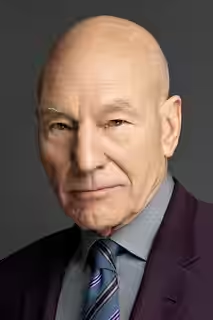
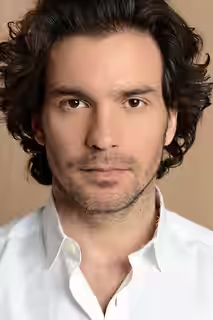
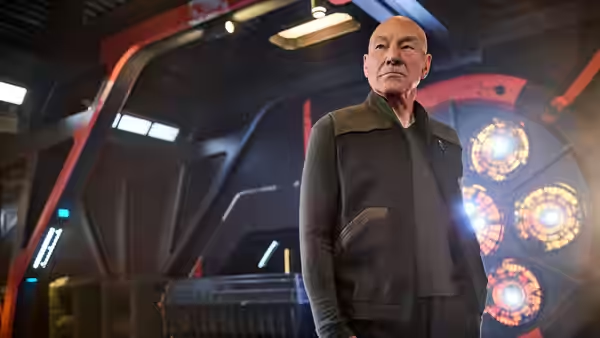
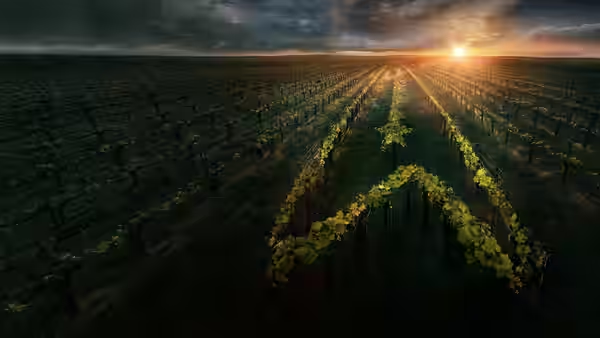
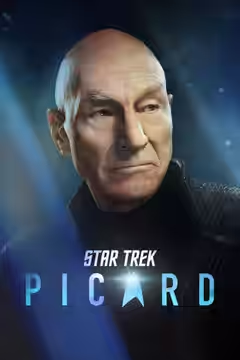
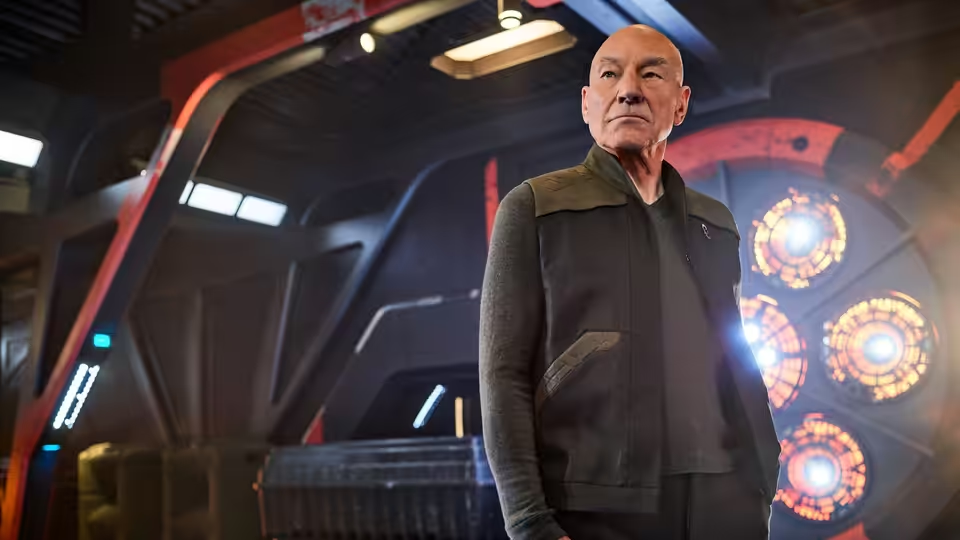
Jean-Luc Picard (Patrick Stewart) stands aboard a starship beside glowing circular consoles
Series review

Star Trek: Picard

2020 · Created by Alex Kurtzman, Kirsten Beyer, Akiva Goldsman, Michael Chabon · Series

In a sentenceThree seasons, three different shows, one Patrick Stewart holding all of them up

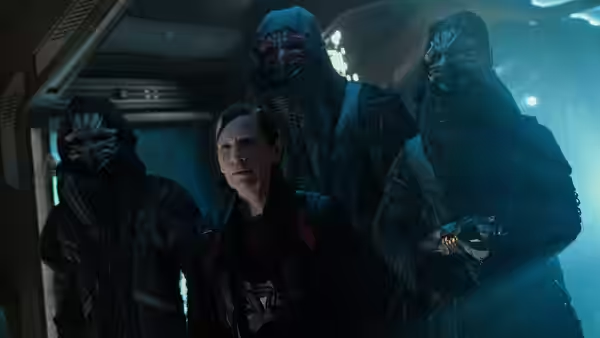
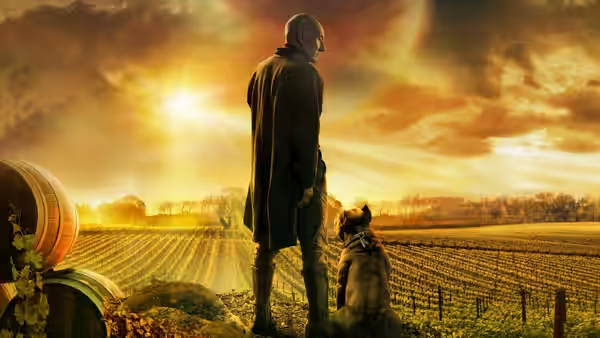
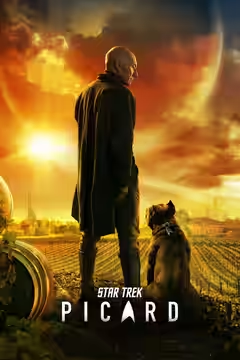
Jean-Luc Picard (Patrick Stewart), a retired Starfleet admiral, lives on his family vineyard in France with his dog and two Romulan housekeepers, still angry about the abandoned evacuation of Romulus. A young woman called Dahj arrives at his gate after masked assassins kill her boyfriend, saying she has seen his face in her mind. Picard follows what she tells him to Starfleet’s archives and to Dr. Agnes Jurati (Alison Pill), a scientist working on synthetic life, then hires a ship from Cristóbal Rios (Santiago Cabrera) and calls on his former officer Raffi Musiker (Michelle Hurd), who has not forgiven him. Far away, on a Borg cube being dismantled by Romulans, Soji Asha (Isa Briones) works with Hugh (Jonathan Del Arco) on former drones, while a Romulan agent, Narek (Harry Treadaway), takes an interest in her.

Plays from YouTube when you press play; nothing loads from them until then.

Fi1m review

Patrick Stewart gives Jean-Luc Picard an old age worth watching, and the series never settles on what to do with it. A promising first season, a lost second and a fond third add up to a show for those who already care.

Star Trek: Picard starts from a question the franchise had never bothered with: what happens to the captain once the ship is gone. Jean-Luc Picard is a retired admiral on his family vineyard in France, with a dog, two Romulan housekeepers and a Starfleet he no longer recognises. Kirsten Beyer, Alex Kurtzman, Akiva Goldsman and Michael Chabon, the credited creators, want a slower, sadder Star Trek about an old man’s regrets. Over three seasons of ten episodes each they make three different programmes: a promising first, a second that loses its way, and a third that drops the new questions to answer an old one.

What holds it together is Patrick Stewart, and he holds it almost alone. Early in the first episode Picard gives a television interview and is asked why Starfleet abandoned the Romulan evacuation. Stewart lets the courtesy drain out of his face, and his voice drops to nothing before it climbs. It moved us more than we expected, and the reason is not the writing, which is on the nose, but the face: here is a man who has been right for so long he has forgotten how to be wanted. He plays the whole first season on that.

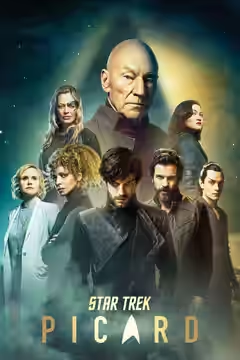
The new crew is better cast than written. Alison Pill’s Dr. Agnes Jurati talks when she is frightened, which is constantly, and Pill makes the nerves funny before the plot makes them something else. Michelle Hurd’s Raffi Musiker is the one person allowed to be angry at Picard, and Hurd plays the grievance as something she has kept warm for years. Santiago Cabrera’s Rios flies a ship crewed by holograms of himself. On the reclaimed Borg cube, Isa Briones’s Soji Asha and Harry Treadaway’s Narek circle one another while Jonathan Del Arco’s Hugh tries to keep the other former drones alive. Hanelle Culpepper directs the opening episodes at a walk, and they are the best-paced hours in the run.

It looks expensive and consistent, which with four credited cinematographers, Darran Tiernan, Philip Lanyon, Jon Joffin and Crescenzo G.P. Notarile, is no small thing: shallow focus, dark backgrounds, lights that smear across the lens whenever a ship moves. Dave Blass and Todd Cherniawsky build the cube as a rusted cathedral of green light and wet walls, and the vineyard in oak and afternoon sun. Jeff Russo gives Picard a soft piano theme. Jerry Goldsmith and Alexander Courage are credited for the fanfares the show borrows, and it plays them whenever it wants a cheer it has not yet earned. The 15 certificate is earned on the cube, where bodies are taken apart on tables, and we did not enjoy it.

The writing is where it falls down. The first season’s Romulan conspiracy needs explaining in every corridor, and the season ends by answering its mystery with a larger one we will not describe. The second season is the low point. It sends the crew into Earth’s past, splits them into pairs and gives each pair a waiting room, and Brent Spiner turns up as Dr. Adam Soong, enjoying himself more than we were. Somewhere around the sixth episode we stopped following and started counting how many were left. Ten hours is a long time to spend on a story that would fit in two.

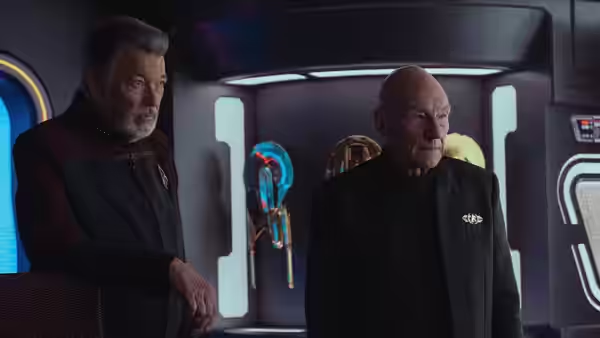
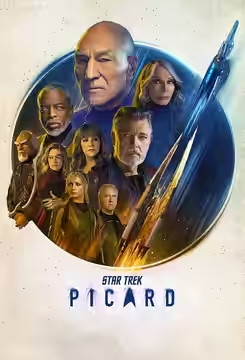
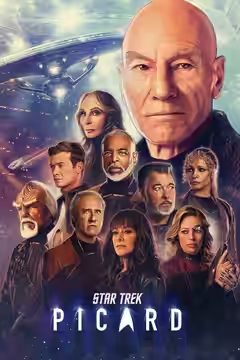
The third season, with Terry Matalas writing and directing, is the one most critics prefer, and we liked it too. The crew of The Next Generation reassembles, Ed Speleers arrives as Jack Crusher, and Jeri Ryan’s Seven of Nine, the best thing in the show after Stewart across all three years, at last gets a uniform and a chair. Stephen Barton’s cues lean hard on the Goldsmith theme. It is a fond, well-made reunion. It is also the least ambitious of the three: the first season asked what a synthetic person is owed and what Starfleet had become, and the third flies a familiar ship down familiar corridors and says nothing further about either.

The Next Generation was a programme about a room full of grown-ups solving a problem by talking. Picard is a programme about one grown-up and a great many people shouting in the dark, and it is at its best when it lets him sit down. Watch the first three episodes for Stewart and the last ten for the company. The middle ten are for the committed, and we say that as people who committed.
Critical consensus AI synthesised

70
Positive
11
Mixed
6
Negative
1

Most critics welcome the series as a considered return rather than a nostalgia exercise, and the praise clusters almost entirely around Patrick Stewart. Review after review singles out his older, more uncertain Picard, remorseful and less remote than the captain of old, as the reason to watch. Several also credit the writing for keeping his empathy intact and for balancing familiar faces with new stories.

The reservations are about pace. Several find the opening episodes slow and heavy with exposition, and Consequence adds that convoluted plotting and clunky dialogue hold the show back. Vulture goes further, arguing the series lacks the curiosity and chemistry that make Star Trek work, while Radio Times wants more optimism and less Borg torture. The spread is wide, from the low forties to ninety, and the warmest reviews are for the third season, which Collider and /Film treat as a marked improvement.

IndieWire
27 February 2020 · B+ · Christian Blauvelt
83

The critic says the episode is exceptionally well written and directed, with its character-driven turns making familiar revelations powerful. They praise Picard’s return to the Borg cube and the empathy shown toward former Borg, while faulting the scant follow-up to Jurati’s shocking actions.

Read the full review →
Empire
31 January 2020 · Dan Jolin
80*

Jolin finds the series a welcome, forward-looking return for Star Trek and its beloved captain. He praises Picard’s enduring empathy and the show’s character-focused approach.

Read the full review →
The i Paper
24 January 2020 · ★★★★ · Jeff Robson
80

Robson calls the premiere an impressive, emotionally engaging start and says it could become a worthy addition to the canon. He praises the action, special effects and Stewart’s quietly intelligent performance.

Read the full review →
The AV Club
23 January 2020 · B · Danette Chavez
77

Chavez finds the series a rousing, forward-looking return that balances nostalgia with new stories, though its packed plotting and action sometimes struggle to find their footing. She singles out Patrick Stewart’s vulnerable, soulful performance as Picard for praise.

Read the full review →
The Telegraph
24 January 2020 · Ed Power
70*

The review finds the series hokey and short of prestige-TV polish, but says it comes close to balancing nostalgia with a modern story. It singles out Patrick Stewart’s performance as sensational.

Read the full review →
Evening Standard
24 January 2020 · Alastair McKay
65*

The review is cautiously positive about the series, despite finding its approach less adventurous and more weary than earlier Star Trek. It praises Patrick Stewart’s reassuring presence and Shakespearean diction in the allegorical future.

Read the full review →

Straight answers AI written, from our review

Is Star Trek: Picard worth watching?
Star Trek: Picard is worth watching for those who already care about Jean-Luc Picard, and we scored it 64. Patrick Stewart gives the retired admiral an old age worth watching, but the three seasons are three different programmes: a promising first, a lost second and a fond third. Watch the first three episodes for Stewart and the last ten for the reunion; the middle ten are for the committed.
Where can I watch Star Trek: Picard in Hungary?
Star Trek: Picard is streaming on SkyShowtime and Amazon Prime Video in Hungary. Availability is checked daily; the links above go straight to each service.
How violent or frightening is Star Trek: Picard, and is it suitable for children?
Star Trek: Picard carries a UK 15 certificate, and it earns it on the Borg cube, where former drones are taken apart on tables in scenes we did not enjoy. Elsewhere it is a slow, talky science-fiction drama with masked assassins and shipboard action rather than sustained gore. It is not for children; older teenagers used to the franchise should manage it.
How does Star Trek: Picard compare to Star Trek: The Next Generation?
Star Trek: Picard is a sadder, slower show than Star Trek: The Next Generation, and the earlier series is the better of the two. The original is about a room full of grown-ups solving problems by talking; the sequel is about one grown-up and a great many people shouting in the dark, and it works best when it lets him sit down. Newcomers should start with the older programme.
What should I watch after Star Trek: Picard?
After Star Trek: Picard, try Star Trek: The Next Generation (1987, Fi1m 84): Where the man came from; a room of adults talking problems into submission. Then Logan (2017, Fi1m 83): Stewart old and failing in a different franchise, and given a better script; and Blade Runner 2049 (2017, Fi1m 83): What a made person is owed, asked patiently and answered on screen.

Members

1 review · Fi1m gave it 64
@joe626 September 2026

Worth it for the swan song.

Members' reviews are checked before they appear and are signed with a handle. Ours is above; theirs are theirs. Seen it? Add yours.

Cast

Awards

Saturn Awards, 2024

Won
Best Science Fiction Television Series

If you liked this, try…

  1. Star Trek: The Next Generation (1987, Fi1m 84)Where the man came from; a room of adults talking problems into submission.

  2. Battlestar Galactica (2004) · not on Fi1m yetAnother tired commander, another fleet with nowhere to go, and far tighter writing.

  3. Logan (2017, Fi1m 83)Stewart old and failing in a different franchise, and given a better script.

  4. Blade Runner 2049 (2017, Fi1m 83)What a made person is owed, asked patiently and answered on screen.

  5. Solaris (1972, Fi1m 87)Grief and regret in orbit, at a pace that makes Picard look hurried.