Mindy Kaling’s sitcom about a doctor who has watched too many romantic comedies is funny, brightly dressed and carried by her sparring with Chris Messina. Its supporting cast never settles and its first season wobbles, but it earns its six seasons more often than not.
Mindy Kaling came up on the American The Office, and with a show of her own she gave herself a lead nobody would call likeable. Dr. Mindy Lahiri is an obstetrician, good at her job and hopeless at the rest of her life, who has decided she is in a romantic comedy that has not started yet. The Mindy Project ran for six seasons and 117 episodes on that idea. It is funny, uneven, and carried a long way by Kaling and Chris Messina arguing in corridors. We recommend it, with the caveat that it takes most of a season to work out what it is.
Kaling plays Lahiri as vain, loud, careless with other people’s time and kind to her patients, and she softens none of it. The joke is that Mindy thinks she is Meg Ryan and everyone around her knows they are in a workplace sitcom. Messina’s Dr. Danny Castellano is the ballast. He plays grumpiness as tiredness rather than charm, moves like a man whose back hurts, and disapproves of Mindy with a steadiness that starts to look like attention. Their arguments over the front desk are the best scenes the show has.
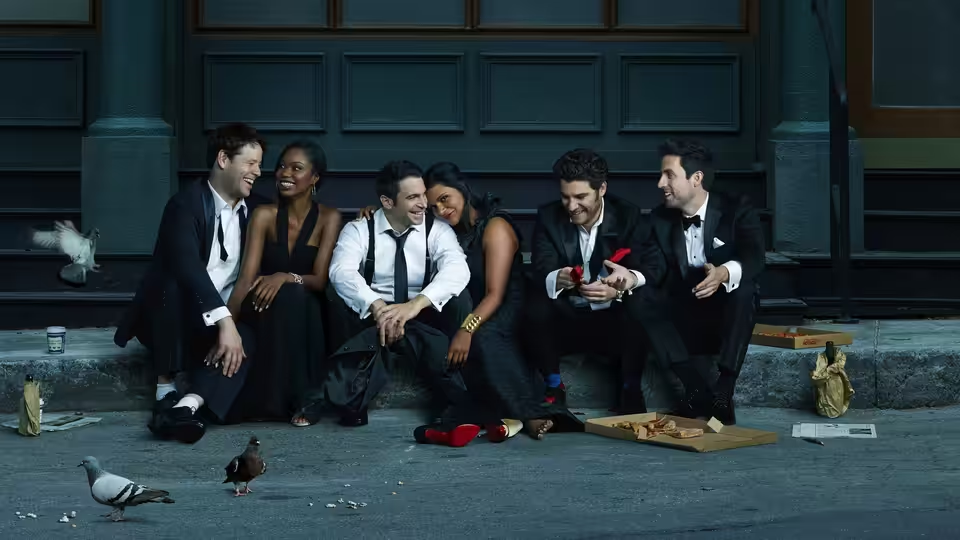
Salvador Pérez Jr.’s costumes do more storytelling than the scripts admit. Mindy comes to work in clashing prints and coats you could see from the street, dressed each morning for the day her life turns into the film she has been waiting for. Kathleen Widomski gives the practice the beige carpet and cramped kitchen of a real medical office, which makes the wardrobe the only fantasy in the building. Marco Fargnoli lights it bright and flat, and nothing in the photography asks to be looked at. David Rogers cuts fast enough that a weak joke is gone before you have finished not laughing at it. Jesse Novak’s music is bouncy and brief.
The supporting cast is where the show never settled. The first season churns: Amanda Setton’s Shauna Dicanio and Zoe Jarman’s Betsy Putch come and go, and Ed Weeks’s Dr. Jeremy Reed is a different and fussier man by the second season. Ike Barinholtz’s Morgan Tookers, a nurse with a criminal record and no filter, is the best thing the writers found: he says the worst possible thing at every turn and means well by it. We laughed at him more than at anyone. Adam Pally’s Dr. Peter Prentice arrives as a frat boy and becomes the kindest person on the staff; Beth Grant’s Beverly has one joke and lands it every time. Garret Dillahunt and Fortune Feimster, as Jody and Colette Kimball-Kinney, arrive late, and Xosha Roquemore’s Tamra Webb is asked to be sharp and little else. The turnover keeps the office from becoming the family the genre depends on.
The early episodes are the trouble. Mindy’s behaviour swings from week to week in the first season: one episode she is the only adult in the practice, the next she is the reason the practice is failing, and the writers do not seem to have agreed which. A running plot about rival midwives, with Mark Duplass as Brendan Deslaurier, goes nowhere much. The show sharpens as it goes, and the last two seasons, at 14 and 10 episodes, are the tightest, which suggests it never had 24 a year in it.
Against the American workplace comedy it sits below The Office and Parks and Recreation, which built their offices out of people who stayed, and above most of what tried romantic comedy on television. What it has that they do not is a lead who refuses to improve. There is a scene in the second season, which we will not describe, where the office goes quiet around Mindy, and we were moved more than a show this brightly lit had prepared us for. It was Messina’s face that did it.
Watch it two at a time, with the first dozen episodes forgiven in advance. It is a 15 certificate for good reason, being frank about sex in a way American network comedy rarely was, and at its best when it stops reaching for romantic comedy and lets its people go to work.