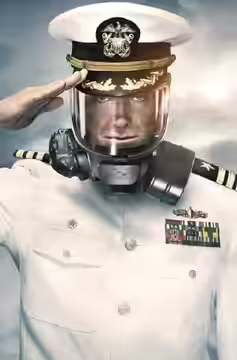
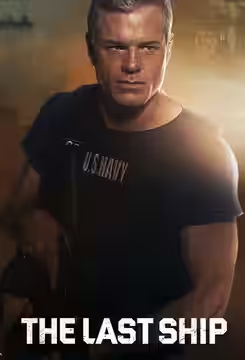
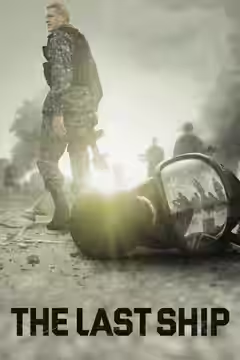
The Last Ship offers serviceable naval action and enough practical survival problems to keep us interested. Its thin characters and explanation-heavy dialogue make it harder to care than to keep watching.
The Last Ship is a decent military action programme with a useful interest in the practical business of survival. It understands that securing resources can provide an immediate reason to keep watching, without requiring an elaborate mystery. Creators Steven Kane and Hank Steinberg give it a clear direction and keep it moving. The disappointment is how often the people undertaking these tasks remain less interesting than the tasks themselves.
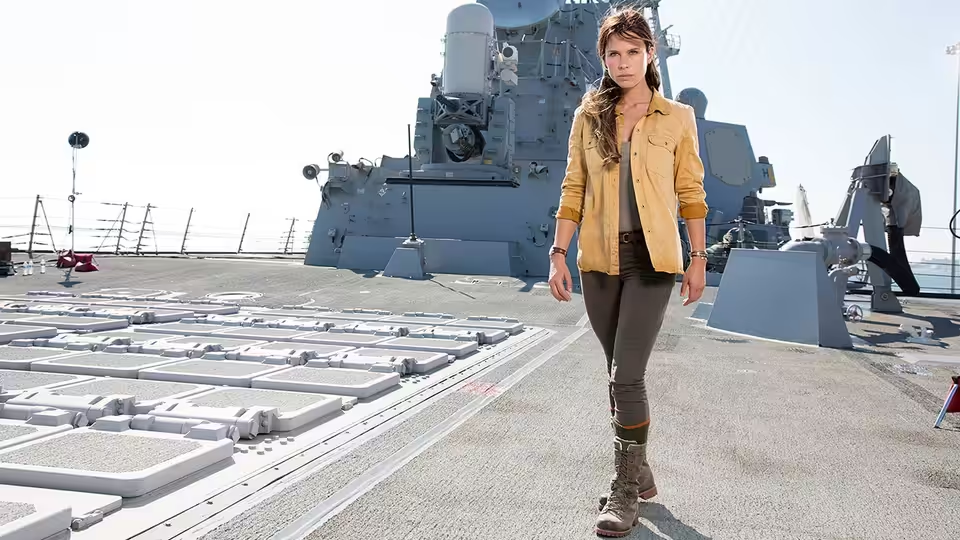
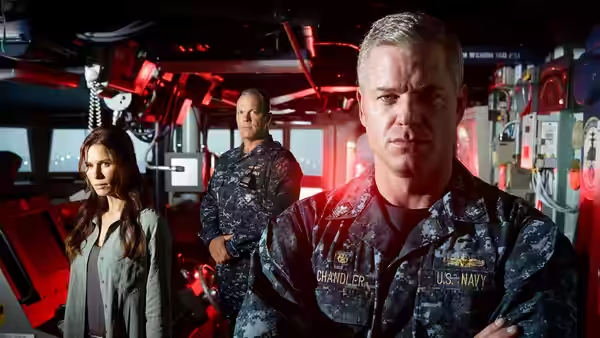
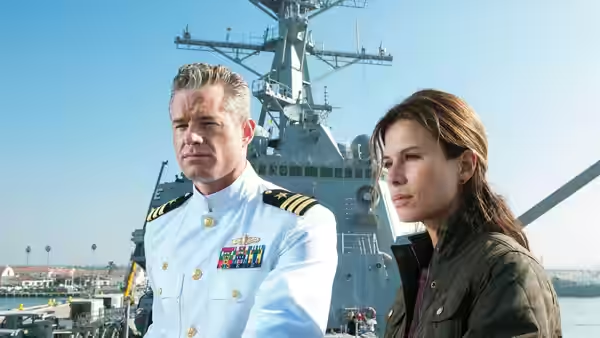
The naval setting helps. A chain of command gives decisions weight, and the need to work within it supplies friction without much preliminary explanation. Eric Dane’s CO CDR Tom Chandler occupies the centre, with Adam Baldwin as XO Mike Slattery and Charles Parnell as CMC Jeter. There is an obvious appeal in watching trained people tackle a practical problem, particularly when the programme allows that problem to remain intelligible. We were drawn in by the attention to survival resources; having something specific to obtain or preserve makes the danger easier to care about.
That practicality also exposes the writing’s limitations. Kane and Steinberg are among the credited writers, and the dialogue too often explains what the action ought to communicate. Technical language can establish a working environment, but accumulated explanations make conversations feel like preparation for an examination. Rhona Mitra’s Dr. Rachel Scott and Sam Spruell’s Dr. Quincy Tophet belong to an ensemble that needs more room for personality. The supporting characters are too thinly developed to make every exchange worth the interruption.
The cinematography, credited to Christopher Faloona, Cort Fey and Lukas Ettlin, gives the naval action a direct, game-like visual appeal. That approach suits a programme built around immediate objectives and forward movement. It is less successful at making the action feel distinctive: a clear task and an energetic presentation do not automatically produce suspense. The military setting supplies interest that the individual action passages do not always sustain.
The editing credits include Marta Evry, Edward A. Warschilka, Randy Jon Morgan, John David Buxton and Ken Blackwell, and momentum is one of the programme’s dependable virtues. There is usually another practical difficulty to occupy the attention before the weaknesses become fatal. Yet the succession of objectives can become mechanical, with too little time spent making the people between them memorable. Music is credited to Nathan Whitehead, James S. Levine and James Dooley, but the decisive weakness is in the dialogue and character writing.
Within the military-thriller genre, this is familiar work with a clear sense of its audience. It does not need to become a searching political drama to justify an evening, and its straightforwardness is sometimes a relief. The trouble is that straightforward action still needs characters whose responses cannot be predicted entirely from their jobs. Here, the practical questions tend to hold our attention more reliably than the personal ones.
There is enough purpose and movement to recommend a cautious start for anyone who enjoys naval thrillers. The resource problems give the action something useful to do, and the setting remains an asset even when the exchanges become laborious. Allow it some stiff dialogue, but do not expect the uniforms to tell us everything worth knowing about the people wearing them.