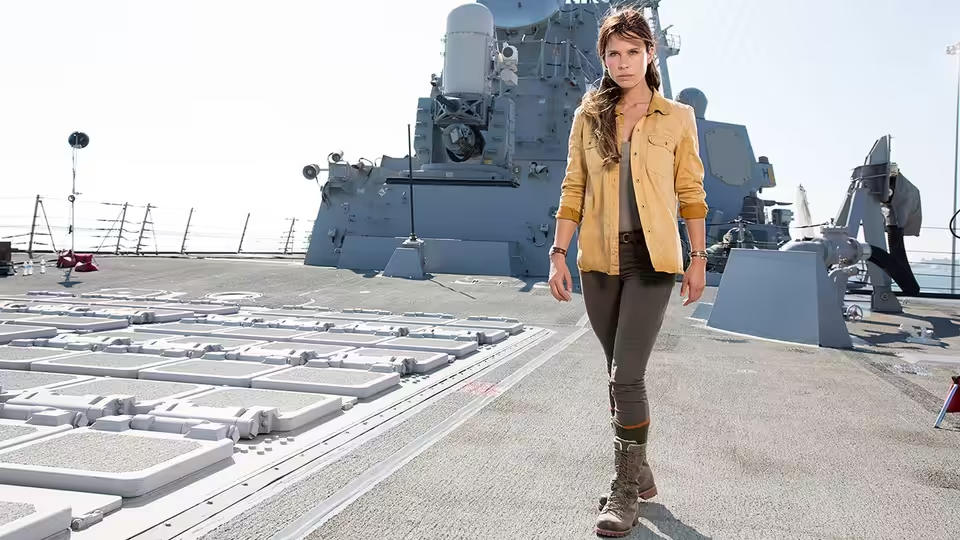
A woman in a tan jacket walks across the deck of a naval ship
Series review

The Last Ship

2014 · Created by Hank Steinberg, Steven Kane · Series

In a sentenceThe naval action is easier to follow than the technical explanations, which seems the wrong way round

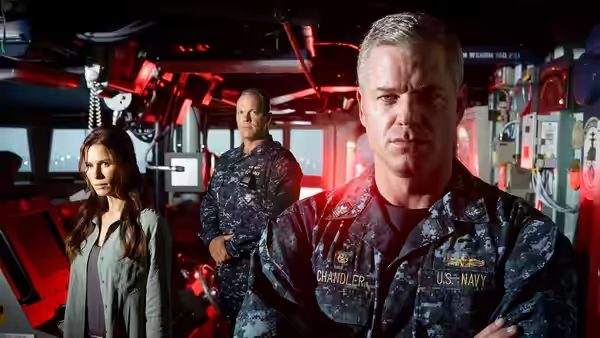
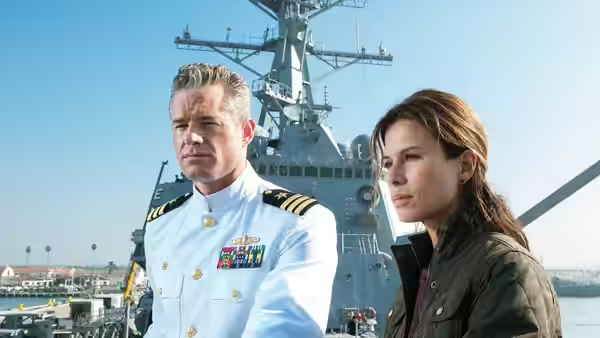
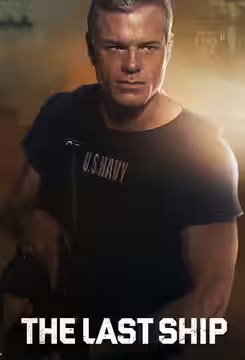
CO CDR Tom Chandler (Eric Dane) leads the naval ensemble of The Last Ship, alongside XO Mike Slattery (Adam Baldwin) and CMC Jeter (Charles Parnell). Dr. Rachel Scott (Rhona Mitra) and Dr. Quincy Tophet (Sam Spruell) supply its scientific personnel, while Lt. Danny Green (Travis Van Winkle), Lt. Kara Foster (Marissa Neitling) and Lt. Alisha Granderson (Christina Elmore) fill out the ranks. The action drama follows military personnel confronting problems of survival, resources and command, with technical decisions and the demands of keeping people alive shaping its naval action.

Plays from YouTube when you press play; nothing loads from them until then.

Fi1m review

The Last Ship offers serviceable naval action and enough practical survival problems to keep us interested. Its thin characters and explanation-heavy dialogue make it harder to care than to keep watching.

The Last Ship is a decent military action programme with a useful interest in the practical business of survival. It understands that securing resources can provide an immediate reason to keep watching, without requiring an elaborate mystery. Creators Steven Kane and Hank Steinberg give it a clear direction and keep it moving. The disappointment is how often the people undertaking these tasks remain less interesting than the tasks themselves.

The naval setting helps. A chain of command gives decisions weight, and the need to work within it supplies friction without much preliminary explanation. Eric Dane’s CO CDR Tom Chandler occupies the centre, with Adam Baldwin as XO Mike Slattery and Charles Parnell as CMC Jeter. There is an obvious appeal in watching trained people tackle a practical problem, particularly when the programme allows that problem to remain intelligible. We were drawn in by the attention to survival resources; having something specific to obtain or preserve makes the danger easier to care about.

That practicality also exposes the writing’s limitations. Kane and Steinberg are among the credited writers, and the dialogue too often explains what the action ought to communicate. Technical language can establish a working environment, but accumulated explanations make conversations feel like preparation for an examination. Rhona Mitra’s Dr. Rachel Scott and Sam Spruell’s Dr. Quincy Tophet belong to an ensemble that needs more room for personality. The supporting characters are too thinly developed to make every exchange worth the interruption.

The cinematography, credited to Christopher Faloona, Cort Fey and Lukas Ettlin, gives the naval action a direct, game-like visual appeal. That approach suits a programme built around immediate objectives and forward movement. It is less successful at making the action feel distinctive: a clear task and an energetic presentation do not automatically produce suspense. The military setting supplies interest that the individual action passages do not always sustain.

The editing credits include Marta Evry, Edward A. Warschilka, Randy Jon Morgan, John David Buxton and Ken Blackwell, and momentum is one of the programme’s dependable virtues. There is usually another practical difficulty to occupy the attention before the weaknesses become fatal. Yet the succession of objectives can become mechanical, with too little time spent making the people between them memorable. Music is credited to Nathan Whitehead, James S. Levine and James Dooley, but the decisive weakness is in the dialogue and character writing.

Within the military-thriller genre, this is familiar work with a clear sense of its audience. It does not need to become a searching political drama to justify an evening, and its straightforwardness is sometimes a relief. The trouble is that straightforward action still needs characters whose responses cannot be predicted entirely from their jobs. Here, the practical questions tend to hold our attention more reliably than the personal ones.

There is enough purpose and movement to recommend a cautious start for anyone who enjoys naval thrillers. The resource problems give the action something useful to do, and the setting remains an asset even when the exchanges become laborious. Allow it some stiff dialogue, but do not expect the uniforms to tell us everything worth knowing about the people wearing them.

Critical consensus AI synthesised

67
Positive
3
Mixed
2
Negative
0
IndieWire
20 June 2014 · B- · Liz Shannon Miller
70

The review finds the series competent but overly familiar and lacking ambition. It praises the premise’s potential and practical focus on survival resources, while criticizing bland action and exposition-heavy dialogue.

Read the full review →
The Hollywood Reporter
20 June 2014 · Tim Goodman
70*

Goodman finds the series entertaining as straightforward, explosion-filled summer viewing, despite its hokey dialogue and limited complexity. He singles out its clear, action-first approach as a selling point for viewers seeking undemanding fun.

Read the full review →
The AV Club
20 June 2014 · C+ · Emily St. James
63

The review finds the series has energetic forward momentum but weak characters and dull action sequences. It praises the video-game-inspired visuals while faulting the storytelling for reducing events to a string of checkpoints.

Read the full review →
Variety
19 June 2014 · Brian Lowry
60*

Lowry finds the series promising but rocky, with enough intrigue to keep watching. He praises the naval setting’s real-world backdrop, while criticizing the thin side characters and tech-heavy dialogue.

Read the full review →
Collider
26 May 2026 · Amanda M. Castro
75*

The critic presents the series as an entertaining, easy-to-binge action drama that embraces its military-thriller identity. They especially praise the scale and authenticity of its naval action, while noting that later storylines can strain credibility.

Read the full review →

Straight answers AI written, from our review

Is The Last Ship worth watching?
The Last Ship is worth a cautious start for naval-thriller enthusiasts, and we score it 67 out of 100. Its practical survival problems and steady momentum keep us interested, but thin characters and explanation-heavy dialogue make it easier to follow the missions than to care about the people carrying them out.
Where can I watch The Last Ship in Serbia?
The Last Ship is not on any streaming or rental service in Serbia at the moment. It is available in 5 other countries; change your country at the top of the page to see where. Availability is checked daily.
How violent or frightening is The Last Ship, and is it suitable for children?
The Last Ship has a UK 15 certificate, so it is not suitable for children under 15. Its military action centres on survival and keeping people alive, but we cannot give a precise account of gore or frightening imagery from the material described; the certificate is the clearest guide for families and sensitive viewers.
How does The Last Ship compare to The Hunt for Red October?
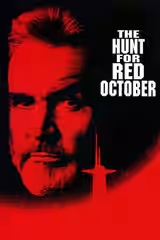
The Last Ship offers serviceable naval action, but we recommend The Hunt for Red October more strongly for patient, absorbing suspense built around consequential decisions. The series favours practical survival tasks and forward movement, while the film makes people thinking under pressure compelling, though both can test our patience with explanations and thin character writing.
What should I watch after The Last Ship?
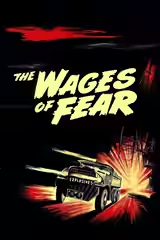
After The Last Ship, try The Hunt for Red October (1990, Fi1m 82): For naval procedure, competing commanders and suspense built around consequential decisions. Then Das Boot (1981, Fi1m 89): For naval tension that gives the crew’s exhaustion room to register; and The Wages of Fear (1953, Fi1m 90): A practical survival task becomes suspense through patient attention to danger.

Cast

If you liked this, try…

  1. The Hunt for Red October (1990, Fi1m 82)For naval procedure, competing commanders and suspense built around consequential decisions.

  2. Das Boot (1981, Fi1m 89)For naval tension that gives the crew’s exhaustion room to register.

  3. Battlestar Galactica (2004) · not on Fi1m yetMilitary command and collective survival, with more difficult questions about obedience.

  4. The Wages of Fear (1953, Fi1m 90)A practical survival task becomes suspense through patient attention to danger.

  5. Contagion (2011, Fi1m 78)For procedural urgency that makes scientific work part of the drama.