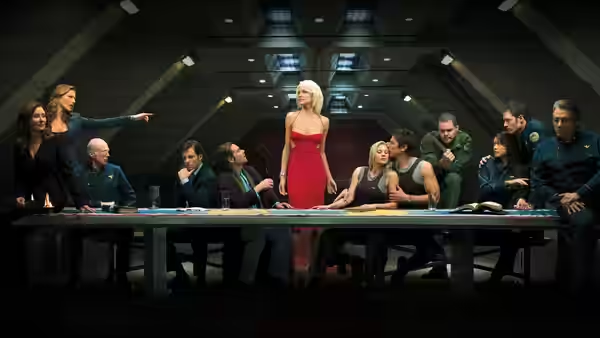
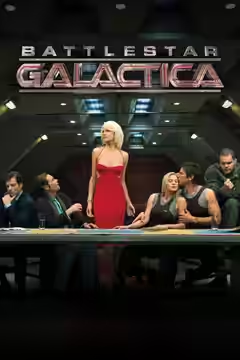
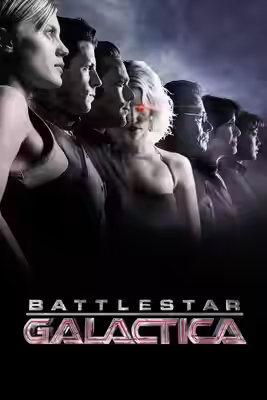
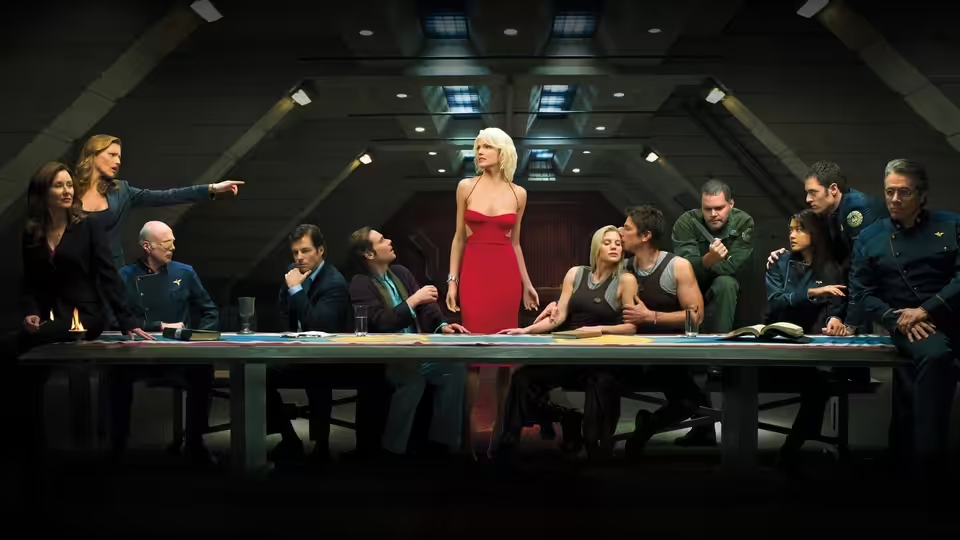
Number Six (Tricia Helfer) in red dress stands at head of long table
Series review

Battlestar Galactica

2004 · Created by Glen A. Larson, Ronald D. Moore · Series · 44m

In a sentenceThe future is miserable, but Edward James Olmos is reassuringly difficult to impress

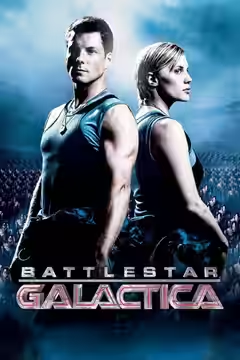
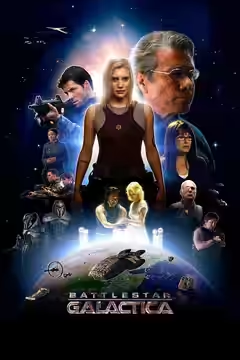
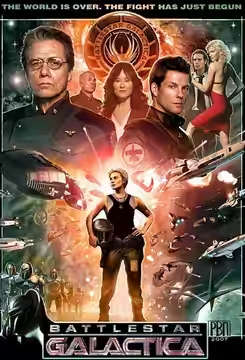
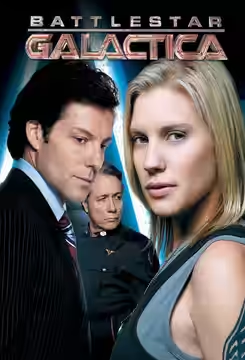
Battlestar Galactica is a dystopian science-fiction series in which politics and mistrust shape the drama. Edward James Olmos plays Admiral William Adama, with Mary McDonnell as Laura Roslin. Jamie Bamber plays Lee ‘Apollo’ Adama and Katee Sackhoff plays Kara ‘Starbuck’ Thrace, while James Callis is Gaius Baltar and Tricia Helfer is Number Six. Grace Park appears as Sharon ‘Boomer’ Valerii, alongside Michael Hogan as Saul Tigh. Across four seasons, the series combines action and adventure with a melancholy mood, following an ensemble whose competing personalities give its political concerns a human focus.

Fi1m review

This dark science-fiction series earns its seriousness through tense storytelling and an ensemble led by Edward James Olmos and Mary McDonnell. We recommend it, with a warning: its persistent gloom can become wearing.

Battlestar Galactica is good enough to justify spending considerable time with people who seldom seem to be enjoying theirs. This is politically minded science fiction, and its strongest reason for being so serious is the pressure it puts on its characters. Ronald D. Moore, credited as a creator alongside Glen A. Larson, gives us plenty to worry about and little encouragement to relax. The tense storytelling and the cast make it worth the effort, though the determination to keep everything sombre sometimes becomes a nuisance.

Edward James Olmos makes Admiral William Adama’s authority convincing without making it comfortable. There is a heaviness to his performance that discourages us from treating command as a reward, and he does not need to advertise his importance. Mary McDonnell’s Laura Roslin is equally compelling, bringing enough firmness to prevent the drama from belonging to Olmos alone. Both make the political material approachable: we care about the person speaking before deciding how much to agree with them.

Katee Sackhoff brings a welcome roughness to Kara ‘Starbuck’ Thrace, while Jamie Bamber’s Lee ‘Apollo’ Adama has a more guarded appeal. James Callis gives Gaius Baltar a nervous energy that usefully disturbs the prevailing solemnity, and Tricia Helfer’s Number Six holds our attention with considerably less apparent effort. These performances help sustain the atmosphere of suspicion without making everyone seem interchangeable. Michael Hogan’s Saul Tigh adds another abrasive presence to an already prickly ensemble.

Stephen McNutt’s cinematography serves the actors well; we notice the strain in the performances before we find ourselves admiring the photography. Richard Hudolin’s production design makes the dystopian setting credible without making it somewhere we would care to visit. Bear McCreary’s music helps maintain the tension, although its force sometimes leaves us wishing for less insistence. All three contributions support the same troubled mood, which is effective until we begin to want a little distance from it.

The editing, with Michael Stern and Andrew Seklir among those credited, is persuasive at sustaining tension without making the people seem incidental to the plotting. We were properly anxious during the opening hour. The uncertainty keeps us alert, while the performances make that uncertainty matter beyond the immediate question of what happens next. That early grip is important: a programme this dour needs to give us a reason to remain in its company, and the opening does.

The weakness is how readily the seriousness becomes the expected response to everything. Moore’s approach gives the political concerns weight, but it also encourages us to brace ourselves rather than remain open to a change of mood. We sometimes wanted the programme to stop insisting on how troubled its characters were and let the actors do the work. They are persuasive enough already, and a little more tonal variety would make their harder moments register more sharply.

Science fiction is entitled to imagine circumstances nobody would willingly endure, and this series gives its dystopian premise sustained dramatic attention. Its interest in politics also gives us something to consider beyond the mechanics of the action. Across four seasons, however, the persistent melancholy is a substantial part of the commitment, rather than an occasional price of admission. Give the opening hour your attention, but choose an evening when cheerfulness is optional.

Critical consensus AI synthesised

83
Positive
6
Mixed
1
Negative
0
Empire
21 August 2006 · Angie Errigo
90*

The reimagined Battlestar Galactica is the best character drama engaging big issues on TV, an adult allegory about war, humanity and post-9/11 themes that far surpasses the original. It features strong ensemble performances and urgent, Shakespearean storytelling.

Read the full review →
The Guardian
19 March 2009 · Richard Vine
90*

The critic argues that despite being sci-fi, BSG is one of the most sophisticated shows ever made, praising its political depth, complex character arcs, and willingness to explore moral ambiguity around war, terrorism, and humanity.

Read the full review →
The Independent
10 October 2004 · Matthew Sweet
90*

The critic finds the new Battlestar Galactica a stark, melancholy work of dystopian science fiction that transforms the original into something as good as the best American network imports. He singles out its reinvention as a politically resonant allegory for praise.

Read the full review →
The Times
19 September 2009 · Dominic Maxwell
90*

The reimagined series is as good as TV gets, up there with The Wire and The Shield. It transcends its sci-fi roots with masterful storytelling and performances.

Read the full review →
The Telegraph
8 September 2020 · Ed Power
85*

The piece celebrates the 2004 reboot as a dark, morally complex, and subversive sci-fi series that stands out for its flawed characters, political resonance, and refusal to offer easy answers, calling it perhaps the greatest science fiction show ever.

Read the full review →
Variety
9 January 2005 · Brian Lowry
70*

The dark re-imagining of the 1970s series provides solid storytelling as a boon to the Sci Fi Channel. It excels with tense plotting in its opening hour and maintains a dour, paranoid tone that sets it apart from standard sci-fi.

Read the full review →

Straight answers AI written, from our review

Is Battlestar Galactica worth watching?
Battlestar Galactica is worth watching for anyone prepared to spend four seasons with people who are seldom enjoying themselves, and we scored it 83. Edward James Olmos and Mary McDonnell make the political material approachable, and the opening hour left us properly anxious. Its persistent gloom becomes wearing, so choose an evening when cheerfulness is optional.

How long is Battlestar Galactica, and what is it rated?
Battlestar Galactica has episodes of about 44m. It is a sci-fi & fantasy and action & adventure series.
Where can I watch Battlestar Galactica in Colombia?
Battlestar Galactica is not on any streaming or rental service in Colombia at the moment. It is available in 27 other countries; change your country at the top of the page to see where. Availability is checked daily.
How violent or frightening is Battlestar Galactica, and is it suitable for children?
Battlestar Galactica carries an 18 certificate in the UK, so it is for adults rather than children or younger teenagers. The review describes a sustained atmosphere of suspicion, anxiety and melancholy rather than dwelling on graphic content, but the certificate implies material stronger than the US TV-14 rating suggests. The squeamish should expect tension more than relief.
How does Battlestar Galactica compare to Das Boot?
Battlestar Galactica and Das Boot both put a pressured ensemble in close quarters and make authority harder to bear, but the earlier film is a single gripping story while the series stretches its mistrust across four seasons. Das Boot is the tighter and more humane of the two; the series gives its characters more room, and its politics more weight, at the cost of unrelenting gloom.
What should I watch after Battlestar Galactica?
After Battlestar Galactica, try Das Boot (1981, Fi1m 89): For another pressured ensemble whose close quarters make authority harder to bear. Then The Expanse (2015, Fi1m 64): For political science fiction that gives rival interests room to become understandable; and Children of Men (2006, Fi1m 85): For a frightened future where keeping people alive becomes a political act.

Cast

Awards

Hugo Awards, 2005

Won
Best Dramatic Presentation, Short Form

If you liked this, try…

  1. Das Boot (1981, Fi1m 89)For another pressured ensemble whose close quarters make authority harder to bear.

  2. Planetes (2003) · not reviewed yetFor working lives in space, with more tenderness and less habitual gloom.

  3. The Expanse (2015, Fi1m 64)For political science fiction that gives rival interests room to become understandable.

  4. Children of Men (2006, Fi1m 85)For a frightened future where keeping people alive becomes a political act.

  5. Star Trek: Deep Space Nine (1993) · not reviewed yetFor another sustained examination of command, compromise and the costs of war.

Free account

Know what to watch tonight

Two lists that know where things are streaming, collections you can share, your own score beside ours, and Discover that remembers what you have seen.

  • Want to see, sorted by what is streaming now
  • Seen, with your score out of ten
  • No adverts, ever