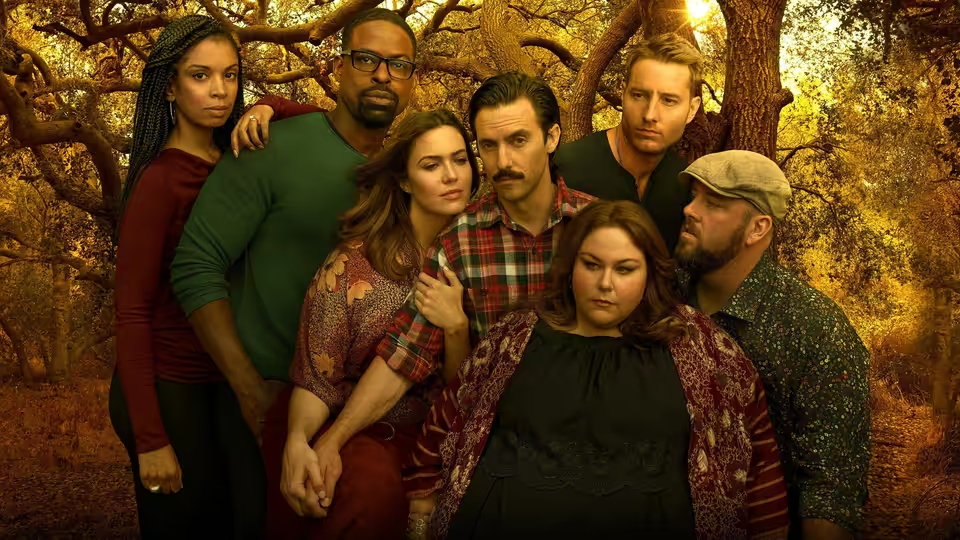
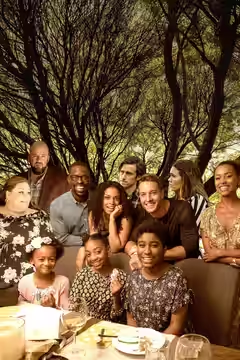
Dan Fogelman’s family drama is worth trying for its cast and its sharp humour. The sentiment often works, though the carefully arranged revelations and persistent musical encouragement can wear down our patience.
Dan Fogelman’s This Is Us is good family drama, warmly acted and funny enough to survive its considerable appetite for tears. It wants us to take ordinary unhappiness seriously, without treating decency as evidence that a character is stupid. That is a welcome starting point, and the cast gives it more life than the premise might suggest. The difficulty is how often the programme prepares an emotional response before the people involved have earned one.
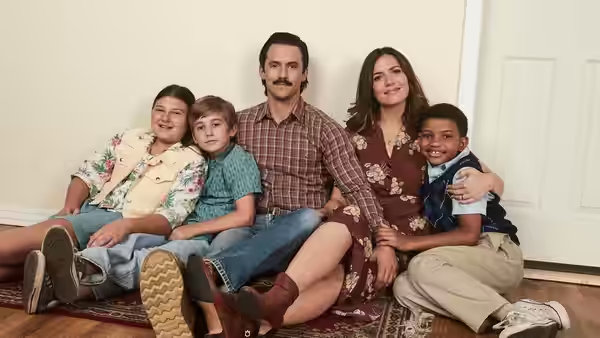
The acting is the reason to stay. We were moved by Sterling K. Brown’s performance as Randall Pearson, because his restraint gives the intimate material weight without asking for our sympathy. Milo Ventimiglia and Mandy Moore, as Jack Pearson and Rebecca Pearson, bring a similar conviction to writing that could easily become embarrassing. Their sincerity makes the more sentimental dialogue easier to accept, even when we can hear how carefully the words have been chosen.
Chrissy Metz and Chris Sullivan are particularly valuable because they make room for humour. As Kate Pearson and Toby Damon, they can make the hokier writing feel like something a person might actually say, which is no small service here. Justin Hartley also gives Kevin Pearson enough personality to keep him from becoming merely another excuse for a touching scene. The jokes are essential: they let us spend time with these people without continually assessing their pain. More of that ease would help.
Visually, the series is less distinctive. The cinematography, credited to James Takata, Brett Pawlak and Yasu Tanida, is at its most effective when it lets the actors command our attention. Dan Bishop and Gary Frutkoff’s production design is similarly unobtrusive, which suits a programme asking us to concentrate on private lives. We would not choose it for the images alone, but neither does it need a grand visual flourish every time somebody feels something.
The editing has a harder job. Brandi Bradburn and Julia Grove are among the editors joining the separate stories, and the shifts keep us curious even when the individual situations are familiar. Yet the insistence on connections sometimes leaves us waiting for information instead of attending to the conversation in front of us. Siddhartha Khosla’s music contributes to the tenderness, while the soft indie soundtrack can make the emotional atmosphere too uniform. There are passages when we would welcome less encouragement.
Dan Fogelman’s fondness for arranging revelations is the greater weakness. The programme can seem unwilling to trust that a well-played exchange is enough, so the way a story is presented becomes a source of suspense in itself. We will not describe those manoeuvres, but their neatness occasionally makes the characters seem less convincing. The writing also has a habit of making people say the consoling thing with just the right amount of polish. Ordinary conversation is rarely this helpful.
Anyone looking for a family drama that distrusts affection will have a difficult time here. The programme takes the possibility of people being good to one another seriously, and we would rather see that attempted with conviction than dismissed as an embarrassment. Its faults do not cancel the pleasure of watching this cast make familiar troubles matter. Start it when a little reassurance sounds appealing, provided a conversation becoming a life lesson does not immediately make you reach for the remote.