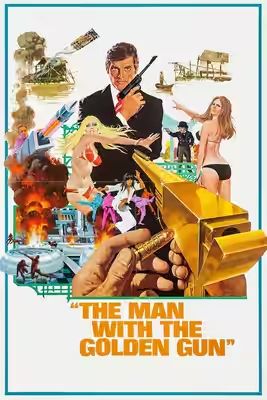
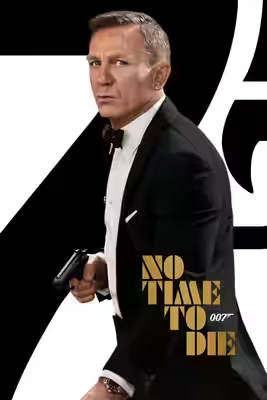
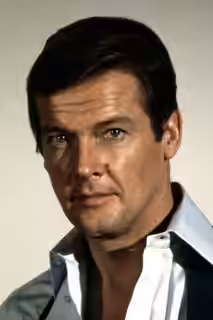
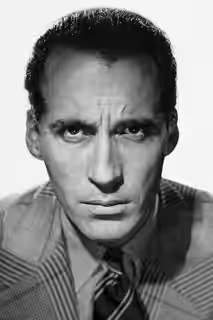
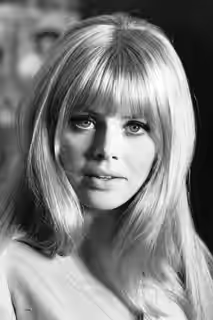
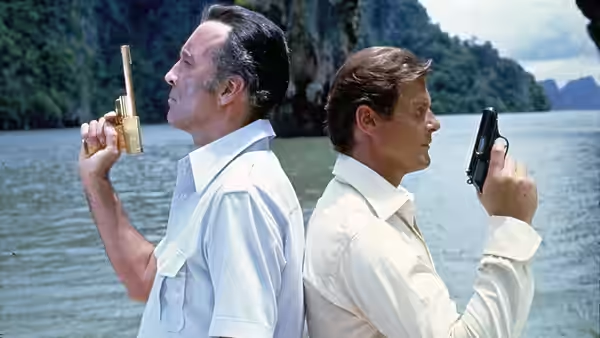
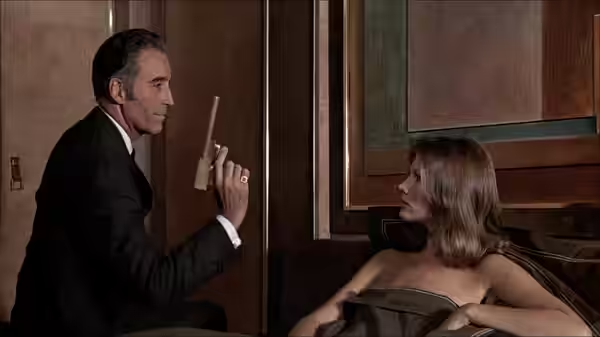
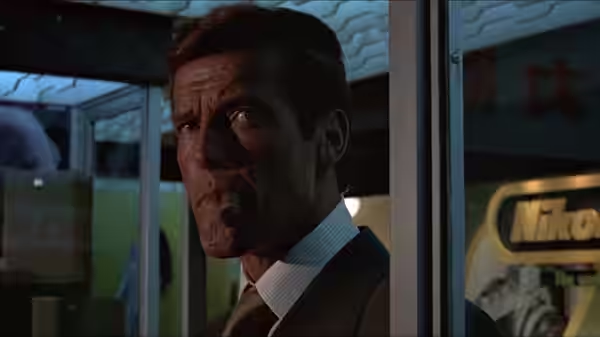
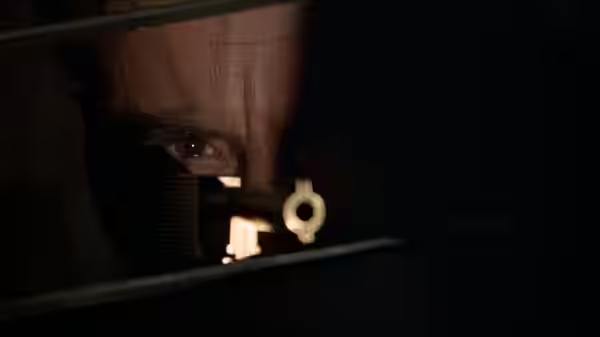
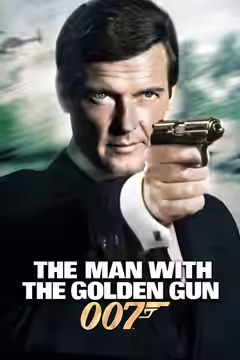
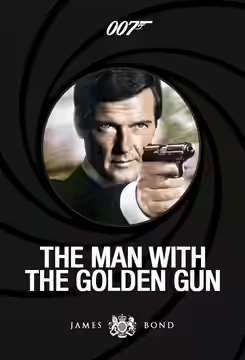
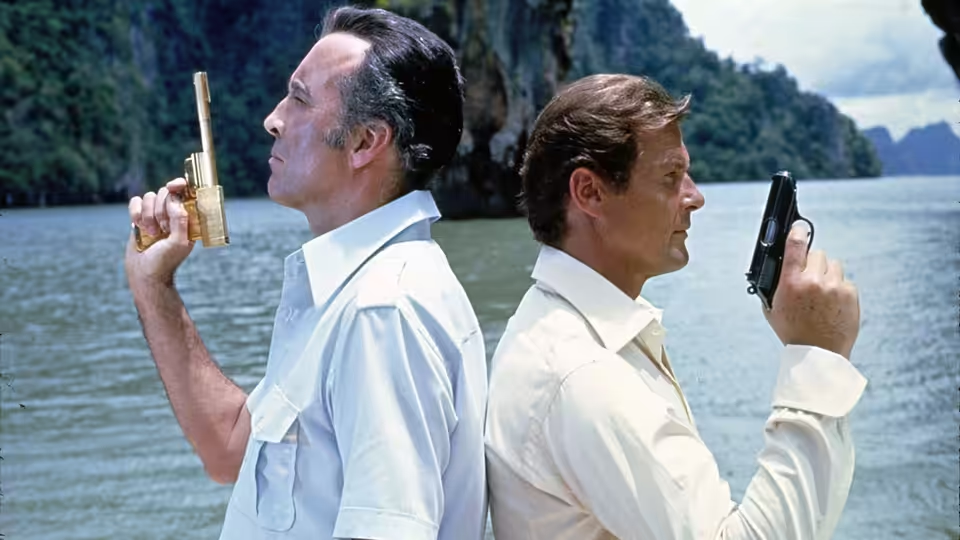
Scaramanga and Bond stand back to back holding guns by the water
Film review

The Man with the Golden Gun

1974 · Directed by Guy Hamilton · 2h 05m

In a sentenceThe best villain of the Moore years, and he spends most of the film waiting for the plot to find him

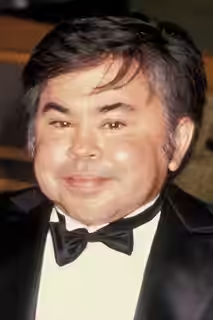
A golden bullet engraved with the number 007 arrives at MI6, and M (Bernard Lee) takes it as a warning: Francisco Scaramanga (Christopher Lee), a hired killer who charges a million dollars a shot and uses a gold pistol, has been paid to kill James Bond (Roger Moore). M pulls Bond off the hunt for a missing solar-energy device, the Solex Agitator, and sends him after the assassin nobody has ever seen. The trail runs from a belly dancer’s dressing room in Beirut to a gunsmith called Lazar (Marne Maitland) in Macau, then to Hong Kong, where Bond follows Scaramanga’s mistress Andrea Anders (Maud Adams) and picks up Mary Goodnight (Britt Ekland), a Secret Service colleague who fancies him. Scaramanga’s diminutive manservant Nick Nack (Hervé Villechaize) is watching.

Fi1m review

Christopher Lee’s Scaramanga is the most elegant killer the series has produced, and the film around him is a tired one, padded with slide whistles and a sheriff on holiday. Worth it for the villain; not enough else to recommend an evening.

The Man with the Golden Gun is Roger Moore’s second outing as James Bond, and its premise is simple: one professional killer is hired to shoot another. Tom Mankiewicz and Richard Maibaum take the name and the gun from Ian Fleming’s novel and little else, and bolt on a solar-energy device called the Solex Agitator that everyone wants because it is 1974 and petrol is short. Guy Hamilton, who directed Goldfinger, is back for his fourth Bond. It runs 125 minutes, and a good half hour of that is the film looking for something to do.

Christopher Lee is the reason it is remembered. His Scaramanga is tall, courteous and unhurried, a man who charges a million dollars a shot and regards this as reasonable. The film introduces him in the pre-title sequence, letting a hired thug (Marc Lawrence) loose in a private funhouse and stalking him through mirrors, wax gangsters and a swinging saloon door while Nick Nack (Hervé Villechaize) commentates. Peter Murton’s funhouse set is cheaply built and deliberately wrong, all slanted floors and dead-eyed mannequins, and we were unnerved by it for longer than a PG has any right to manage. Lee never raises his voice.

Moore is less well served. The film cannot decide what kind of Bond he is, so it asks him to be two: the light comedian who is particular about his drinks, and a thug who twists a woman’s arm in a Hong Kong hotel room and threatens to break it. He plays the rough scenes as if someone off camera had told him to, and Maud Adams is the one who comes out of them with dignity. Her Andrea Anders is the only person in the film who seems to have thought about what living with Scaramanga would be like, and she is not on screen nearly enough.

The locations are well used, and Oswald Morris and Ted Moore shoot them without fuss. Hong Kong harbour at dusk is done in long lenses that make the junks look like moths, and Murton’s best idea is MI6’s local headquarters inside the half-sunk hull of the liner Queen Elizabeth, every desk and filing cabinet propped level on a floor that tilts. Bernard Lee’s M sits in there looking as though the angle offends him personally. The film gives it about four minutes.

Then there is the bridge. During a chase through Bangkok, Bond’s car takes off from one half of a broken bridge over a canal, turns a full corkscrew in the air and lands on the other half, and it is plainly done in one piece by a real car and a real driver. We sat forward and stopped breathing for a second, which is what a stunt is for. Then John Barry’s soundtrack puts a slide whistle over it. Whoever made that decision turned the best moment in the film into a cartoon.

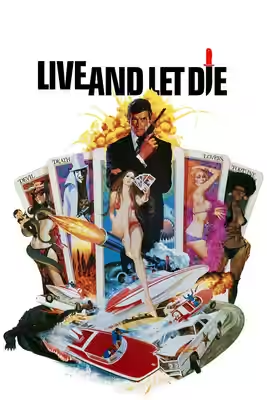
The rest of the comedy is worse. Clifton James’s Sheriff J.W. Pepper, the bellowing lawman from Live and Let Die, is on holiday in Thailand and ends up in the passenger seat for the chase, shouting. He gets more screen time than the villain’s mistress. Britt Ekland’s Mary Goodnight is a Secret Service officer written as a fool, and Ekland does what she can, which is to look pretty and bewildered on cue. Barry’s score is thinner than usual, and Lulu’s title song spends three minutes finding rhymes for ‘gun’. Raymond Poulton and John Shirley cut it all at a pace that keeps stopping for a joke.

Hamilton knew, on Goldfinger, that a Bond film is a run of rooms that each have a purpose. Here the Solex drops out of the story for long stretches, a karate school appears because somebody had seen Enter the Dragon, and Bond and Scaramanga, who are meant to be circling one another, share too few scenes. When they do meet the film comes alive, and the second half takes them somewhere we will not describe.

Most critics sit where we do, admiring Lee and not much else, and we see no reason to argue with them. If you want to watch one of the great screen villains do a job of work, this is a good evening. If you want a good Bond film, there are better ones on either side of it.
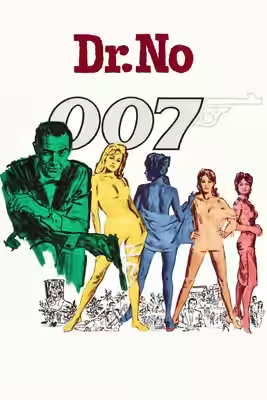
Critical consensus AI synthesised

46
Positive
2
Mixed
3
Negative
4

The reviews lean negative, and almost every one of them agrees on the same thing: Christopher Lee. His Scaramanga is praised across the board as suave, aloof and the film’s chief pleasure, with several critics calling him its only saving grace. The car jump across the broken bridge is singled out as one of the series’ great stunts, and the locations get a word of approval. Beyond that, praise is thin.

The reservations cluster on the script and on Roger Moore, whom several critics find bland next to Connery, and on comedy that lands as fumbled or overdone. The spread is wide. Empire and Total Film both rate it a solid entertainment, Total Film admiring John Barry’s uneasy score where Eye for Film hears a weak one; Britt Ekland is funny to Radio Times and dim to Eye for Film. Den of Geek is harshest, calling the plot shambolic and the premise wasted.

Empire
22 September 2006 · Ian Freer
70*

The film delivers an entertaining 007 adventure that fits tonally with the Connery era, with strong action sequences and a memorably quirky villain in Christopher Lee’s Scaramanga. It suffers from an overemphasis on knockabout comedy and underdeveloped female characters.

Read the full review →
Total Film
19 July 2012 · Nick Setchfield
70*

The movie has a uniquely queasy, macabre atmosphere with surreal set-pieces and an uneasy John Barry score that makes Bond’s world feel dangerously strange. It also features one of the franchise’s great stunt sequences in the car jump across the broken bridge.

Read the full review →
Radio Times
★★★ · Adrian Turner
60

The critic notes it improves on the novel, with fine villain Christopher Lee and funny Britt Ekland, but criticizes repeated climax scene and return of a character from previous film, while praising the location.

Read the full review →
The New York Times
19 December 1974
30*

The critic finds the film characterized by poverty of invention and excitement, with Roger Moore lacking Sean Connery's impudence and the script delivering dull chases and routine explosions. Christopher Lee and Herve Villechaize provide the only energetic moments with their sinister vitality.

Read the full review →
Time Out
10 September 2012 · VG
30*

The critic finds it formulaic and lacking style, with a banal script and bland Bond performance from Roger Moore, but praises Christopher Lee's suave villainy as Scaramanga.

Read the full review →
Variety
31 December 1973 · ** · Variety Staff
30*

The review notes the screenwriters aimed for more maturity and fewer gadgets but delivered comparatively spare mechanical devices and fumbled humor. The story diverts Bond to hunt a hit man using gold bullets, with Bond predictably conquering obstacles and ending with time for one of the Bond girls.

Read the full review →

Straight answers AI written, from our review

Is The Man with the Golden Gun worth watching?
The Man with the Golden Gun is worth watching for Christopher Lee's Scaramanga and not for much else, and we scored it 56. The villain is courteous, unhurried and the best of Roger Moore's years as Bond, but the film around him is padded with a holidaying sheriff and slide-whistle comedy. Watch it for Lee; look elsewhere for a good Bond film.
How long is The Man with the Golden Gun, and what is it rated?
The Man with the Golden Gun runs 2h 05m. It is an adventure and action film.
Where can I watch The Man with the Golden Gun in Slovakia?
The Man with the Golden Gun is not on any streaming or rental service in Slovakia at the moment. It is available in 47 other countries; change your country at the top of the page to see where. Availability is checked daily.
How violent or frightening is The Man with the Golden Gun, and is it suitable for children?
The Man with the Golden Gun is a PG, and most of its violence is the bloodless shooting and fighting of a 1970s Bond film. The one thing that may unsettle younger children is the opening funhouse sequence, with its slanted floors, mirrors and dead-eyed mannequins, which we found unnerving for longer than a PG usually manages. There is also a scene in which Bond roughly twists a woman's arm.
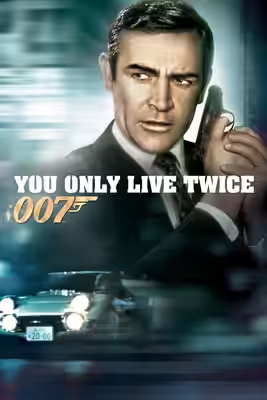
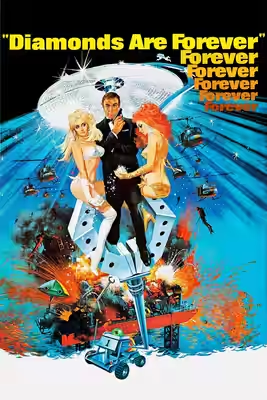
How does The Man with the Golden Gun compare to Diamonds Are Forever?
The Man with the Golden Gun and Diamonds Are Forever are both tired Bond films rescued by their killers, and the later film has the better villain by some distance. Christopher Lee's Scaramanga is the most elegant assassin the series has produced; Sean Connery's return in the earlier film is a shrug, though Las Vegas and John Barry keep it watchable. Choose the Moore film for Lee, the Connery one for Connery.
Is The Man with the Golden Gun based on a true story or a book?
The Man with the Golden Gun is based on the Ian Fleming novel of the same name, but only loosely. The screenwriters keep the villain's name and his gold pistol and discard nearly everything else, adding a solar-energy plot of their own to suit the 1974 fuel shortage. You do not need to have read the book, and readers who have will find little of it here.
Do you need to have seen the other James Bond films before The Man with the Golden Gun?
The Man with the Golden Gun stands alone, and you need no earlier Bond films to follow it. It is Roger Moore's second outing, and one returning joke, Clifton James's Sheriff J.W. Pepper from Live and Let Die, plays no better if you know him. It is not a good place to start the series, because there are better Bond films on either side of it.
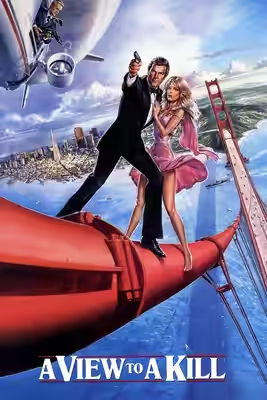
What should I watch after The Man with the Golden Gun?
After The Man with the Golden Gun, try The Wicker Man (1973, Fi1m 90): Lee again, as another courteous man of leisure who is not what he seems. Then From Russia with Love (1963, Fi1m 84): The series doing a professional assassin properly, with Robert Shaw and a train; and Le Samouraï (1967, Fi1m 88): Alain Delon as a hired killer with Scaramanga’s stillness and none of the props.
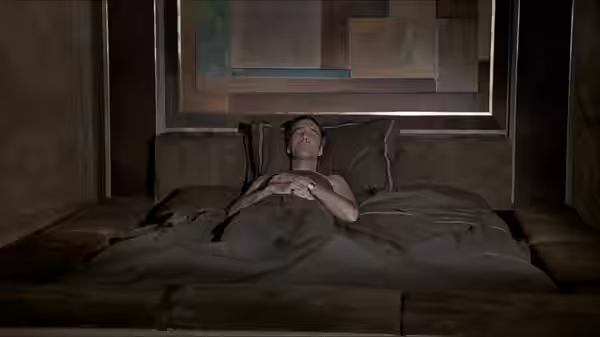
What order should I watch the James Bond films in?
Release order is the safe choice for James Bond, and it is the order our collection page lists them in. The Man with the Golden Gun is number 10 of the 27 James Bond titles on Fi1m; before it comes Live and Let Die and after it The Spy Who Loved Me. The full order.

Part of · 10 of 27

James Bond

27 films on Fi1m · 1962–2021 · average 67 · best Casino Royale 86

All 27 in order

Cast

If you liked this, try…

  1. The Wicker Man (1973, Fi1m 90)Lee again, as another courteous man of leisure who is not what he seems.

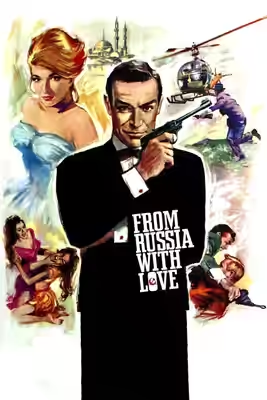
  2. From Russia with Love (1963, Fi1m 84)The series doing a professional assassin properly, with Robert Shaw and a train.

  3. Le Samouraï (1967, Fi1m 88)Alain Delon as a hired killer with Scaramanga’s stillness and none of the props.

  4. Enter the Dragon (1973, Fi1m 79)The Hong Kong action film this one was imitating, done by people who could.

  5. The Day of the Jackal (1973, Fi1m 84)An assassin’s job of work followed step by step, with almost no jokes.

Free account

Know what to watch tonight

Two lists that know where things are streaming, collections you can share, your own score beside ours, and Discover that remembers what you have seen.

  • Want to see, sorted by what is streaming now
  • Seen, with your score out of ten
  • No adverts, ever