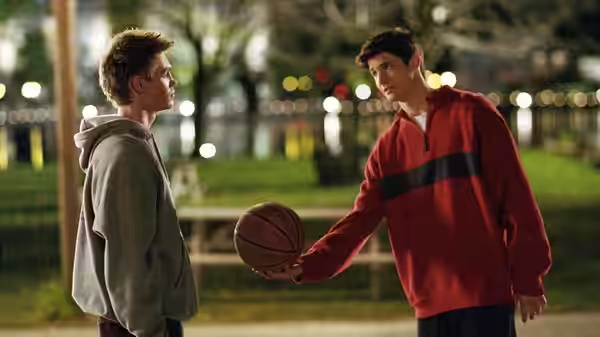
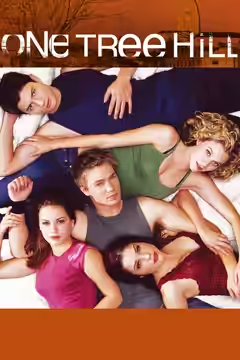
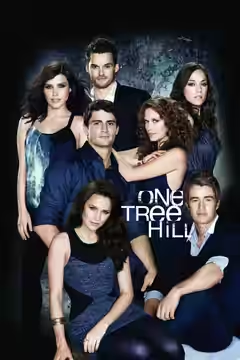
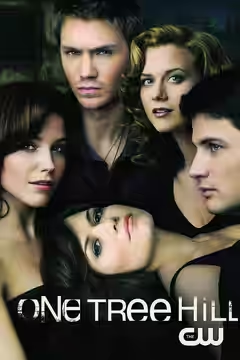
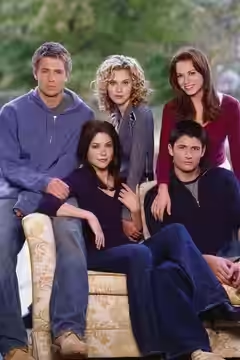
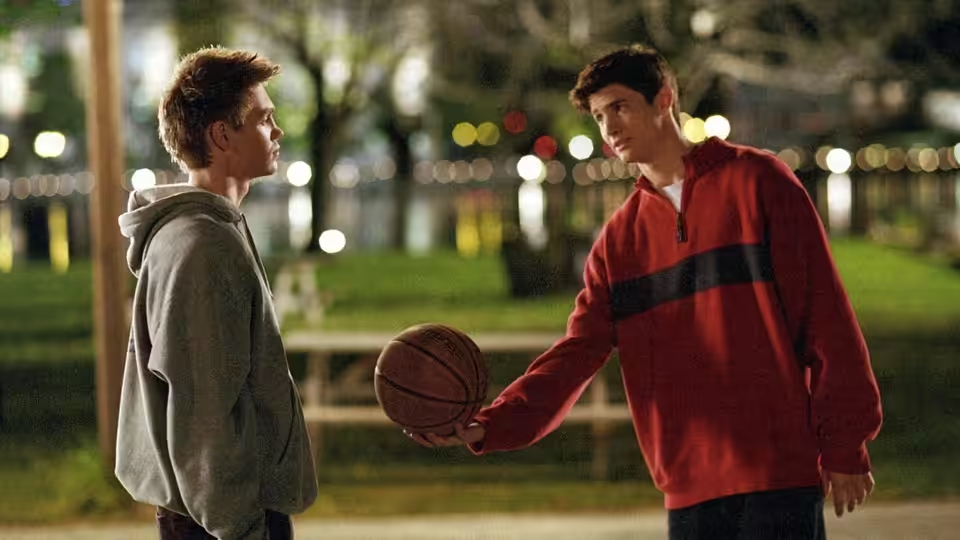
Lucas Scott (Chad Michael Murray) and Nathan Scott (James Lafferty) on a nighttime basketball court
Series review

One Tree Hill

2003 · Created by Mark Schwahn · Series · 42m

In a sentenceThese boys can share a basketball court, but a sense of proportion is asking too much

In a small town, half-brothers Lucas Scott (Chad Michael Murray) and Nathan Scott (James Lafferty) take their family rivalry onto the basketball court. Each wants to prove himself, and neither can keep the other out of his life. Peyton Sawyer (Hilarie Burton) is among the teenagers navigating the same town’s tangled relationships. As the brothers compete, the tensions between them extend beyond sport into friendships and romance. Their shared family makes it difficult to treat the competition as something that ends when a game is over.

Fi1m review

The basketball and believable teenage hurt give One Tree Hill some pull. It is a decent prospect for soap devotees, provided familiar family quarrels and an almost complete lack of humour do not put them off.

Creator Mark Schwahn gives One Tree Hill a serviceable reason for all its teenage anguish: two half-brothers who cannot keep their rivalry off the basketball court. It is a decent, conventional soap, with enough feeling to make some familiar quarrels matter. The series understands how completely a young person’s life can be occupied by winning, fitting in and being noticed. It is less good at allowing those preoccupations to seem briefly ridiculous, which makes spending time with this company harder than it needs to be.

Chad Michael Murray’s Lucas Scott and James Lafferty’s Nathan Scott give the programme its clearest source of tension. Their family connection makes the sporting rivalry difficult to dismiss as ordinary competitiveness. We were more caught up in the basketball than we expected, because the brothers make losing feel humiliating in ways that reach beyond the score. The sports scenes give their hostility something concrete to work through, and the actors benefit from having more to do than discuss it.

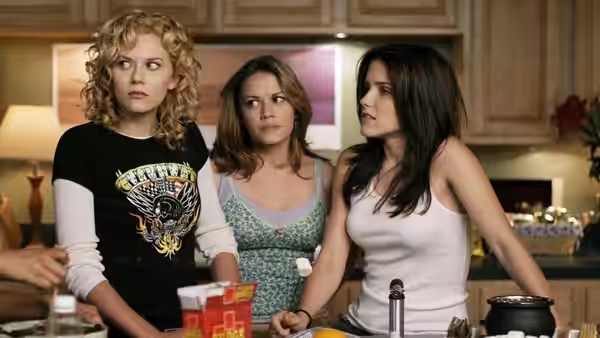
Hilarie Burton’s Peyton Sawyer belongs to a teenage ensemble whose appeal is its recognisable ordinariness. These young people can be self-absorbed without becoming impossible to care about, and their hurts seldom feel negligible just because the situations are familiar. The performances are more persuasive when they let that hurt stand without insisting on its importance. There is enough vulnerability here to explain why we might forgive a predictable exchange, although the writing too often relies on that forgiveness.

The basketball also makes good use of the programme’s visual polish. Billy Dickson, Stephen Thompson and Peter B. Kowalski are among the credited cinematographers; the attractive North Carolina photography gives a modest setting a proper claim on our attention. The sports scenes have the energy the family disputes sometimes lack. Crucially, the handsome presentation does not make the teenagers seem too remote from ordinary life.

Elsewhere, the polish helps less. Stan Salfas is among the editors, and some emotional exchanges last longer than their familiar grievances warrant. Music contributors include Mark Snow, and the music is too willing to reinforce the programme’s solemnity. Alan Hook is among the production designers; the town is pleasant enough to spend time in, but has little character beyond the people arguing in it.

The main limitation is the familiar collection of relationship and family problems in Mark Schwahn’s series. A teen soap can revisit jealousy and sibling resentment as often as it likes, provided the people involved keep finding ways to surprise us. Here, the writing spends too long explaining grievances we have already understood. A little humour would help the characters live with one another, and would help us live with them.

That leaves a programme whose appeal depends heavily on an appetite for its particular kind of seriousness. Episodes run 42 minutes, and the first season has 22 of them: there is room to grow attached, but familiarity is a substantial part of the bargain. The brothers’ competition is a sound reason to begin. If the first few family quarrels try your patience, there is no particular virtue in persevering.

Critical consensus AI synthesised

3 of 6
Positive
2
Mixed
0
Negative
1
The Guardian
4 January 2023
83*

The critic finds the series holds up well on rewatch and feels genuinely emotional about it, praising how the teenagers feel believable as ordinary small-town kids rather than glossy archetypes.

Read the full review →
Variety
22 September 2003 · Brian Lowry
70*

This earnest teen soap about half-brothers and basketball strings together familiar WB cliches but plays them well enough for its target audience and is beautifully shot in North Carolina with solid sports scenes.

Read the full review →
Empire
19 April 2006 · William Thomas
40*

The show is a generic teen drama about warring half-brothers in a sleepy town full of relationship and family angst, lacking any comedic edge or originality compared to stronger entries in the genre.

Read the full review →

Straight answers AI written, from our review

Is One Tree Hill worth watching?
One Tree Hill is worth considering for devoted teen-soap viewers, and we score it 66 out of 100. We find the basketball rivalry and believable teenage hurt involving, but familiar family quarrels drag on and humour is scarce. If those early disputes test our patience, the programme offers little reason to persevere.
How long is One Tree Hill, and what is it rated?
One Tree Hill has episodes of about 42m. It is a drama series.
Where can I watch One Tree Hill in the UAE?
One Tree Hill is streaming on Netflix and Amazon Prime Video in the UAE. Availability is checked daily; the links above go straight to each service.
How violent or frightening is One Tree Hill, and is it suitable for children?
One Tree Hill has a US TV-14 certificate, suggesting parental caution for younger teenagers and making it a poor default choice for young children; no UK certificate is supplied. The drama centres on family rivalry, teenage relationships and emotional hurt, but we cannot give a more specific warning about violence or frightening material from those details alone.
How does One Tree Hill compare to Friday Night Lights?
One Tree Hill is the more conventional teen-soap choice beside Friday Night Lights, which we recommend more readily for its performances and stronger sense of community. Both take sport and family pressure seriously, but Kyle Chandler’s patient authority helps make the latter’s earnestness easier to forgive; the former suits viewers chiefly interested in tangled teenage relationships.
What should I watch after One Tree Hill?
After One Tree Hill, try Friday Night Lights (2006, Fi1m 86): Sport and family pressures feel more rooted in a recognisable community. Then My So-Called Life (1994, Fi1m 87): For teenage uncertainty handled with sharper observation and less manufactured commotion; and Breaking Away (1979, Fi1m 86): Sport, friendship and family expectations, with a lighter touch and warmer humour.

Cast

If you liked this, try…

  1. Friday Night Lights (2006, Fi1m 86)Sport and family pressures feel more rooted in a recognisable community.

  2. My So-Called Life (1994, Fi1m 87)For teenage uncertainty handled with sharper observation and less manufactured commotion.

  3. Show Me Love (1998) · not on Fi1m yetSmall-town adolescent longing, with more awkwardness and a welcome sense of humour.

  4. Skam (2015) · not on Fi1m yetTeenage friendships and romantic confusion treated with patience, intimacy and fewer contrivances.

  5. Breaking Away (1979, Fi1m 86)Sport, friendship and family expectations, with a lighter touch and warmer humour.