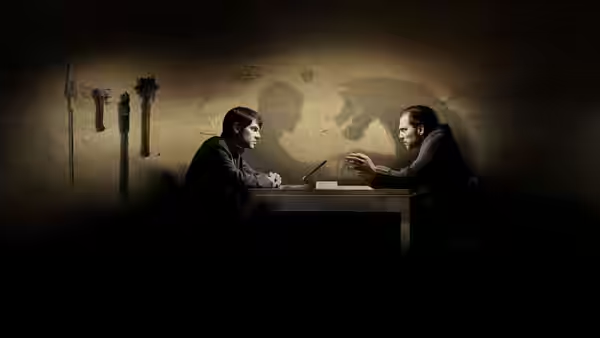
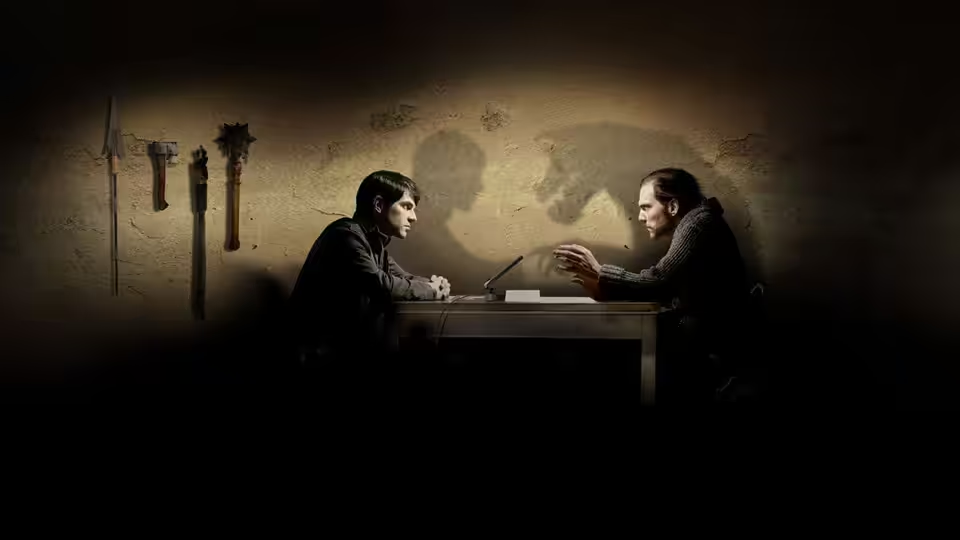
Two men sit across a table as one gestures toward the other
Series review

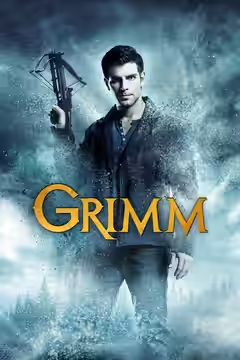
Grimm

2011 · Created by David Greenwalt, Jim Kouf, Stephen Carpenter · Series

In a sentenceHalf the city is secretly something with teeth and the only one worth knowing keeps apologising for it

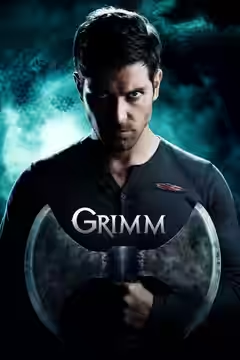
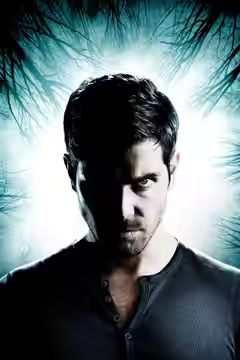
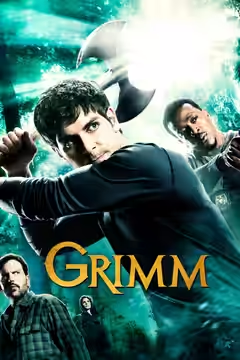
Nick Burkhardt (David Giuntoli) is a police detective who begins to see something else under the faces of ordinary people, and learns that he is the latest in a line of Grimms, the family the fairy tales were named for, who have always been able to see it. His partner Hank Griffin (Russell Hornsby) knows nothing of this, and neither does his girlfriend Juliette Silverton (Elizabeth Tulloch). His first case in the new world takes him to Monroe (Silas Weir Mitchell), one of the creatures, who wants nothing to do with a Grimm and ends up helping him anyway. Their captain, Sean Renard (Sasha Roiz), watches from a careful distance, and Drew Wu (Reggie Lee) keeps the jokes coming at the crime scenes.

Fi1m review

David Greenwalt, Stephen Carpenter and Jim Kouf’s fairy-tale procedural is an amiable monster-of-the-week show with a bland lead, rubbery effects and a mythology that outgrows it. Silas Weir Mitchell’s grumbling, reluctant Monroe makes it worth the evening.

David Greenwalt, Stephen Carpenter and Jim Kouf took a police procedural and sewed a fairy tale into every case. Nick Burkhardt (David Giuntoli), a detective, finds he can see what nobody else can: the man across the interview table has an animal’s face under his own, and the Brothers Grimm were writing case files. It is a good hook. It carried the show through six seasons and 122 episodes, from 28 October 2011 to a short final run in 2017, and for most of that stretch Grimm is pleasant, tidy and a little less than it might have been. Watch it for the company. Do not expect it to frighten you.

Silas Weir Mitchell is the company. Monroe is one of the creatures, a man who has gone straight and would like to be left alone, and who finds himself dragged into police work by a Grimm, the one kind of person his kind has learned to fear. Mitchell plays him as permanently put upon, and he delivers each objection as if he had rehearsed it in the car. We laughed more than we expected to at a network monster show, and nearly all of it was him, starting with the wince every time Nick turns up at his door. Bree Turner’s Rosalee Calvert gives him someone to be gentle with, and their scenes are the warmest in the series.

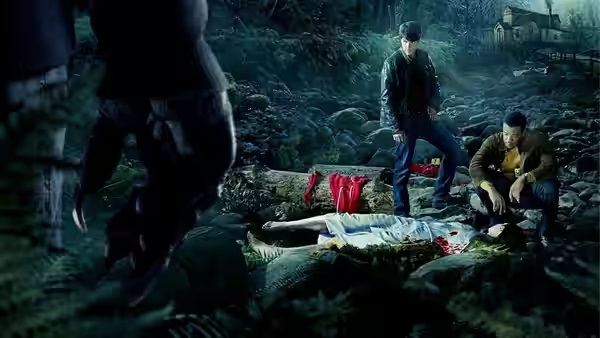
It looks like a place where it rains: water on windscreens, moss on the fences, grey afternoons that give up by four. Marshall Adams and Eliot Rockett, two of six cinematographers across the run, keep the interiors amber and the woods cold and blue, and the contrast does work the scripts leave undone. Michael Wylie, Craig Stearns, Steven Wolff and Paul Eads, who share the production design, are fondest of clutter, and the camera lingers longest wherever the shelves are fullest. The weak point is the transformation, the moment a human face turns animal. It is a digital ripple and a rubbery creature head, and in 2011 it passed; it does not improve much, and after a hundred episodes it looks like a filter. Richard Marvin’s score is sturdy procedural music, brass for the chases and a music-box tinkle for the fairy tale, and it rarely asks to be noticed.

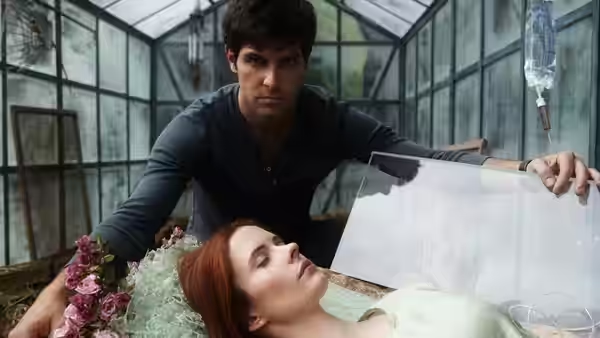
Giuntoli is the soft centre. He is handsome, even-tempered and decent, and almost entirely without edges; Nick is a man to whom things happen. The scripts give him a girlfriend, Juliette Silverton (Elizabeth Tulloch), who spends the first season being lied to for her own protection, the oldest and dullest way television has of keeping a partner in the dark. Russell Hornsby makes Hank Griffin a better partner than the show has time for, and Reggie Lee’s Drew Wu gets the dry lines and, for a long while, none of the information.

The mythology is where it outgrows its clothes. What begins as one creature a week, each with a name in approximate German, acquires a police captain, Sean Renard (Sasha Roiz), with secrets of his own, a lawyer, Adalind Schade (Claire Coffee), who is more than a lawyer, and eventually a plot that keeps cutting away to Vienna, which we watched with the patience one gives a neighbour’s holiday photographs. We were bored, and then irritated at being bored by a show that had a joke landing two scenes earlier.

Greenwalt came from Buffy the Vampire Slayer and Angel, and it shows in the bickering and the found family round a kitchen table. What is missing is those shows’ willingness to hurt the people they liked. Grimm is fond of everyone, and the fondness keeps the stakes low.

Take it a couple of episodes at a time, at home, with something to eat. Twenty-two episodes a season is a great deal of woodland.

Critical consensus AI synthesised

65
Positive
3
Mixed
2
Negative
1

Most critics lean warm on Grimm without quite falling for it, and the praise gathers around one performance. Silas Weir Mitchell’s Monroe, the reformed wolf who becomes the detective’s unlikely ally, is what reviewers of the pilot keep returning to: the comic turn that lets the air out of an otherwise solemn procedural. The fairy-tale premise is generally called clever, and the critics who stay with the series past its first season warm further, finding the ensemble’s bond and the invention of individual episodes worth the wait.

The reservations cluster around the lead and the writing. Several critics find Nick too bland and too clean a hero for a programme about monsters, and the episode-level reviews complain of slack suspense and subplots kept at arm’s length. The spread is wide: The AV Club’s finale review sits near the top, while Variety’s pilot review doubts the mythology can carry a series at all. Most of these reviews judge single episodes rather than the whole run.

The AV Club
1 April 2017 · A- · Les Chappell
90

Chappell finds the finale emotional and inventive, though its time-reset resolution is frustrating; overall, he sees it as a fitting, happy ending. He particularly praises the ensemble’s bond, highlighted by the group working together to brew their poison.

Read the full review →
The Hollywood Reporter
23 October 2011 · Tim Goodman
65*

Goodman finds the pilot creative and entertaining, though one episode is not enough to judge the series’ future. He especially praises Silas Weir Mitchell’s comic performance as Monroe, which eases the tension.

Read the full review →
Variety
21 October 2011 · Brian Lowry
30*

Lowry finds the series’ premise modestly clever but doubts its mythology and lead can sustain it. He particularly praises the first monster threat’s creepy, playful concept while faulting the lead’s blandness.

Read the full review →
Paste
8 March 2014 · 8.0/10 · Shannon M. Houston
80

Houston finds the episode compelling and excellent despite its disturbing scenes. She praises Wu’s new connection to Nick’s world, while criticizing the graphic attacks on pregnant women.

Read the full review →
Collider
20 October 2011 · Dave Trumbore
75*

Trumbore finds the premiere an engaging start with potential to become a favorite, despite its uncertain tone and uneven visual effects. He especially praises Silas Weir Mitchell’s quirky, well-suited portrayal of Monroe.

Read the full review →
Den of Geek
29 November 2014 · 3 out of 5 · Kendall Williams
54*

Williams finds the episode entertaining but not suspenseful or frightening enough, and criticizes its weak writing and acting. The review singles out Nick’s too-clean characterization and the distant Vienna subplot as shortcomings.

Read the full review →

Straight answers AI written, from our review

Is Grimm worth watching?
Grimm is worth watching as an amiable monster-of-the-week procedural, and we scored it 63. Silas Weir Mitchell's put-upon Monroe is the reason to stay; David Giuntoli's lead is bland, the transformation effects are rubbery, and the mythology sprawls into a Vienna plot that drags in later seasons. Take it a couple of episodes at a time and expect company rather than fear.
Where can I watch Grimm in Indonesia?
Grimm is streaming on HBO Max in Indonesia. Availability is checked daily; the links above go straight to each service.
How violent or frightening is Grimm, and is it suitable for children?
Grimm is not frightening, and it carries a US TV-14 certificate with no UK certificate, which places it at about the level of a mid-teen watch. The creatures are digital ripples and rubbery heads rather than anything that lingers, and the show is too fond of its characters to let them come to much harm. Small children may find the animal faces unsettling; teenagers will be fine.
How does Grimm compare to Buffy the Vampire Slayer?
Grimm is the gentler, slighter show; Buffy the Vampire Slayer, where co-creator David Greenwalt worked earlier, is the better of the two. Both gather a bickering found family around monsters, but Buffy uses its monsters as metaphor and is willing to hurt the people it likes, while Grimm is fond of everyone and keeps the stakes low. Choose Grimm for company on a wet evening, Buffy if you want to be moved.
What should I watch after Grimm?
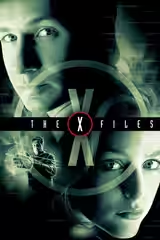
After Grimm, try Buffy the Vampire Slayer (1997, Fi1m 80): Greenwalt’s earlier employer; monsters as metaphor, and a family that actually gets hurt. Then The X-Files (1993, Fi1m 84): The monster-of-the-week procedural done with proper dread and better lighting; and Penny Dreadful (2014, Fi1m 76): Victorian London, every monster from the library, and a script that means it.

Cast

If you liked this, try…

  1. Buffy the Vampire Slayer (1997, Fi1m 80)Greenwalt’s earlier employer; monsters as metaphor, and a family that actually gets hurt.

  2. Being Human (2008) · not on Fi1m yetA vampire, a werewolf and a ghost share a Bristol flat; British and rougher.

  3. The X-Files (1993, Fi1m 84)The monster-of-the-week procedural done with proper dread and better lighting.

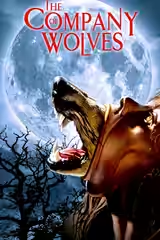
  4. The Company of Wolves (1984) · not on Fi1m yetNeil Jordan and Angela Carter take the red hood story somewhere properly strange.

  5. Penny Dreadful (2014, Fi1m 76)Victorian London, every monster from the library, and a script that means it.