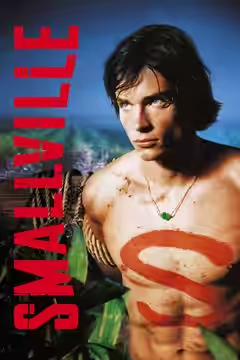
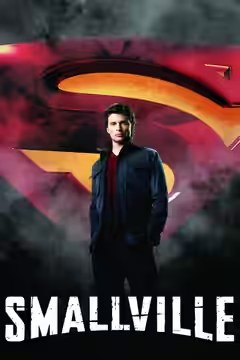
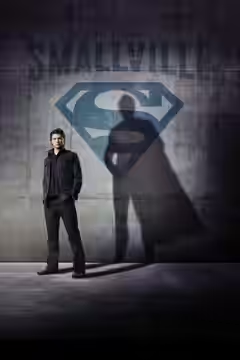
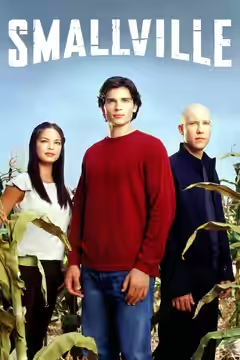
Clark Kent (Tom Welling) stands with arms crossed outside a school
Series review

Smallville

2001 · Created by Alfred Gough, Miles Millar · Series · 43m · RO 12

In a sentenceEvery week a classmate gets meteor powers and every week Clark tells Lana nothing

Smallville, Kansas, a farming town hit by a meteor shower that also delivered a small boy in a spacecraft. A dozen years on, Clark Kent (Tom Welling) is at high school, hiding the speed and strength his adoptive mother Martha (Annette O’Toole) has told him never to show. He is in love with Lana Lang (Kristin Kreuk), the girl next door, and cannot get within arm’s length of her because the meteor-rock necklace she wears makes him ill. His friend Chloe Sullivan (Allison Mack) runs the school paper and keeps a wall of clippings about the town’s unexplained oddities. Into all this drives Lex Luthor (Michael Rosenbaum), the billionaire’s son sent by his father Lionel (John Glover) to run the local fertiliser plant, whose car goes off a bridge and whose life Clark saves.

Fi1m review

Alfred Gough and Miles Millar’s Superman-without-the-suit is warm, handsome and better acted than it needed to be, chiefly by Michael Rosenbaum and John Glover as the Luthors. It is also 216 episodes long, and about a third of them are the same episode.

The idea is a good one and it is stated in the first hour. Take Superman, remove the cape, the flying and Metropolis, and leave a teenager on a Kansas farm who can outrun a truck and does not know why. Alfred Gough and Miles Millar built Smallville on that, and for its first two or three seasons it is a proper, sturdy piece of Tuesday-night television. It then ran for ten years, and our verdict is the one you would expect: the good years are worth your time, and the rest are for people who have already decided to stay.

The town is the best thing in it. Attila Szalay and Glen Winter light the Kent farm in late-afternoon gold, all yellow fields and red barn boards, and the Luthor mansion in cold blues and greys, so that you always know which family you are in before anyone speaks. Lance King’s production design gives Clark a loft in the barn, which tells you most of what you need to know about him, and gives Lex a mansion with far more rooms than people, which tells you the rest. Mark Snow’s score is soft strings and piano under the farm and a low electronic pulse under the mansion, and it is doing more work than the dialogue in a good many scenes.

Michael Rosenbaum is the reason to watch. His Lex is clever, lonely, quick to be kind and quicker to be hurt, a young man who wants very badly to be good and keeps finding it is not in him. Rosenbaum plays every scene with Clark as a friendship he half knows will end, and we found ourselves rooting for him, for years, against every piece of comic-book history we knew by heart, and feeling faintly foolish about it. John Glover, as Lionel, is the programme’s other adult pleasure: silk-voiced, amused, and cruel in the tone other men use to order lunch. When the two of them share a scene the show stops being a teen drama and becomes something closer to a chamber play about a father who would rather ruin his son than lose him.

Tom Welling is decent and steadily gets better. He has the frame for the part and an honest, worried face, and he is at his best in the scenes where Clark is simply a son, with Annette O’Toole’s Martha giving the farm its warmth and its spine. He is less well served by Kristin Kreuk’s Lana, or rather by the writers’ handling of her; for season after season the two of them stand in the barn and fail to say the one thing that would end the plot, and the show mistakes this for tension. It is not tension. It is a delay, and by the fourth year we had stopped caring whether it was ever resolved.

The structure does not help. Most weeks a classmate or a drifter is touched by the meteor rock, gains a power, misuses it, and is dealt with by the end of the hour, and after the first season this formula is visibly holding the programme up rather than the other way round. There is a stretch in the middle years, involving witchcraft and Jensen Ackles as a games coach with a secret, during which we were bored, and then irritated at being bored by a show we had liked.

It recovers. Erica Durance arrives as Lois Lane and is a jolt of energy, brash and funny and unimpressed by everyone, and Justin Hartley’s Oliver Queen gives Clark a rival who has already made the choices Clark keeps putting off. Cassidy Freeman’s Tess Mercer and Callum Blue’s Zod give the last seasons a harder edge. Laura Vandervoort’s Kara, when she comes, is the only person in Kansas who can fly, and the show gets some sly comedy out of Clark’s envy. Allison Mack, throughout, is the programme’s most reliable performer: Chloe is the friend who knows, and Mack plays the cost of knowing without ever asking for credit.

Against the 1978 film and against what came after, Smallville sits somewhere in the middle: more patient than most of what has followed, more sentimental than Richard Donner, and with a villain who is, for a long while, the best written person on screen. Each episode runs 43 minutes and carries a 12. Watch the first three seasons, skip forward when the barn scenes start repeating, and stay for anything with a Luthor in it.


Critical consensus AI synthesised

2 of 6
Positive
1
Mixed
1
Negative
0

With only 2 reviews in so far, the lean is cautiously warm, and the two critics are writing about different programmes. Variety, reviewing the pilot on arrival, finds it handsomely produced, with convincing small-town Kansas scenery and capable action, but worries that a familiar origin story and a mopey teen-outsider angle will wear thin. The Ringer, looking back fifteen years later, treats it as cheerfully trashy teen drama and admires the love triangles, the daft plots and the refusal to fuss over its superhero mechanics, poor writing notwithstanding. Both agree the surface is more appealing than the script; they part on whether that is a flaw or the whole point.

Variety
12 October 2001 · Steven Oxman
66*

The critic finds the series well-produced with impressive special effects in the pilot but notes the familiarity of the story might work against it. They single out the believable bucolic idealism of the look and solid action sequences for praise while complaining about the whiny teen outsider focus.

Read the full review →
The Ringer
2 November 2016 · Justin Charity
75*

The critic views Smallville as a frivolous but charmingly trashy teen drama that succeeds through its zany plots, romantic entanglements, and refusal to overthink its superhero elements despite poor writing. He singles out its love triangles and underdeveloped superpowers as key strengths that later shows like Supergirl could emulate.

Read the full review →

Straight answers AI written, from our review

Is Smallville worth watching?
Smallville is worth watching for its first three seasons and for any episode with a Luthor in it, and we scored it 66. Michael Rosenbaum and John Glover give the programme better acting than it needed, and the Kent farm is handsomely lit. The middle years repeat themselves, and Clark and Lana's barn conversations go nowhere for far too long.
How long is Smallville, and what is it rated?
Smallville has episodes of about 43m and is rated 12 by the RO in Romania. It is a sci-fi & fantasy and action & adventure series.
Where can I watch Smallville in Romania?
Smallville is streaming on Netflix and Amazon Prime Video in Romania. Availability is checked daily; the links above go straight to each service.
How violent or frightening is Smallville, and is it suitable for children?
Smallville carries a UK 12 and a US TV-14, and it is a teen drama rather than a horror. Most weeks a classmate gains a power from meteor rock and misuses it, which means fights and peril but little that would trouble a teenager. Younger children may find some of the meteor-freak episodes unsettling, and the Luthor family scenes are more cruel than violent.
How does Smallville compare to Buffy the Vampire Slayer?
Smallville is the gentler and more sentimental of the two, and Buffy the Vampire Slayer is the sharper written and the funnier. Both turn high school into a monster factory, but Buffy has better jokes and a heroine allowed to be irritable, while Smallville's strength is its villain, Lex Luthor, who for years is the best written person on screen. Choose Buffy for wit, Smallville for warmth.
What should I watch after Smallville?
After Smallville, try Buffy the Vampire Slayer (1997, Fi1m 80): The high school as a monster factory, done with sharper writing and better jokes. Then Friday Night Lights (2006, Fi1m 86): Small-town America, teenagers, fathers and fields, with no superpowers and more truth.

Cast

If you liked this, try…

  1. Buffy the Vampire Slayer (1997, Fi1m 80)The high school as a monster factory, done with sharper writing and better jokes.

  2. Superman (1978) · not on Fi1m yetThe Kansas half is where this show came from; Glenn Ford’s farmer is the model.

  3. Friday Night Lights (2006, Fi1m 86)Small-town America, teenagers, fathers and fields, with no superpowers and more truth.

  4. Misfits (2009) · not on Fi1m yetBritish community-service kids get powers in a storm and behave far worse with them.

  5. Chronicle (2012) · not on Fi1m yetThree schoolboys find a thing in a hole and the outsider goes wrong; ninety minutes.