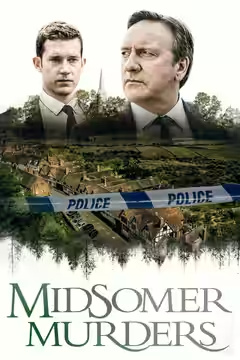
Nearly three decades of thatch, flint and inventive homicide. The county looks lovely, John Nettles is quietly excellent, and the plotting has not changed since 1997. It does one thing, does it politely, and asks nothing of you. That is either the appeal or the complaint.
Anthony Horowitz adapted Caroline Graham’s novels for television and the first episode went out on 23 March 1997. The series has since run to twenty-five series, each episode 90 minutes long and carrying a 15 certificate that it earns with the deaths and almost nothing else. The premise is a fictional English county of impossible loveliness and an impossible murder rate, and a detective, DCI Tom Barnaby (John Nettles), who turns up in a decent suit and asks decent questions. Here is the verdict, so you can get on with your evening: it is good at exactly one thing, and it has done that thing, without deviation, for longer than most of its victims lived.
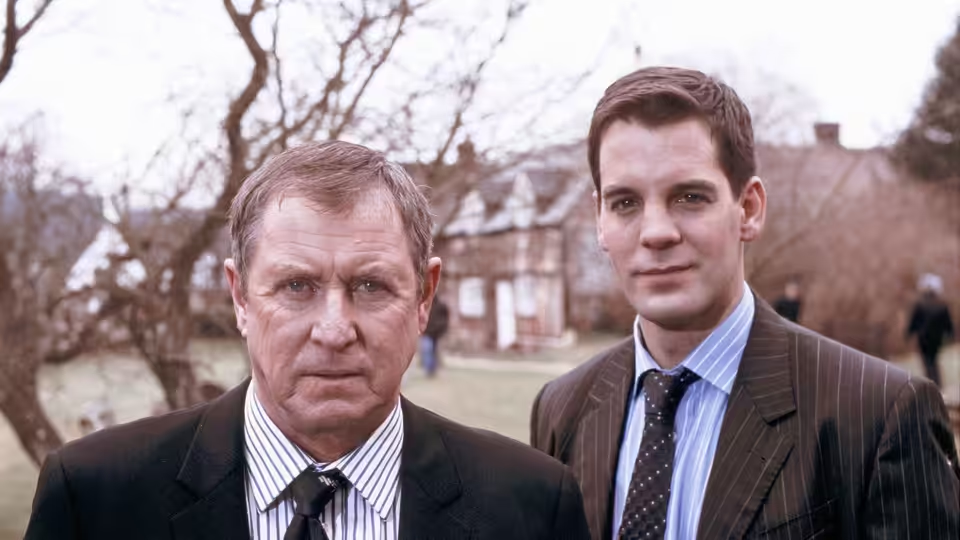
The one thing is Nettles. Barnaby is not a wounded man. He does not drink, he is not divorced, he has no dead partner and no past he will not discuss. He listens, he is faintly amused, and he goes home to Joyce (Jane Wymark), whose cooking is a running joke that Wymark plays with more grace than the writing deserves, and to his daughter Cully (Laura Howard). Barry Jackson’s pathologist George Bullard gives cause of death like a man reading out cricket scores. In a genre that has spent thirty years piling damage onto its detectives, a happy one is a relief, and Nettles knows precisely how little he needs to do.
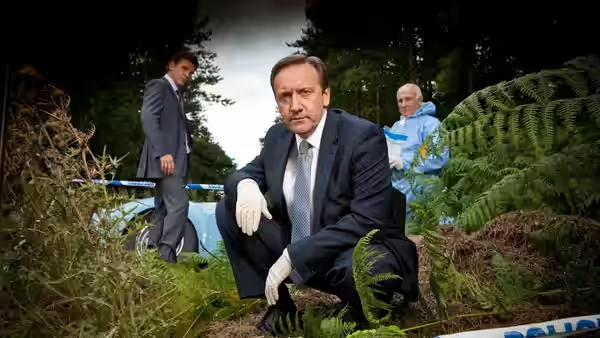
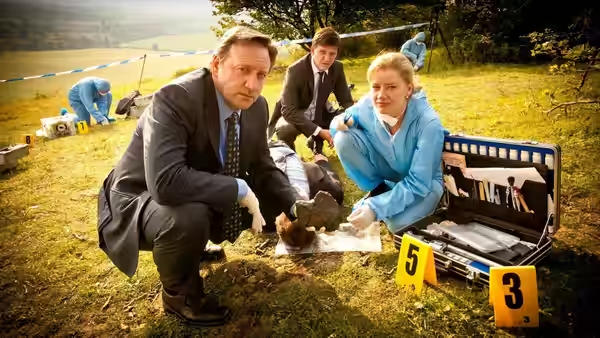
The county is the other asset, and it is a designed one. Doug Hallows shoots the villages in flat, bright, uncomplicated light, all green lawns and gold stone, and nothing stays in shadow for long, including the corpses. Christine Ruscoe furnishes it with pubs, village halls, kitchens with dressers and the big house that always has a locked room. Jim Parker’s theme, played on a wobbling theremin, tells you in ten seconds that none of this is to be taken seriously. Derek Bain cuts at a pace that could be described as Sunday. Directors come and go, Renny Rye, Jeremy Silberston, Peter Smith and dozens more, and you could not tell one episode’s direction from another’s, which is the point and is also the problem.
The murders are the joke, and the writers know it. People are done in with kitchen implements, garden tools and, on one occasion, a wheel of cheese. We laughed at the cheese, out loud, and then felt slightly ashamed, which we suspect is the intended response. We should also admit the other thing. We have been soothed by this programme more often than we would like to say, usually at the end of a poor week, and what does it is not the mystery but the church clock, the cricket pitch and the certainty that Barnaby will be home by the end.
What does not work has not worked since the start. The plotting is signposted from the first quarter hour: the guilty party is whoever has the least screen time and the nicest garden. The sergeants exist to be explained to, and John Hopkins’s Dan Scott, Gwilym Lee’s Charlie Nelson and Nick Hendrix’s Jamie Winter are all written as the same young man with a different haircut. For years the county had no non-white faces at all, and the series took a long time to notice. The later run is better on that score, and better in general, for Manjinder Virk’s Kam Karimore, Tamzin Malleson’s Kate Wilding and Annette Badland’s Fleur Perkins, a pathologist who is drier than the scripts around her. The faces around Barnaby changed over the years, and in time it is Fiona Dolman’s Sarah Barnaby running the kitchen; the county carried on as if nothing had happened, which tells you how much of the programme was ever the detective and how much was the scenery.
Against the standard of Inspector Morse (1987), which gave its detective a wound and a city with real weather, this is a lesser thing and does not pretend otherwise. Watched in a run, as some critics have done under duress, it turns into wallpaper and we were bored by the third episode in an afternoon. Watched one at a time, on a Sunday, with something to do with your hands, it is exactly what it says on the tagline. Do not expect to be surprised; expect to be told, at the eighty-minute mark, who did it, and to have half guessed.